
A Millionaire Saw a Cleaning Lady Dancing with His Son in a Wheelchair — What He Did Next Shocked Everyone…
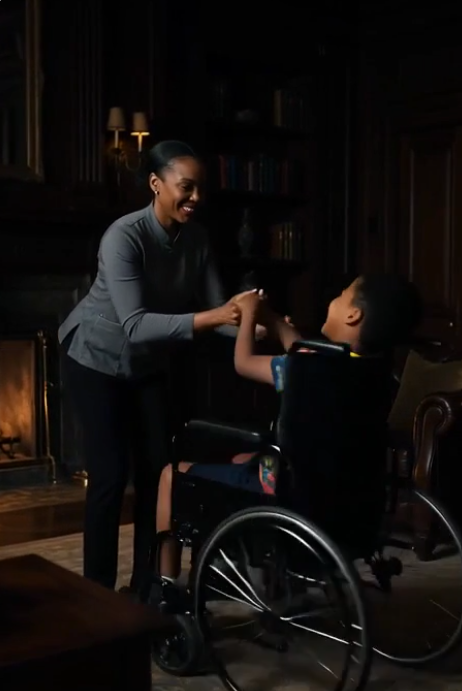
Mykhailo Kovalchuk, a famous businessman and billionaire, returned home unexpectedly in the middle of the day, surprising even the security staff. Usually, he only showed up late at night or spent the night at the office altogether. But today, another empty deal had drained him, and a strange sense of unease wouldn’t leave him alone.
The house was drowned in silence. He walked past the living room, intending to head upstairs, but suddenly stopped.
Music was coming from inside — a soft classical melody, barely audible, as if someone had turned it on not for background noise, but to truly feel it. He opened the door and froze.
In the middle of the spacious hall, between antique furniture and the fireplace, a young woman in a simple uniform was dancing. It was Natalka, the cleaning lady he had barely ever noticed in the house.
But she wasn’t dancing alone.
In her hands were the hands of his son, Levko, sitting in a wheelchair. The boy was laughing — genuinely, openly — not the forced, polite laughter he gave the governess or the psychologist, but the way he used to laugh before the accident. Natalka guided Levko through the dance, slowly spinning, leaning toward him, lifting his hands as if conducting life itself.
His face was glowing, and his eyes sparkled with delight. In those moments, it seemed he forgot about his legs, the wheelchair, the pain. He was simply a child laughing with a young woman.
Mykhailo stood there, unable to move.
Something stirred inside him — something long forgotten. He didn’t know what shocked him more: the fact that Levko was laughing, or how deeply the moment affected him.
Natalka didn’t notice the owner of the house right away. But the moment she turned around, she froze.
The music was still playing, but her eyes filled with anxiety. Slowly, she placed the boy’s hands back onto the wheelchair armrests and stepped away.
Mykhailo walked forward a few steps. His voice sounded low and heavy.
“What is happening here?”…
Still smiling, Levko hurried to answer.
“We were just dancing, Dad. Natalka showed me how you can still move, even if you’re sitting down. It was so fun.”
But Mykhailo was already staring at Natalka — sternly, cautiously.
Confusion, anxiety, even fear could be seen in his eyes. She tried to explain something, but he raised his hand to stop her.
“Leave. Immediately.”
Levko cried out.
“Dad, no! Don’t yell at her! She’s my friend!”
But Mykhailo had already turned around and walked out, slamming the door behind him.
He didn’t understand why what he had seen affected him so deeply. He didn’t know why he felt as though he had witnessed something forbidden.
But one thing he knew for certain — that dance had changed everything.
The night was restless. Mykhailo couldn’t sleep. He lay in the silence of his enormous bedroom with four-meter ceilings, staring into the darkness above him as if into emptiness itself.
Something inside him buzzed painfully, refusing to let him rest.
Again and again, the scene replayed before his eyes: Levko’s laughter, Natalka’s gentle movements, their dance — something completely foreign to the world he himself lived in.
He got up, walked to the window, silently ran his hand along the windowsill, then went into his office and turned on the security camera monitors.
He knew every room was recorded for safety reasons.
Sitting down in his leather chair, he opened the archive and pulled up footage from the living room several hours before his arrival.
Once again, he saw Natalka enter with a bucket and mop. He watched her turn around after hearing Levko call her name. He saw her smile — sincerely, warmly, not out of politeness.
Then she switched off the vacuum cleaner, pulled an old phone from her pocket, turned on the music, and suggested that Levko dance in their own way.
What he saw next pierced him to the core.
The way she touched Levko so carefully, as if he were fragile porcelain. The way she didn’t pity him or baby him, but treated him like a complete child — with respect, with playfulness.
The way he laughed wholeheartedly, the way he used to laugh with his mother.
Mykhailo clenched his teeth.
He felt ashamed.
Ashamed that he had thrown her out. Ashamed that he himself had failed to give his son even a fraction of the joy Natalka had given him with a single dance.
He remembered everyone he had hired — elite psychologists, expensive rehabilitation instructors, trainers, speech therapists.
Everything had followed protocol. Schedules. Systems.
And none of it had worked.
He pressed pause.
On the screen was the moment Levko leaned forward and whispered something into Natalka’s ear. She laughed, pressed a finger to her lips, and continued dancing in a slow half-circle.
It was magic.
Real, living magic.
Mykhailo stood up and paced around the room. The anger he felt toward himself was stronger than ever before.
He had always controlled everything.
But now he realized that in his pursuit of status, he had missed the most important thing — his son’s childhood.
Joy. Life.
And this simple young woman, a cleaning lady, had given Levko more in fifteen minutes than he had given him in the past two years.
He pressed the security intercom button.
“Tomorrow morning. Natalka. Find her. Bring her back.”
“Mr. Kovalchuk, but you personally ordered her access to be restricted.”
“I know what I said.
Now I’m saying something different.”
He cut the connection and looked once more at the frozen image on the screen.
There was his son — laughing, alive.
And a young woman who, somehow, had become closer to his child than all the “proper” adults around him.
And he understood that from now on, everything would be different.
The next morning, the house sank into tense silence.
Normally, the staff moved according to schedule, the butler made his rounds through the rooms, and the nanny prepared Levko for his lessons.
But today everything felt frozen.
Levko sat in his wheelchair by the window, refusing to talk, refusing to eat breakfast. He ignored the nanny’s questions, didn’t want his tablet turned on, and didn’t even want to see his father.
His eyes were empty, as if all the energy and joy from yesterday had vanished without a trace.
Mykhailo watched him from behind the door.
He wasn’t used to feeling powerless, but now it weighed on him like a concrete slab.
He didn’t know how to bring back the spark he himself had extinguished.
Around noon, security reported that they had found the girl. She was cleaning at a neighboring house, having temporarily taken work there so she wouldn’t lose income.
Mykhailo didn’t wait.
He got into the car and drove there himself.
He entered the hallway of an ordinary apartment building. The contrast with his mansion was overwhelming.
Outside the apartment door, the air smelled of cleaning products and fresh dust.
He knocked.
Natalka opened the door.
She wasn’t in uniform — just jeans, damp hair, and a confused expression. She clearly hadn’t expected to see him.
“Hello,” she said quietly without looking up.
“We need to talk,” he said. “My son… he isn’t eating, he isn’t sleeping. He wants to see you.”
Natalka pressed her hands to her chest. Her heart was beating so loudly she thought he might hear it.
“I’m sorry, but I don’t belong in your house,” she answered with effort. “I shouldn’t have danced with him.
It was unprofessional.”
Mykhailo lowered his eyes and took a deep breath.
“And I shouldn’t have thrown you out.
You know… I watched the recording again.
Every minute of it.
He was laughing. I haven’t heard that laugh since his mother died.
You did the impossible.
Please… come back. Not as a cleaning lady. Just as someone who can be there for him.
He needs you.”
She stood there silently, torn between pride and pain.
And only when he added:
“I need you too,”
did her eyes finally meet his for the first time.
Two hours later, Natalka walked back into the Kovalchuk house.
Not in a uniform. Not carrying a rag.
But holding a teddy bear she had bought along the way.
Levko was waiting in the hallway, tense and withdrawn, his eyes dim.
But the moment he saw her, he threw his arms open and shouted.
Natalka ran to him and hugged him tightly.
He clung to her for a long, long time, refusing to let go.
Mykhailo stood nearby, feeling something shift inside him, as though this moment was healing not only his son, but himself as well.
“Can we dance again?” Levko whispered.
Natalka nodded through tears.
“Only if you lead.”
Levko nodded and squeezed her hands.
The music began to play once more, and the dance started again.
Only this time, they were no longer being watched by cold, suspicious eyes, but by eyes filled with something close to admiration.
Several days passed, and the house seemed to come alive.
Levko’s laughter became a constant sound echoing through the halls, and Natalka became an inseparable part of the family’s daily routine.
Every day they listened to music together, practiced movement, played games, and read books.
Mykhailo watched it all with amazement and growing inner turmoil.
He started staying home more often — not to control things, but simply to be there.
To watch his son return to life.
And he began noticing other things too.
The way Natalka carefully adjusted the blanket over Levko’s legs.
The way she handed him a mug of cocoa with such care.
The gentle encouragement she gave him whenever something didn’t work out.
And the way she looked at him — not like a sick child, but like a strong, living boy.
It was a special kind of tenderness. Almost maternal warmth.
One morning during breakfast, Mykhailo suddenly caught himself smiling.
He listened as Levko excitedly talked about yesterday’s dance competition, where they had competed to see who could spin the wheelchair faster to the music.
Natalka only laughed and covered her face with her hands in embarrassment.
Suddenly, Mykhailo wished the morning would never end.
“Dad, don’t you want to dance with us?” Levko suddenly asked.
Mykhailo became embarrassed.
He couldn’t remember the last time he had done anything that wasn’t connected to business negotiations.
But Natalka stood up and held out her hand.
“I’m sure you have excellent rhythm,” she said with a slight smile.
He laughed — almost shyly.
“If someone gets their feet stepped on, I apologize in advance.”
He stood and took her hand.
And in that moment, the silence between them changed into something else — something delicate and vulnerable.
He looked at her as if for the first time.
Not as an employee.
Not as Levko’s helper.
But as the woman who had changed their home… and their lives.
They danced slowly, awkwardly.
Mykhailo tried to follow the rhythm without making mistakes, while Natalka laughed lightly and sincerely.
And in that room — once huge, marble, and cold — it finally became truly warm.
The next day, Mykhailo did something he hadn’t done in years.
He called a charitable foundation and asked to be connected with dance therapy specialists.
He wanted other children with disabilities to experience what his son had experienced.
He wanted to create a center where Natalka could work, develop her methods, and help people who had lost hope.
It was her chance.
And his chance to stay close to her.
When he told her about it, she stood there stunned.
“Me? I’m just a cleaning lady. I don’t have an education or diplomas.”
“But you have something many people with diplomas don’t,” he replied.
“A heart. A soul. And talent.”
She didn’t know what to say.
She only looked at him deeply — with gratitude, and with something slowly becoming love.
That evening, Levko fell asleep early.
Mykhailo and Natalka sat on the veranda with cups of tea in their hands.
It was a warm evening, and the garden lights blurred softly in the darkness.
Silence hung between them — but not an awkward silence. A warm one.
“You saved my son,” Mykhailo said quietly. “And maybe… you saved me too.”
“And you allowed me to feel valuable again,” she replied. “Not as a worker. As a person.”
He touched her hand carefully.
“For the first time in a very long time, this feels like only the beginning, Natalka.
I hope you’ll stay with us…
Forever.”
And she nodded, holding back tears.
At last, something lit up inside that house — something that had been missing for many years.
The feeling that people truly lived there.
Not merely surviving.
Not suffering.
Not filling emptiness.
But truly living.
Related Post

My Mother In Law Treated My Moms Country House Like A Resort Until I Set Boundaries
The alarm went off at five in the morning. For once, I didn’t hit snooze. [...]

My Husband Put a Code Lock on the Fridge to Control What I Ate Because I Had Put on Weight After Giving Birth – But He Didn’t Expect His Mother to Teach Him a Lesson
I was holding my two-month-old daughter and staring at a code lock hanging from my [...]

A Couple Ordered a $400 Dinner and Left Without Paying, so My Manager Made Me Cover the Bill – The Next Morning, He Handed Me What They’d Forgotten and Said, ‘I Think You Need to See This’
When a couple left without paying for the dinner, I cried, because I didn’t have [...]