
The Lion Came to the Funeral of the Man Who Saved Him. What Happened Next Shocked Everyone.
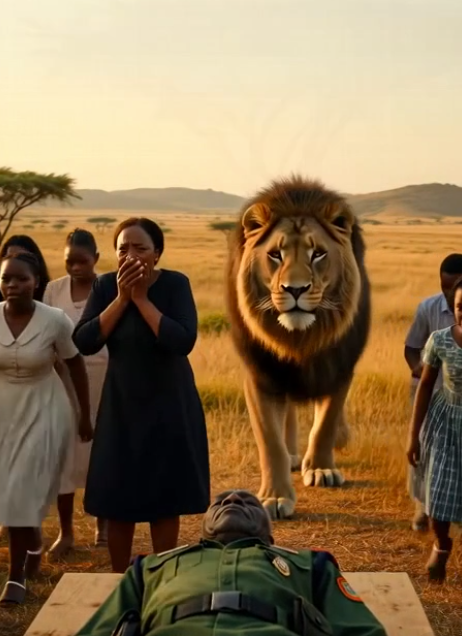
When the massive figure of a lion emerged from the acacia thickets during the funeral of the old ranger Mekont, time seemed to stop. Panic swept through the gathered crowd. Many people ran, while others, as if hypnotized, continued to watch. The 440-pound predator moved slowly toward the body, its eyes focused only on the deceased man.
What the animal did when it reached the old ranger shocked everyone present to their core. The powerful lion lowered itself onto its front legs before the dead man and then let out such a heart-wrenching roar that even experienced hunters raised their rifles and nearly pulled the trigger.
The Serengeti is one of the most extraordinary places on Earth.
This national park in Tanzania stretches across tens of thousands of square miles and is home to thousands of animal species. But one man holds a special place in the reserve’s history—a ranger named Mekont, who devoted more than fifty years of his life to protecting wildlife. His story is not merely a biography; it is a chronicle of sacrifice and an extraordinary bond between humans and wild animals.
Mekont came to the Serengeti as a very young man, when his hair was still black and the fire of youth burned brightly in his eyes. He was born in a small village near the reserve and grew up hearing stories about its beauty and dangers. His grandfather was one of the first local residents to assist European explorers, and it was from him that the boy inherited his love of nature.
Over the years, Mekont captured hundreds of poachers, saved thousands of animals, and became a living legend of the Serengeti. New rangers looked at him with admiration, while veterans respected him deeply. His knowledge of wildlife behavior was encyclopedic.
By studying tracks, he could determine when an animal had passed through, assess its condition, and even predict its route.
When he retired at the age of seventy, Mekont could not bring himself to stay home. Every morning, he climbed into his old jeep, a gift from the park administration, and headed out to patrol the reserve.
He was given the title of honorary consultant, but everyone knew the truth—the old man was still a ranger, only now he served as a volunteer.
Mekont showed particular concern for elderly animals. Young animals could defend themselves, but the old ones needed protection.
A joke eventually spread throughout the reserve:
“The old man protects the old ones.”
Mekont considered it his duty to ensure that aging animals could live out their final days in peace and safety.
Then the fateful day arrived without warning.
Thermometers in the Serengeti read 113 degrees Fahrenheit. The heat was extreme, even by African standards.
Animals sought refuge in the shade of trees, and rangers avoided going outdoors unless absolutely necessary. But Mekont would not have been himself if he had stayed in the break room.
The day before, he had received a report about an injured rhinoceros.
The animal may have fallen victim to a poacher’s trap.
Despite the heat and the warnings from his colleagues, the old ranger set out to check on the rhino’s condition.
His jeep rolled slowly across the sun-scorched savanna.
The air conditioner had long since stopped working, and Mekont wiped sweat from his eyes. At moments like these, he felt his age more than ever. Years ago, this kind of heat would not have troubled him nearly as much.
The rhinoceros stood beneath the shade of a giant baobab tree.
The old man carefully stepped out of the vehicle, trying not to startle the animal. Even an injured rhino is dangerous, and Mekont knew that well.
He approached slowly, examining the wound on the animal’s side.
The injury looked serious, but not fatal. With proper treatment, the rhinoceros should survive.
That was when Mekont felt a sharp pain in his chest.
At first, he thought it was heartburn, but the pain intensified with every passing second.
Dark spots blurred his vision.
His knees gave way.
The old ranger collapsed onto the ground.
The last thing he saw was the rhinoceros’s eyes, watching him with what seemed like almost human curiosity.
Elijah and Musa, two young rangers working nearby, heard a faint cry for help.
They rushed toward the sound and found Mekont unconscious.
His pulse was weak and irregular.
There was no medicine in his pockets.
Apparently, in his haste, he had forgotten to bring it with him.
Events unfolded rapidly.
A medical team was called by radio.
All work in the reserve was halted.
Everyone united to save the man who had spent so many years saving others.
A special vehicle transported Mekont to the medical station, where doctors immediately began resuscitation efforts.
Fifteen minutes of fighting for his life felt like an eternity.
Finally, the chief physician spoke the words no one wanted to hear.
“We lost him. His heart stopped too long ago.”
The old ranger passed away exactly as he had lived—on duty, caring for those under his protection.
News of Mekont’s death spread throughout the reserve in an instant.
People could not believe that the man who had seemed as eternal as the Serengeti itself was gone.
According to his final wishes, the funeral was held in the reserve, outdoors, surrounded by the nature to which he had devoted his life.
The ceremony followed local traditions.
Mekont’s body, dressed in his ranger uniform, was placed on a wooden platform in the center of the courtyard.
The morning sun illuminated his face, frozen in a peaceful smile.
Every employee came forward to say goodbye to the man who had become a teacher to so many.
Then the unbelievable happened.
A loud roar echoed from the direction of the reserve’s gate.
Everyone turned and saw a lion—a huge male with a magnificent mane.
People began searching for cover, but the animal showed no aggression.
It slowly walked through the crowd that parted before it and headed straight toward the old ranger’s body.
The lion circled the platform, sniffing and quietly growling.
Then it stopped at the foot of the platform and, to everyone’s astonishment, lowered its head as though paying its final respects.
In the silence, only its heavy breathing could be heard.
Elijah recognized the visitor.
It was the very lion that he and Mekont had rescued fifteen years earlier.
Back then, the young lion had been caught in a poacher’s trap. The rangers had freed him and nursed him back to health.
The scar on the animal’s side—the mark left by the trap—was unmistakable.
Gradually, fear faded, and people approached the lion and the old ranger’s body, sharing that sacred moment.
When the time came to carry the body to the burial site beneath a massive tree in the middle of a grassy field, the lion followed the procession, continuously letting out low growls that seemed filled with grief.
After the ceremony ended, the man’s body was laid to rest, and a stone bearing his name was placed on the grave.
People slowly began to leave.
But the lion remained.
It lay beside the mound of fresh earth and stared into the distance, toward the place where the Serengeti sky met the horizon.
Then it lifted its head and released a piercing roar that brought tears to many eyes.
In the days that followed, the lion returned to the grave again and again.
It seemed to stand guard over the final resting place of the man who had given him a second chance at life.
Rangers who came to honor Mekont’s memory often found the mighty animal there.
Without aggression, it would step aside to allow them near the grave, yet it always returned after they left.
We often think that only humans are capable of deep emotions, that only we can love, remember, and feel gratitude.
The story of Mekont and his lion reminds us otherwise.
We are not alone in that ability.
And perhaps that is the greatest lesson the old ranger left behind for all of us—a lesson of respect and love for every living thing that surrounds us.
Related Post
Right after my husband divorced me, he called my mother and said, “Come pick up your useless daughter. I don’t want her anymore.”
Right after my husband divorced me, he called my mother and said, “Come pick up [...]

Before My Son Passed Away, He Donated His Heart to an 18-Year-Old Girl – After the Transplant, Her Mother Handed Me a Letter from My Son
I thought I knew every secret my husband had carried to his grave. Then, after [...]
My Husband Refused to Take Me or Our Kids on Vacation with His Family for 11 Years – One Day, I Found Out Why After Unexpected Help from My MIL
PART 1 For years, I believed my husband’s family had decided that my children and [...]