
My Sister-in-Law Put My Daughter’s Lunchbox on an Auction Table to Shame Us — Then the Headmaster Revealed the Truth
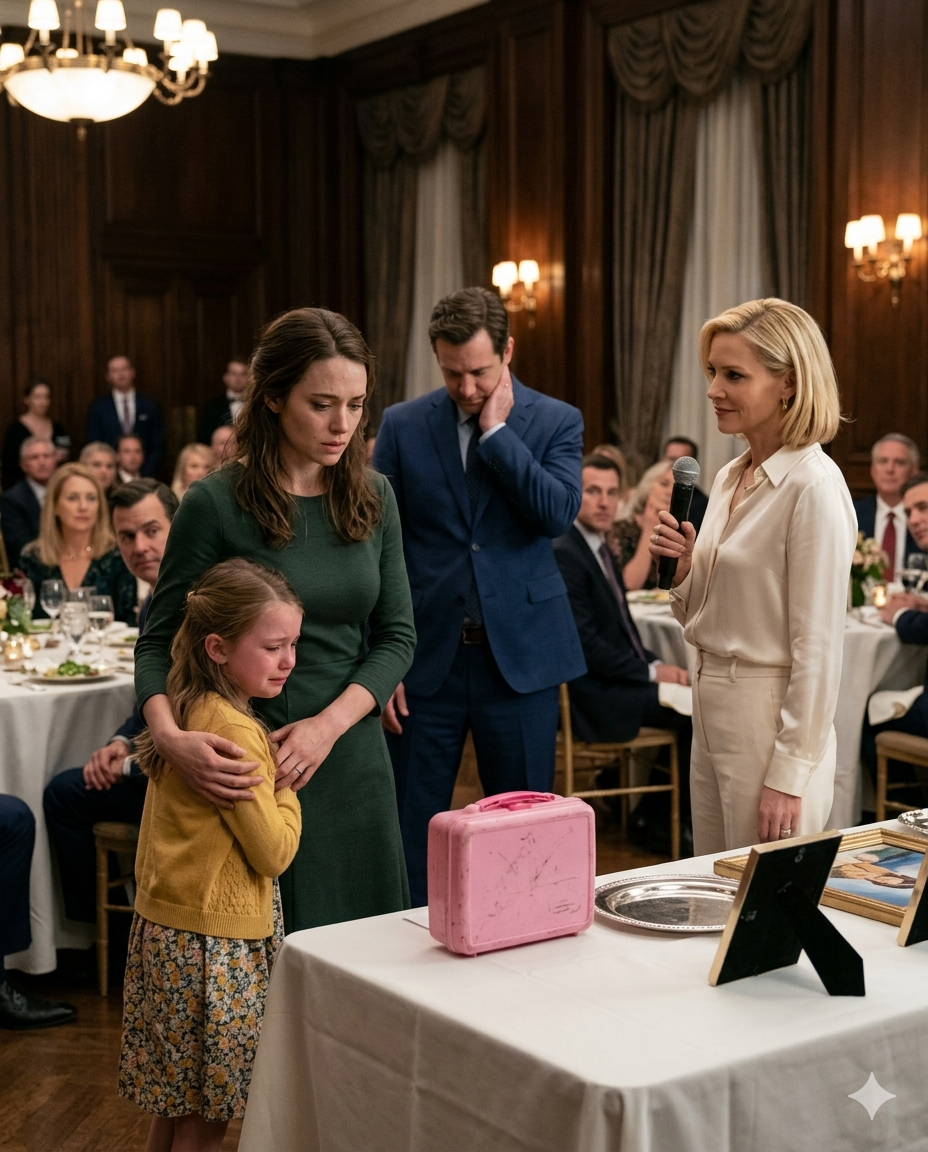
The Lunchbox on the Auction Table
Nora Ellison knew something was wrong the moment her daughter’s lunchbox appeared on the auction table.
It was small, pink, and scratched at the corners. A faded unicorn sticker peeled from the lid. Inside were the peanut butter crackers Nora had packed that morning because they were the only thing left in the pantry before payday.
But now the lunchbox sat under the lights of the private school fundraiser, between a designer handbag and a weekend golf package.
The room went quiet for half a second.
Then someone laughed.
“Is this a joke?” a woman in pearls asked.
Nora’s eight-year-old daughter, Ivy, gripped her mother’s hand so tightly her little fingers trembled.
Across the ballroom, Nora’s sister-in-law, Celeste Ellison, smiled like she had been waiting all night for this.
Celeste lifted the microphone.
“Our next item,” she announced, “is a reminder that charity starts at home.”
A few people chuckled.
Nora’s stomach dropped.
Her husband, Drew, stood beside his mother near the champagne table, his face pale but silent.
Nora looked at him.
Please don’t let her do this.
Drew looked away.
Celeste continued, her voice sugary and cruel.
“This lunchbox belongs to little Ivy Ellison. Apparently, some families at Harbor Ridge Academy need help feeding their children.”
Ivy’s eyes filled with tears.
“Mommy,” she whispered, “why is she showing my lunch?”
Nora knelt quickly. “Don’t listen, baby.”
But the damage had already started.
Parents turned. Some looked shocked. Some looked embarrassed for her. Some looked entertained.
Celeste stepped closer to the table.
“My brother married for love,” she said, “but love does not pay tuition, groceries, or dignity.”
Nora stood slowly.
“That’s enough,” she said.
Celeste tilted her head. “Oh, Nora. I’m only trying to help.”
“No,” Nora said. “You’re trying to humiliate a child.”
A sharp silence cut through the room.
Drew’s mother, Margaret Ellison, walked forward in her silver dress.
“Nora,” Margaret warned, “do not make a scene.”
Nora almost laughed.
Her daughter’s lunchbox was on an auction table, and she was the one making a scene.
For three years, Nora had endured the Ellisons.
They never forgave Drew for marrying a waitress from Ohio.
They never forgave Nora for having calloused hands.
They never forgave Ivy for being born before Drew got promoted, before the family could polish the story.
When Drew lost his sales job six months earlier, Nora had taken extra shifts cleaning hotel rooms. She left before sunrise and came home after Ivy was asleep. Drew promised he would tell his family soon.
But he never did.
Instead, he let them believe Nora was the problem.
“Maybe if Nora budgeted better,” Margaret once said.
“Maybe if Nora dressed like a wife,” Celeste added.
“Maybe if Nora stopped embarrassing this family,” Drew muttered one night after his mother criticized Ivy’s thrift-store shoes.
And Nora stayed quiet.
Because Ivy loved her school.
Because Ivy loved her teacher.
Because Ivy had finally stopped asking why Grandma Margaret never hugged her.
But tonight, Celeste had touched Ivy’s shame in front of everyone.
And Nora felt something inside her break.
She walked toward the auction table.
Celeste held the microphone tighter. “Careful. That item may be worth more once people hear the full story.”
Nora stopped.
“What full story?”
Celeste smiled.
“The missing tuition payment.”
A murmur moved through the ballroom.
Nora turned to Drew.
His lips parted, but no words came.
Celeste held up a folder.
“Harbor Ridge is a generous school,” she said. “But when families fall behind, people deserve to know who they’re supporting.”
Ivy began to cry harder.
Nora moved to take her daughter away, but Margaret blocked her.
“You should have told us you were struggling,” Margaret said coldly. “Instead, you let our name get dragged through late notices.”
Nora stared at her.
“Our name?”
Drew finally stepped forward. “Mom, please.”
Margaret snapped, “You stay out of this.”
And he did.
Again.
Celeste looked around the room, pretending sadness.
“My poor brother works so hard,” she said. “And Nora still can’t manage to keep their life together.”
Nora’s face burned.
She wanted to shout the truth.
She wanted to say Drew had been unemployed for months.
She wanted to say Drew had emptied their savings trying to start a business his family didn’t know had failed.
She wanted to say she had paid the mortgage twice with tips and hotel wages.
But Ivy was watching.
So Nora swallowed the truth one last time.
Then Ivy stepped forward.
“My mom works every day,” she said, voice shaking. “She falls asleep in her clothes.”
People stopped whispering.
Celeste’s smile twitched.
Ivy wiped her nose with the back of her hand.
“And Daddy doesn’t go to work anymore.”
Drew froze.
Margaret’s head turned slowly toward her son.
“What does she mean?”
Drew whispered, “Ivy…”
But the room had already changed.
Nora gently touched Ivy’s shoulder. “Baby, come here.”
Ivy shook her head.
“No. They’re being mean to you.”
Celeste laughed nervously. “Children misunderstand things.”
Nora looked at her.
“Do they?”
Celeste’s eyes narrowed.
That was when the headmaster, Mr. Collins, walked into the ballroom from a side hallway. He looked uncomfortable, holding a sealed envelope.
“Nora,” he said softly, “I’m sorry. I didn’t know they were planning this.”
Margaret frowned. “Planning what?”
Mr. Collins looked at the lunchbox on the table.
“That was never an auction item.”
The ballroom went silent.
Celeste’s face went white.
Nora’s breath caught.
Mr. Collins continued, “Mrs. Celeste Ellison asked one of our volunteers to bring it from Ivy’s cubby. She said it was part of a family presentation.”
Gasps moved through the room.
Nora turned slowly toward Celeste.
“You took my daughter’s lunchbox from her classroom?”
Celeste lifted her chin. “I was proving a point.”
“You stole from a child,” Nora said.
Celeste’s expression hardened. “Don’t be dramatic.”
But Mr. Collins wasn’t finished.
He held out the envelope.
“There’s something else.”
Drew’s eyes widened.
“Don’t,” he said.
Nora turned to him.
“What is it?”
Drew looked trapped.
Mr. Collins looked at Nora with pity.
“The tuition was paid in full three days ago.”
Nora blinked. “What?”
Margaret stared at Drew. “You paid it?”
Drew said nothing.
Mr. Collins shook his head.
“No. Nora did.”
Every face turned.
Celeste whispered, “That’s impossible.”
Mr. Collins opened the envelope and removed a receipt, keeping it turned away from the crowd so no one could read details.
“She paid the past-due balance, the next term, and donated enough to cover three anonymous lunch accounts for other children.”
Nora felt the floor disappear beneath her.
That donation was supposed to be private.
It was from the money she had saved after selling the little gold watch her late father gave her before he died.
She had told herself Ivy’s dignity mattered more than a memory sitting in a drawer.
Drew covered his face.
Margaret’s eyes filled with confusion. “Nora… why didn’t you say anything?”
Nora looked at Drew.
“Because your son asked me to let him tell you he paid it.”
Margaret turned toward Drew.
The silence became heavier than any accusation.
Drew’s voice cracked. “I was going to fix everything.”
Nora looked at him with tears in her eyes.
“You let them put our daughter’s lunchbox on a table.”
Drew shook his head. “I didn’t know Celeste would go that far.”
“But you knew they blamed me.”
He had no answer.
Celeste snapped, “This is ridiculous. She’s playing the victim.”
Mr. Collins’s voice turned firm.
“Mrs. Ellison, you removed a child’s property from school grounds and publicly humiliated a student. Harbor Ridge will be reviewing your family’s board position.”
Celeste’s mouth opened.
Margaret looked stunned. “Her board position?”
Mr. Collins nodded. “This violates every conduct policy we have.”
For the first time in Nora’s life, Celeste had nothing clever to say.
Parents who had laughed moments earlier now avoided her eyes.
Ivy walked to the auction table and picked up her lunchbox with both hands.
She hugged it to her chest like it was something precious.
Nora knelt beside her.
“I’m sorry,” Nora whispered.
Ivy shook her head. “You didn’t do it.”
Nora pulled her close.
Margaret stepped forward, crying quietly.
“Ivy,” she said, “I’m so sorry.”
Ivy looked at her grandmother.
“Are you sorry because everyone knows?”
Margaret flinched.
Nora closed her eyes.
Children had a way of saying the truth adults spent years avoiding.
Drew reached for Nora’s hand.
She pulled away.
“Please,” he whispered. “Don’t leave like this.”
Nora stood.
“I didn’t leave,” she said. “You did. Every time you stayed silent.”
The ballroom was so quiet, even the chandelier seemed to hum.
Nora took Ivy’s hand and turned toward the exit.
Mr. Collins stepped aside.
Before she reached the doors, Ivy stopped and looked back at Celeste.
“My lunch wasn’t charity,” Ivy said softly. “My mom packed it because she loves me.”
No one laughed this time.
Celeste looked down.
Margaret covered her mouth.
Drew cried openly.
Nora squeezed Ivy’s hand and walked out.
The next morning, Celeste’s name was removed from the school fundraiser committee. By the end of the week, her board seat was suspended.
Margaret came to Nora’s small apartment with groceries, an apology, and no excuses.
Nora accepted the groceries.
Not the apology.
Not yet.
Drew came too, standing in the hallway with flowers and regret.
“I’ll do anything,” he said.
Nora looked at the flowers, then at the daughter doing homework at the kitchen table with her pink lunchbox beside her.
“Start by telling the truth when it costs you something,” Nora said. “Not after it costs us everything.”
Then she closed the door.
And for the first time, the Ellisons finally understood what Nora had known all along.
A poor woman can lose money and still keep her dignity.
But a rich family can lose their dignity in front of everyone.
Related Post

My mother-in-law moved my sister-in-law into my home to give birth. When I objected, my husband snapped: ‘Watch your mouth!’ I didn’t argue. I secretly sold the house and fled to England.
My mother-in-law moved my sister-in-law into my home to give birth. When I objected, my [...]

My husband had been in his coffin only a few hours when my mother-in-law demanded our house keys. “Pack your bags, incubator,” she sneered, tossing a f3ke paternity test onto the coffin. “My son’s millions belong to his real family.” My husband’s lawyer entered with a projector. Then my husband’s face appeared on screen, and his first sentence made my mother-in-law collapse.
PART 1 “Pack your things, incubator… this house was never yours.” Doña Teresa’s voice rang [...]

Three hours before the wedding, my future mother-in-law ruined my wedding dress and left a note with just four words: “Know your place.”
Three hours before the wedding, my future mother-in-law destroyed my wedding dress and left behind [...]