
MY HUSBAND LEFT ME PENNILESS AT EIGHT MONTHS PREGNANT
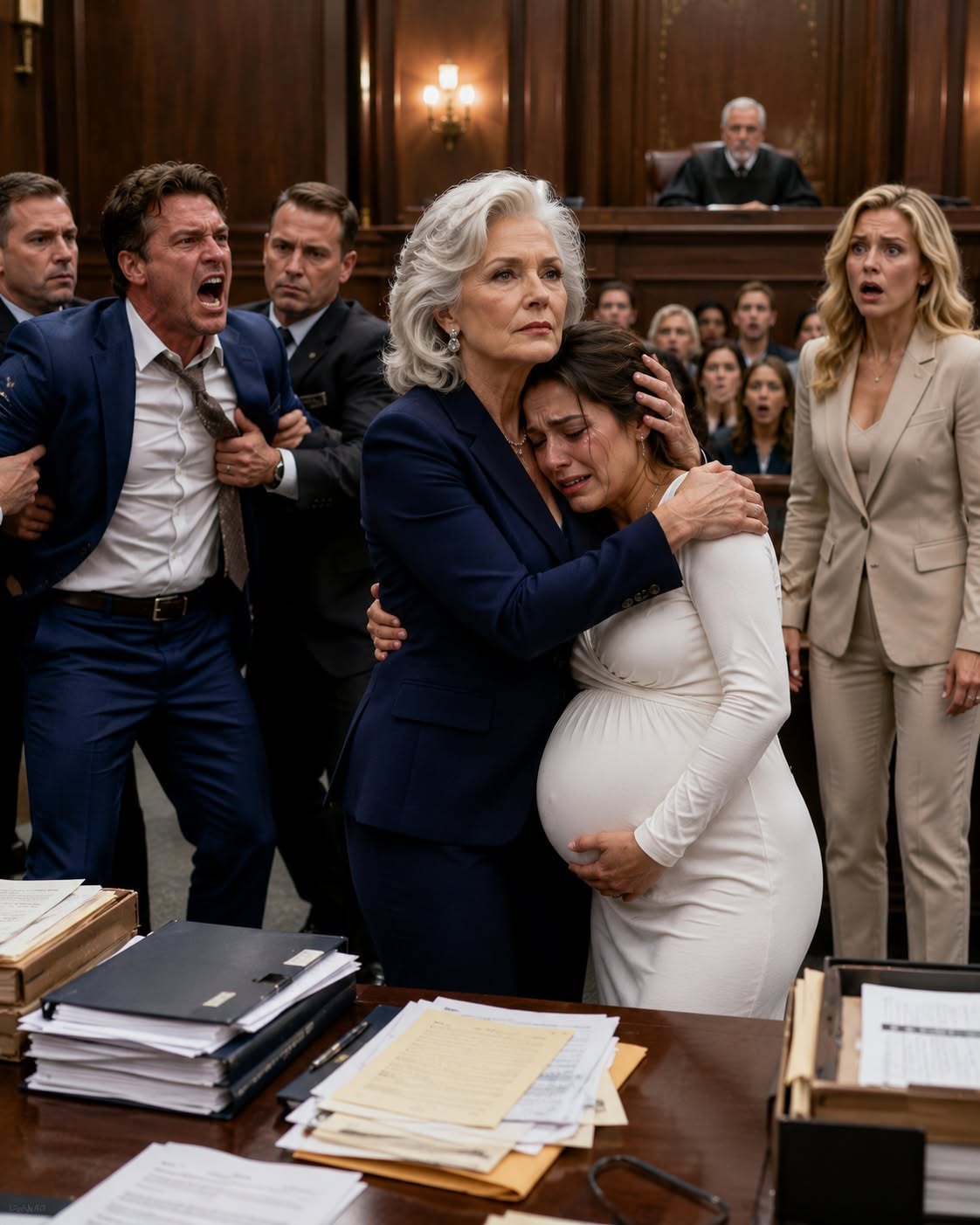
The courtroom had gone so quiet that I could hear the faint buzz of the overhead lights.
Eleanor Sterling’s hand still rested against my stomach, trembling so lightly that I wondered whether anyone else noticed. Her eyes were fixed on me, not with suspicion, but with a kind of frightened
recognition—as if she had spent years searching for me only to discover that finding me had opened another door she was not prepared to walk through.
“Does Julian know the truth about the baby’s father?”
The question hung in the air.
My mouth went dry.
Julian was staring at me as though the ground had shifted beneath him. His face, which only minutes
earlier had carried the satisfaction of a man certain he had won, now looked pale and unsettled.
“What truth?” he asked.
No one answered.
Even the FBI agents at the back of the courtroom stood still, their professional masks slipping just enough to reveal that Eleanor’s words meant something to them, too.
Judge Carter leaned forward, his expression sharpening. “Mrs. Sterling, this courtroom is not a place
for dramatic accusations. If there is something relevant to the case, it needs to be stated clearly.”
Eleanor did not take her eyes off me.
“Clara,” she said softly, “I am asking you because I need to hear it from you. Not from a report. Not
from anyone else.”
A report.
My heart thudded so hard it hurt.
“You had me investigated,” I whispered.
Her face changed at once. Regret passed over it, gentle but unmistakable. “I had your life traced. I had to know where you had been, who had hurt you, who had kept you from me. I did not do it to
invade you. I did it because I was afraid that finding you too late meant I might already have failed you again.”
Again.
The word reached me deeper than all the rest.
All my life I had carried the ache of being unwanted. Foster homes had taught me to pack lightly and expect nothing. Birthdays had passed with borrowed cakes, borrowed smiles, borrowed last names. I
had learned to stop asking where I came from because every unanswered question became another room in me with no light.
And now this woman—this impossible woman—stood before me saying she had never stopped
looking.
Yet even that miracle could not loosen the fear wrapped around my chest.
Because she knew.
Somehow, she knew about the night I had buried beneath silence. The night that had not been betrayal, not in the way Julian would believe. Not in the way a courtroom would reduce it into a sentence. It had been a moment born from grief, confusion, and a truth I had not been strong
enough to face.
Julian gripped the edge of the table.
“Clara,” he said slowly, “answer her.”
There was no affection in his voice now. No pleading. Only calculation.
I looked at him and remembered our marriage as it had been in the beginning: candlelit dinners in a small apartment, his hand at the base of my back when we crossed streets, the way he used to say my
name as if it were something precious. I had not married a monster. That made the ending more painful. He had become small by inches—resentful of my quietness, impatient with my fears, embarrassed by the parts of me that did not fit into his polished world.
When the infertility tests came back two years earlier, something in him changed.
The doctor had spoken with careful kindness. Julian had sat beside me, nodding, his jaw tight. It had not been my body that carried the complication. It had been his. But on the drive home, he had not
said a word. By dinner, he was already blaming stress, timing, doctors, me.
After that, love in our house became a negotiation.
I pressed both hands to my stomach.
“My baby is mine,” I said, my voice unsteady but clear. “That is the truth that matters.”
Julian gave a short laugh. “That’s not an answer.”
“No,” I said, turning to him. “It’s the only answer you deserve in this room.”
A murmur moved through the benches.
Judge Carter lifted a hand. “Order.”
One of Eleanor’s attorneys leaned toward her and whispered something, but she did not respond.
Her attention remained on me, searching, careful.
Then one of the FBI agents stepped forward.
“Your Honor,” he said, “with respect, this matter may intersect with an active investigation. We’d like
to request a private conference with the court.”
Julian’s eyes widened. “Active investigation into what?”
The agent did not look at him. “Financial misconduct, identity fraud, and related matters.”
“Identity fraud?” Julian repeated.
Eleanor’s posture stiffened.
I felt the baby kick again, slower this time, as if reminding me to breathe.
Judge Carter stared at the agent for a long moment before removing his glasses. “Counsel, chambers. Now. Mrs. Bennett, Mrs. Sterling, Mr. Bennett—you will remain seated until I decide otherwise.”
The room began to stir, but the judge’s bailiff moved quickly to control the crowd. Reporters had not
been present; this was only a divorce proceeding, after all. But clerks, attorneys, and people waiting for their own cases were all whispering now, their eyes flicking toward me as though I had become a headline before their very eyes.
I lowered myself into the chair the bodyguard had placed behind me. My legs were trembling.
Eleanor crouched beside me despite the elegant cut of her cream suit and the diamond at her throat. Up close, she did not look like the photographs I had seen on magazine covers. She looked older,
softer, human. Fine lines framed her mouth. Her eyes were dark blue like mine.
Like mine.
“I’m sorry,” she said.
I looked away. “For which part?”
“All of it.”
I wanted to be angry at her. It would have been easier. Anger had edges. It could hold me upright.
But the sorrow in her voice undid me.
“You said I was stolen,” I murmured. “How?”
She swallowed.
Before she could answer, Julian spoke from across the aisle.
“Isn’t anyone going to acknowledge how convenient this is?” His voice rose, gaining strength from desperation. “The moment Clara loses the divorce, a billionaire appears and claims her? Then
suddenly there are hidden assets? FBI agents? A mystery baby? This is insane.”
Eleanor stood slowly.
She did not raise her voice. She didn’t need to.
“Mr. Bennett, I have spent thirty years hiring investigators, reviewing cold files, following false leads, and burying hope every time a woman with my daughter’s age and features turned out not to be her. There is nothing convenient about what this has cost.”
Julian faltered, but only briefly.
“She’s my wife.”
“She is not your property.”
The words were calm. That made them land harder.
I closed my eyes.
For years I had mistaken control for concern because I had been so hungry for belonging. Julian had
not locked doors or shouted in public. He had done subtler things. He had sighed when I wanted to go back to school. He had corrected my clothes before dinners with his colleagues. He had called me fragile when I disagreed, emotional when I cried, ungrateful when I asked questions about money.
And I had stayed because somewhere inside me, the abandoned child still believed love had to be earned.
The chamber doors opened.
Judge Carter returned first, followed by the attorneys and the agents. His face looked older now, as if the private conversation had pulled years from him.
He resumed his seat.
“This court is vacating its prior ruling pending review,” he announced.
Julian shot upright. “You can’t do that.”
“I can,” Judge Carter said sharply, “when credible evidence has been presented that financial
disclosures may have been materially false.”
Julian’s attorney, who had grown increasingly quiet, placed a hand on his client’s arm. “Julian, sit down.”
But Julian did not sit.
He looked at me then, and there was something frightening in his expression—not violence, not exactly, but the panic of a man losing the story he had written for himself.
“You did this,” he said. “You planned this.”
I shook my head. “I didn’t know any of this.”
“Then tell them,” he demanded. “Tell them the baby is mine.”
My throat closed.
The entire courtroom seemed to hold its breath again.
Eleanor’s hand found my shoulder. She did not squeeze. She simply let it rest there, offering presence
without command.
I looked at Julian.
There had been a time I would have protected him from embarrassment at any cost. I had kept his
secrets from doctors, friends, even from myself. When he refused to discuss adoption, I agreed. When he claimed we needed privacy, I withdrew. When he started sleeping in another room, I told myself marriage had seasons.
Then came the night of the Sterling Foundation gala eight months earlier.
I had gone alone because Julian had canceled at the last minute. He had said he was busy. Later, I would learn he had been with his financial adviser, moving money I didn’t know existed.
At the gala, I met a man named Daniel Vale.
He was not charming in the easy way Julian had once been. Daniel was quiet. Thoughtful. He worked with one of the foundation’s legal aid programs, helping foster youth access records and
scholarships. When he learned I had grown up in the system, he listened without pity. That was what undid me: the listening.
We talked for two hours in a balcony garden above the city. I told him things I had not told anyone in
years. Not because I intended anything to happen. Because for once, someone asked who I had been before I became Mrs. Bennett.
Later, when Julian called and accused me of embarrassing him by staying too long, I cried in the
coatroom. Daniel found me there. He offered to call a car, then stepped back as if distance mattered.
It should have ended there.
But grief is not always dramatic. Sometimes it is quiet. Sometimes it asks to be held for one minute
longer than it should.
I opened my eyes.
“I can’t tell them that,” I said.
Julian went still.
His attorney lowered his gaze.
The judge’s expression did not change, but the silence around us deepened.
Julian’s voice cracked. “So it’s true.”
I placed a hand over my belly. “You told me for two years that I was the reason we couldn’t have a child. You let me believe my body had failed us. You watched me apologize for something that wasn’t
mine to carry.”
His face tightened.
“That doesn’t justify—”
“No,” I said, and my voice surprised me by remaining steady. “It doesn’t justify everything. It doesn’t erase my choices. But this child was conceived after our marriage was already broken in every way except on paper. And when I found out I was pregnant, you had already filed for divorce.”
“That’s not how it happened.”
“It is.”
“You should have told me.”
I nodded slowly. “I should have told the truth sooner. But not because you owned it. Because I needed to stop being afraid of it.”
Eleanor’s eyes glistened beside me.
Julian looked around the courtroom as if searching for someone to agree with him. No one spoke.
Judge Carter cleared his throat. “Paternity will be addressed through appropriate legal channels, not accusations in open court. For now, this court is concerned with the financial disclosures made under
path.”
The FBI agents stepped closer to Julian’s table.
“Mr. Bennett,” one said, “we have some questions for you regarding several accounts associated with
Bennett Holdings.”
Julian sat down heavily.
For the first time since I had known him, he looked truly small.
Not defeated. Not punished. Just exposed.
And strangely, seeing him that way did not give me satisfaction. It gave me sadness. This was the man I had loved. This was the man who had held my hand through winter walks and once burned
pancakes trying to make me breakfast on my birthday. There had been real tenderness once. There had also been real harm.
Both truths stood together. Neither canceled the other.
The judge adjourned the proceeding pending further review.
As the room began to empty, Eleanor’s bodyguards formed a quiet barrier around us. I felt dizzy. Too much had happened too quickly. My life had been pulled apart in front of strangers, then handed
back to me in pieces I did not recognize.
Eleanor turned toward me.
“Will you come with me?” she asked.
The question was simple, but I heard what she did not say.
Will you trust me?
Will you let me explain?
Will you allow me to be your mother when I have arrived thirty years too late?
I looked toward Julian.
He was speaking urgently with his attorney while the agents waited nearby. For a moment, his gaze
met mine. There was anger there, yes, but also fear. I had once shaped my life around managing his fear.
I could not do that anymore.
“Yes,” I said.
Eleanor exhaled as though she had been holding her breath for decades.
Outside the courthouse, the winter air struck my face cold and clean. A black car waited at the curb,
but Eleanor did not hurry me into it. She stood beside me on the courthouse steps while people passed below, unaware that the world had just rearranged itself.
“I don’t know how to do this,” I admitted.
“Neither do I,” she said.
That startled a laugh out of me. It broke halfway and became something close to a sob.
Eleanor’s eyes softened. “We can learn.”
In the car, she handed me a bottle of water and a soft gray shawl that smelled faintly of lavender. I wrapped it around my shoulders because I was cold, and because some small, aching part of me wanted to accept care without apologizing.
We drove through the city in silence for several blocks.
Then I asked, “Who was she?”
Eleanor looked out the window. “The nanny?”
I nodded.
Her jaw tightened, but her voice remained composed. “Her name was Margot Vale.”
Vale.
The name moved through me like a draft beneath a locked door.
I turned sharply. “Vale?”
Eleanor looked back at me.
“My baby’s father is Daniel Vale,” I said.
For one suspended second, Eleanor did not move.
Then her face went pale.
The car seemed to shrink around us.
“Daniel,” she whispered.
“You know him?”
She closed her eyes briefly, as if steadying herself.
“I know of him.”
“That’s not an answer.”
“No,” she said quietly. “It isn’t.”
My pulse quickened. “Eleanor.”
At the sound of her name, something passed through her expression. Pain, maybe. Or the realization
that I could not yet call her Mother.
She accepted it without flinching.
“Margot Vale was the woman who took you,” she said. “For years, we believed she acted alone. Later,
evidence suggested she may have had help. We followed every connection she had—family, employers, bank accounts, aliases. Daniel Vale appeared in one of those searches.”
My stomach tightened. “What was he to her?”
“Her nephew.”
I stared at her.
The city blurred beyond the glass.
Daniel Vale. The man who had listened to me. The man who had touched my hand as if it were something breakable and sacred. The man whose child I carried.
The nephew of the woman who stole me.
“That’s impossible,” I said.
“I wish it were.”
“No.” I shook my head, suddenly too warm beneath the shawl. “Daniel works with foster youth. He
helps people find records. He helped me start looking for mine before I got scared and stopped. He couldn’t have known.”
Eleanor’s gaze sharpened. “He helped you look?”
“Yes.”
“When?”
“After the gala. I told him I didn’t know where I came from. He said he knew people who could help.
We met twice. He requested some files for me.” I swallowed. “Then I found out I was pregnant and stopped answering his calls.”
Eleanor’s lips parted slightly.
“What?”
She reached for her phone, then seemed to think better of it. “The DNA match that confirmed you were my daughter came through an independent family-search database three weeks ago. We could
not identify who uploaded the sample. It was submitted under a privacy shield, then removed within forty-eight hours.”
I barely breathed.
“You think Daniel uploaded it?”
“I don’t know,” she said. “But if he did, then he may have known who you were before I did.”
The thought was too much to hold.
Daniel had looked at me with such tenderness. Had it been real? Had anything been real? Or had I been found, studied, guided back toward a family fortune without understanding the path beneath my feet?
“No,” I whispered. “He wouldn’t do that.”
Eleanor’s voice softened. “Clara, I am not accusing him. I am telling you why I was afraid in the courtroom.”
“Because my child is connected to the family that took me.”
“Yes.”
I turned toward the window. People moved along the sidewalks carrying coffee, briefcases, shopping
bags. Ordinary lives. Ordinary problems. A woman laughed into her phone at a crosswalk, and I envied her so intensely it hurt.
My baby shifted inside me.
Whatever Daniel knew or didn’t know, whatever history had wrapped itself around us before I was old enough to speak, this child was innocent. Mine. Real. Not a clue, not a scandal, not evidence in anyone’s investigation.
“I need to talk to him,” I said.
“I understand.”
“Do you know where he is?”
Eleanor hesitated.
That hesitation told me enough.
“You do.”
“He left the city yesterday.”
“Why?”
“We don’t know.”
The answer landed quietly, but it changed the air between us.
I looked at her. “Were you following him?”
“Our investigators flagged him because of the name Vale. Once we confirmed your identity, we
reviewed everyone close to you.”
“Everyone close to me?” I echoed. “You mean Julian. Daniel. My friends. My doctors.”
“I know how that sounds.”
“It sounds like I traded one person controlling my life for another.”
Her face crumpled in a way I had not expected.
Not dramatically. Not performatively. Just enough to show the wound beneath her composure.
“You are right to say that,” she said. “I won’t defend it. I have spent thirty years trying to find a child who was taken from me, and somewhere along the way, fear became the way I loved what I had lost. That is not fair to you.”
My anger softened, not because it disappeared, but because she had not argued with it.
“I need room,” I said.
“You’ll have it.”
“I need answers, too.”
“You’ll have those as well.”
The car turned through iron gates into a quiet estate tucked behind high stone walls. I had seen
photographs of Sterling House in magazines, but no photograph captured its stillness. It was not flashy. It was old brick and ivy, white columns and tall windows glowing gold against the gray afternoon.
As we pulled up the drive, my throat tightened.
This could have been mine.
Not the wealth. Not the house.
The belonging.
A childhood bedroom. A mother’s voice calling from downstairs. Someone knowing which foods I hated and which songs helped me sleep. Someone keeping my drawings, my baby shoes, my first lost
tooth.
A whole life had existed somewhere, waiting for me, while I learned not to wait for anyone.
Eleanor seemed to understand. She did not speak as the driver opened the door.
Inside, the house smelled of polished wood, fresh flowers, and something warm from the kitchen. A woman with silver hair appeared in the foyer, pressed both hands to her mouth, and began to cry.
“This is Marion,” Eleanor said. “She has been with our family for forty years.”
Marion stepped forward, then stopped, as if afraid to startle me. “Miss Clara,” she whispered.
No one had ever said my name like that. Like it had history.
I nodded because I could not speak.
Eleanor led me upstairs slowly, pausing whenever I needed to catch my breath. At the end of a long hallway, she stopped before a white door.
“I kept it,” she said.
My hand went cold.
She opened the door.
The room beyond was soft yellow, filled with light. A small bed had been replaced with a larger one,
but the walls still held painted birds and clouds. Shelves displayed carefully preserved toys: a wooden horse, cloth rabbits, picture books with worn corners. On the dresser sat a silver frame.
Inside was a photograph of a toddler with dark curls and serious blue eyes.
Me.
I walked toward it as if crossing water.
My fingers touched the frame.
“I don’t remember,” I said, and the words broke something open in me. “I don’t remember any of this.”
Eleanor stood in the doorway. “You loved that horse. You called him Captain, though it sounded more like ‘Capta.’ You would not sleep unless he was facing the window.”
A laugh escaped her, small and tearful.
I picked up the wooden horse. One wheel was chipped.
My hand closed around it, and for one impossible second, I felt something—not a memory exactly,
but a warmth. A rhythm. Sunlight on a floor. A woman humming.
I turned to Eleanor.
“Did you sing?”
Her face changed.
“Yes,” she whispered. “Every night.”
The room blurred.
I sat on the edge of the bed and cried.
Not prettily. Not softly. I cried for the child who had been taken, for the girl who had waited by windows in foster homes, for the woman who had married the first person who made permanence
sound possible. I cried for Eleanor, too, though I was not ready to forgive the world on her behalf.
She did not rush to hold me.
After a while, I reached for her.
Then she came.
Her arms went around me carefully at first, then tighter when I did not pull away. She smelled of jasmine and rain. I did not feel like a daughter. Not yet. But for the first time in my life, I understood
what it might feel like to stop falling.
That evening, Marion brought soup and bread to the sitting room adjoining my old bedroom. Eleanor insisted I eat, then immediately apologized for insisting. The awkwardness of it almost made
me smile.
We talked in fragments.
She told me my birth name was Clara Elise Sterling. Bennett was a name I had taken through
marriage; Clara was the one thing that had stayed with me, though no one knew why. The foster records listed me as Clara Reynolds at first, then Clara Moore, then Clara Bennett after marriage. Somewhere along the way, the truth had been thinned into paperwork and clerical errors.
“My father?” I asked.
Eleanor looked toward the fire.
“Your father’s name was Thomas Greer. We were not married, but he loved you deeply. He died five
years after you disappeared.”
I absorbed that quietly.
“Did he think I was alive?”
“Until his last breath.”
The words settled into me with unexpected force.
Another person who had wanted me.
Another person I would never meet.
Eleanor reached for a small envelope on the table. “He wrote to you every year on your birthday. I did, too. I didn’t know if you would ever read them, but I couldn’t bear not writing.”
I stared at the envelope.
My name was written across the front in elegant blue ink.
Clara, age five.
I couldn’t open it. Not yet.
“I’m tired,” I said.
“Of course.”
She stood, then paused. “Your doctor is coming in the morning. Only for a routine check, unless you prefer your own physician.”
I almost made a joke about billionaires arranging doctors like tea service, but the concern in her face
stopped me.
“Morning is okay,” I said.
After she left, I sat alone in the room that had once been mine.
My phone had been silent for hours. I had turned it off after seeing twelve missed calls from Julian and one from an unknown number. Now, with the house quiet around me, I powered it on.
Messages flooded the screen.
Julian: We need to talk.
Julian: You embarrassed both of us.
Julian: I know you’re confused. Don’t let her manipulate you.
Julian: Clara, please. I’m sorry.
I stared at the last message longer than I wanted to.
Then I saw another.
Unknown Number: Clara, it’s Daniel. Please don’t trust everything Eleanor tells you. There are things she doesn’t know. There are things I couldn’t say until you were safe.
My heart began to race.
Another message appeared beneath it.
Unknown Number: I never meant to disappear. Margot is alive.
The room tilted.
I read the words again.
Margot is alive.
The woman who had stolen me. The woman everyone believed had vanished into history. The woman
whose name had just connected my past to my unborn child’s future.
My fingers shook so badly I almost dropped the phone.
A third message arrived.
Unknown Number: She wants to see you before the baby is born.
I stood too quickly, pain tightening low in my back. I gripped the dresser until it passed.
Then, from somewhere beyond the bedroom door, I heard voices.
Eleanor’s voice.
And another voice—male, low, urgent.
I moved quietly to the door and opened it just a crack.
Down the hallway, near the staircase, Eleanor stood facing one of the FBI agents from the courtroom. He held a file in one hand. His expression was grave.
“We confirmed it,” he said. “The original kidnapping report was altered.”
Eleanor’s face had gone white. “By whom?”
The agent hesitated.
Then he said a name I recognized.
Not Margot Vale.
Not Daniel.
Not Julian.
He said, “Thomas Greer.”
My father.
The man Eleanor had just told me loved me until his last breath.
I stepped back from the door, one hand over my mouth, while my phone lit up once more in my palm.
Unknown Number: Clara, your mother has only told you half the story.
Related Post
I had been a widow for three years. Then I made the unthinkable decision to marry my late husband’s identical twin.
On my wedding night, I noticed a small curved scar near my new husband’s hip. [...]
I WAS SECRETLY MARRIED FOR 3 YEARS. AT MY HUSBAND’S LAW FIRM, A PARALEGAL SAID: ‘CONGRATS, MR. CARTWRIGHT. YOUR WIFE’S BABY SHOWER IS ALL SET.’
The first time I heard another woman called my husband’s wife, I was standing in [...]

I hid from my husband that I had just won 97 million dollars
I hid from my husband that I had just won 97 million dollars. That night, [...]