
Who Came to Pick Up Grandma? One Kind Act Turned the Retired Woman’s Life into a Real-Life Fairy Tale.
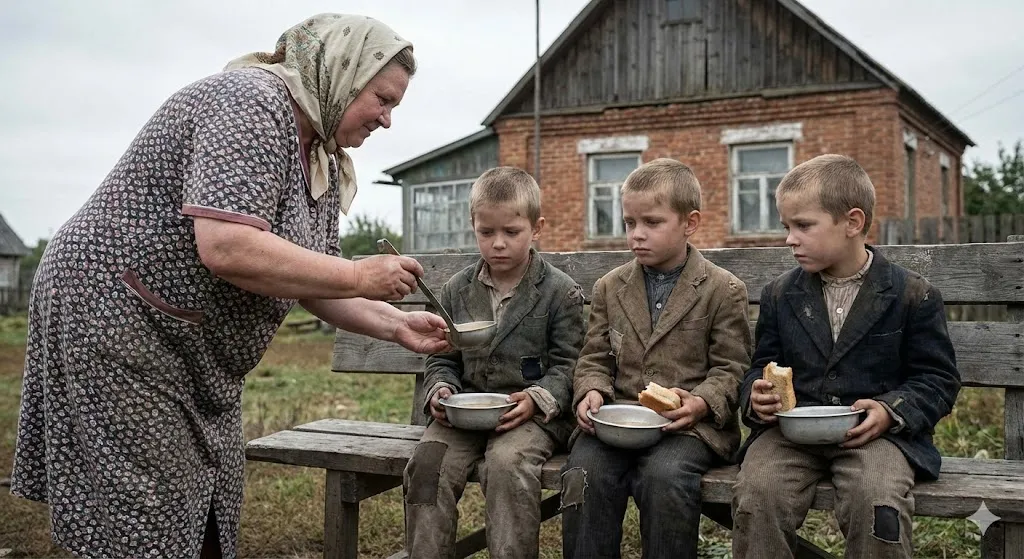
**An elderly woman fed three homeless children, unaware that this decision would change her life years later.**
Steam rose slowly from the pot, mixing with the aroma of broth and fresh pancakes. Zinaida Petrovna’s stall was modest but clean.
**Who came for Grandma? One good deed turned a pensioner’s life into a real fairy tale | July 1, 2026**
An old metal cart, a faded awning, a hissing frying pan, and jars of sauces lined up like little soldiers. Around her, the street buzzed: cars, hurried footsteps, a distant horn, and voices crossing without looking at one another. Zinaida Petrovna had working hands—hands with small burns and tired nails.
She adjusted her stained apron and handed a plate to a customer who had known her for many years.
“God bless you, Petrovna!” the man said, leaving a few coins.
She gave a faint smile. It wasn’t a broad one, just the kind that doesn’t last long because life doesn’t give you a break.
“Bless you too, son!” she replied.
When the customer left, Zinaida Petrovna looked at the small box of change. It was never full, and never had been. That day it felt even lighter than usual. There were fewer buyers because of the construction on the corner, which diverted people, and because of a new competitor two streets over with a fancier stall.
Still, Zinaida Petrovna kept going. She always kept going. It was around six in the evening when the sun began to set and the shadow from the awning grew longer. That was when she saw them—three children. They weren’t running like the others or talking loudly. They walked huddled together, as if the world was too big to walk through alone. All three had the same faces: dark eyes, prominent cheekbones, and messy black hair. They looked like dusty mirrors. Their clothes were worn and too big, and their sneakers had lost their shape.
No backpacks, no adults—just hunger. Zinaida Petrovna looked at them calmly, without exaggerated horror. She didn’t clutch her heart or make a scene; she simply looked at them the way one looks at something that hurts, because it’s reality.
The children stopped two meters from the stall, not daring to come closer. One of them, the middle one, took a step and spoke quietly:
“Auntie, do you have anything you won’t sell?”
Zinaida Petrovna froze with a ladle in the air. She had heard this phrase before from other children in other years. But there was something special about these three. They weren’t asking with cunning; they were asking with shame.
“Do you have a mother?” she asked, without accusation.
The three glanced at each other as if the question had struck them.
“We don’t,” said the middle one, and his voice trembled slightly. “We don’t have anyone.”
Zinaida Petrovna swallowed, looking at the pot. She looked at the prepared plates, at the box of change, and then back at the three children. The one on the right lowered his gaze. The one on the left pressed his lips together as if trying not to cry. Zinaida Petrovna took a deep breath and made a decision that didn’t seem heroic to her. It seemed simple.
“Come here,” she said, waving her hand. “Come on, approach. I won’t bite.”
The three came closer slowly, as if afraid it was a trap. Zinaida Petrovna gave them three small portions of what was left. They weren’t full plates like for an adult, but they were hot. And warmth, when you’re hungry, is a promise. The children sat on the plastic stools, huddling together. At first they ate quickly and greedily, then more slowly, as if their bodies had finally realized there would be something in their stomachs.
Zinaida Petrovna watched them eat and felt a lump in her chest, not understanding where it came from. Maybe from memories of her own son. Maybe from years of exhaustion. Maybe from the bitter thought that no one should have to see three children eating as if it were their last chance.
“What are your names?” she asked, trying to keep her voice steady.
The three glanced at each other again.
“I’m Matviy,” said the first.
“I’m Hlib,” said the second, the middle one.
“And I’m Denys,” said the third.
Zinaida Petrovna nodded slowly, memorizing the names as one keeps something they don’t want to lose.
“Where do you sleep?” she asked.
The three lowered their eyes.
“Wherever we can…” Hlib whispered.
Zinaida Petrovna gripped the ladle tightly. She looked around. People walked by, buying, not looking. A couple crossed the street laughing, not noticing the children. A man in a nice shirt glanced over and grimaced, as if hunger were contagious. Zinaida Petrovna felt a pang of anger.
Then she heard a voice behind her, cold as stone:
“Zinaida Petrovna, handing out food again?”
She turned. It was a man from the neighborhood, one of those who always spoke as if he owned the street. Rohov—the one who claimed to know people who issued permits.
“Don’t complain later when you’re short on money,” he added, looking at the children as if they were trash.
The triplets froze. One gripped the edge of his plate; another hid his face. Zinaida Petrovna straightened up, even though her back hurt.
“I’m not complaining,” she said firmly. “And they’re eating.”
Rohov smiled briefly.
“You’ll gather vagrants at your spot,” he muttered. “Then the inspectors will come. And goodbye.”
Zinaida Petrovna held his gaze without lowering her head.
“Let them come,” she said. “There’s nothing dirty here, only hunger.”
Rohov clicked his tongue and left. But his threat lingered in the air. Zinaida Petrovna looked at the children. Matviy looked at her as if he didn’t understand why someone would defend them. Hlib swallowed slowly. Denys pressed his lips together with restrained anger.
Zinaida Petrovna lowered her voice:
“Eat. And when you’re finished, tell me where you’re going. I won’t rest easy if I just let you go.”
The three glanced at each other, and for the first time something besides hunger appeared in their eyes. A small spark of hope. Zinaida Petrovna didn’t know it, but in that moment, with three simple plates and a firm phrase, she had done something the world doesn’t easily forgive or forget. Because feeding three homeless children was an act of kindness, but also, without intending to, a promise.
The street remained the same. Cars drove by, people bought without looking, the frying pan crackled like a tired heart. But for Zinaida Petrovna the evening was no longer the same from the moment the three children sat on her plastic stools. Matviy, Hlib, and Denys finished their portions carefully, as if wanting to stretch out the warmth of the food longer. They didn’t ask for more—not because they didn’t want to, but because they were ashamed.
Zinaida Petrovna took a napkin and handed it to the middle one.
“Wipe yourself properly, son,” she said without excess sweetness, the way a real grandmother would.
Hlib nodded, lowering his gaze.
“Thank you, Auntie,” he whispered.
Zinaida Petrovna collected the plates slowly, looking at their small hands. Children’s hands, but marked by the street: scrapes on the knuckles, broken nails, fingers slightly swollen from sleeping wherever they could.
“Well then,” she said, placing the plates on the tray, “where will you go when the sun sets?”
The three glanced at each other as if deciding without words.
“Under the bridge,” Matviy said almost soundlessly.
Zinaida Petrovna felt a lump in her throat. The bridge was a known place. Shadows, cardboard, dampness. In the city there were such corners where people disappeared and no one noticed.
“Why not a shelter?” she asked.
Denys pressed his mouth with distrust.
“They separate us,” he said directly. “They say those are the rules.”
Zinaida Petrovna frowned.
“And you don’t let them.”
Hlib shook his head with sad stubbornness.
“If they separate us, we won’t find each other again,” he said, swallowing. “And alone is worse.”
Zinaida Petrovna fell silent for a second. She looked at the pot, at the street, at the box of change, and felt quiet anger at rules invented at desks but applied to children’s skin.
“Alright,” she said at last. “I won’t separate you either.”
The triplets raised their eyes at the same time, as if that phrase had become a roof over their heads. Zinaida Petrovna lowered her voice.
“But you’re not just leaving like that,” she said. “Who abandoned you? Do you have any relatives?”
Matviy shrugged. Denys looked away. Hlib hesitated for a second but spoke.
“We don’t really remember,” he whispered. “Just a car at night, and then everything.”
Zinaida Petrovna felt a chill. It wasn’t a full story, just a fragment. And fragments, when something is missing, usually hide something heavy. She didn’t press. She didn’t want to pull the pain out by force.
“Alright,” she said. “You ate today, and tomorrow, if you want, come again. But with one condition.”
The three tensed, as if afraid of a price.
“What condition?” Denys asked.
Zinaida Petrovna looked at them firmly.
“Don’t steal,” she said. “Not from hunger, not from anger. If I give to you, you respect me and respect yourselves.”
Matviy nodded quickly.
“We don’t steal,” he said.
Denys pressed his lips together.
“Sometimes they accuse us anyway, even though we didn’t do anything,” he muttered.
Zinaida Petrovna understood. On the street, guilt is handed out based on faces and clothes.
“It’s not like that here,” she said. “Here we tell the truth.”
The children fell silent. And then, as Hlib moved to get off the stool, something showed from under his shirt collar. A thin chain, dusty, with a small pendant. Zinaida Petrovna barely noticed it. But she did. It was a metal pendant. Simple, but very distinctive in shape: three dots connected like a strange clover or three stars together.
Zinaida Petrovna froze. She had seen this symbol before. Not on the street, but in a place that didn’t match a homeless child.
“Hey,” she said gently. “That pendant. Where did you get it?”
Hlib instinctively pressed his hand to his chest, protecting it.
“It’s mine,” he said with distrust. “I’ve had it since before.”
Zinaida Petrovna swallowed.
“Before you ended up on the street…?”
Hlib nodded. Matviy and Denys moved closer, as if the pendant were something sacred.
“We all three have them,” Matviy said, pulling back his collar to show his.
Denys did the same. All three pendants were identical.
Zinaida Petrovna felt her heart beat harder. This was unusual. It wasn’t something bought at the market. It was a symbol from someone who had money, or family, or places where they ordered identical things for three identical children. Zinaida Petrovna looked at the symbol again, and something stirred in her memory, like a creaking door. She remembered an old news item from many years ago, an announcement posted on a pole near the market. Three identical ones, a desperate family, a phone number, the word “Reward,” and a small logo in the corner. The same three stars. Zinaida Petrovna felt the blood drain from her fingers.
“What is it?” Denys asked, seeing her serious face.
Zinaida Petrovna swallowed, trying not to scare them.
“Nothing, son,” she said, but her voice didn’t quite obey. “It’s just this symbol… it’s not from the street.”
Hlib clutched the pendant.
“I don’t know,” he said. “I only know that when I touch it, I remember a voice singing.”
Matviy stared at the ground.
“And a smell,” he whispered, “like expensive soap.”
Denys frowned.
“And I remember big gates,” he said quietly. “Tall, metal ones.”
Zinaida Petrovna went cold. Gates, expensive soap, a singing voice. This wasn’t the bridge; this was a home. Zinaida Petrovna looked around as if someone might be listening. The street was ordinary, but inside she was no longer calm, because she understood what no one else saw. These children had not only hunger; they had a history. And if someone had been looking for them with a reward and a logo, it meant someone also wanted them to stay unfound.
Zinaida Petrovna took a deep breath, leaned toward them, and lowered her voice.
“Listen to me carefully. Today you’re not going under the bridge. Today you stay with me. Not because I want it, but because I feel that someone might want you to be far away.”
The three looked at her fearfully.
“Who?” Hlib asked.
Zinaida Petrovna gripped the ladle as if it were a shield.
“I don’t know yet. But I’ll find out.”
And for the first time in that modest stall, danger stopped feeling like hunger and began to feel like something more—like a shadow coming from the past. The sun sank lower, and the air grew fresh with that street smell of dust, food, and gasoline. Zinaida Petrovna stood behind her stall, stirring with a ladle in feigned calm, but inside she was tense. The three pendants with the three-star symbol had ignited memories in her that she didn’t want to fully believe.
Matviy, Hlib, and Denys stayed nearby, not crossing the street, as if for the first time they had a place where they weren’t immediately chased away. They spoke little, watching people with caution, and every time someone came too close, the three huddled together as if they were one whole. Zinaida Petrovna brought them a glass of water.
“Drink slowly,” she said. “I don’t want you getting sick.”
Hlib took the glass carefully.
“Thank you, Auntie.”
At that moment, a dry chuckle sounded a few steps away.
“Just look at her.”
Zinaida Petrovna turned. Rohov was walking toward them, followed by two men with the look of “I have permits for everything.” One had a folder, the other a cap and a cheap radio. Rohov smiled as if he had come for pleasure.
“Zinaida Petrovna,” he said. “What a big heart you have! Handing out food to vagrants. Don’t cry later when they take your spot.”
The triplets froze. Matviy lowered his gaze. Denys pressed his lips together. Hlib pressed closer to the edge of the cart, as if hiding. Zinaida Petrovna straightened up.
“They’re not vagrants,” she said. “They’re children.”
Rohov raised an eyebrow.
“Children who eat for free today and steal tomorrow,” he replied. “That’s how it all starts.”
One of the men behind him opened the folder and pretended to read.
“A complaint has been received,” he said. “About unsanitary conditions and obstructing the roadway.”
Zinaida Petrovna felt a blow to the stomach. The word “unsanitary” was a favorite when they wanted to take something without telling the truth.
“How am I in the way? My spot is clean,” she said firmly. “It always has been.”
The man shrugged.
“That’s for us to decide,” he said.
Zinaida Petrovna looked at the frying pan, the pot, the jars. Everything was in order. She knew it. But she also knew that when an inspector comes wanting to find something, he finds it.
Rohov smiled.
“I told you, Petrovna,” he muttered. “If you wanted to live quietly, you should have listened to me.”
Zinaida Petrovna looked at him with restrained anger.
“What do you want?” she asked.
Rohov lowered his voice. But loud enough for the children to hear.
“For you to stop attracting problems,” he said. “And these children. Get them out of here.”
Hlib raised a frightened gaze. Matviy gripped the edge of the stool. Denys, on the contrary, took a step forward as if wanting to stand in front. Zinaida Petrovna reached out a hand to stop him, but without touching.
“No,” she whispered. “Don’t get involved.”
Rohov noticed the gesture and smiled.
“Look at that, what a sight! She’s already got bodyguards,” he said. “How much do you pay them? Soup?”
People began to turn their heads. The curious came closer. That was the plan—to humiliate her publicly so that shame would do its work. One woman from the market muttered:
“That’s why there’s trouble starting here.”
A man on a motorcycle threw out:
“They should be sent to an orphanage.”
The children heard and shrank even more. Zinaida Petrovna felt anger rising but forced herself to speak calmly.
“They haven’t done anything,” she said. “They’re eating. That’s all.”
The inspector with the folder approached the cart and stuck his nose in as if looking for infection.
“Mmm,” he drawled exaggeratedly. “It smells strange here.”
Zinaida Petrovna gripped the ladle.
“It smells like food,” she said. “As it should.”
Rohov stepped forward and pointed at the triplets.
“You see,” he addressed the people, “this woman encourages street life. Then they’ll start stealing, and everyone will complain. But no one will do anything.”
Denys clenched his fists. His eyes shone with rage.
“We don’t steal!” he burst out, unable to hold back.
Silence lasted a second, and in that second Rohov smiled.
“Oh, you don’t?” he said. “Well, prove it. Come on, what’s in your pockets?”
Matviy looked at Hlib fearfully. Hlib instinctively clutched his pendant. Zinaida Petrovna stepped forward, becoming a wall.
“You have no right,” she said loudly. “They’re children.”
The man with the radio moved closer…
“We do if there’s suspicion,” he said.
People whispered. The word “suspicion” was like gasoline. Rohov raised his voice as if doing a good deed.
“Zinaida Petrovna, don’t be stubborn. Either you chase them away, or I will. For real.”
Zinaida Petrovna felt the world collapsing on her. And in that moment she saw something: the torn pocket on Matviy’s pants, Hlib’s trembling chin, Denys’s desperate anger. They were children. They were hungry, and now humiliated too. Zinaida Petrovna took a deep breath, gathered all her courage, and spoke clearly for everyone.
“You want to take my spot? Take it,” she said. “But I won’t chase three children away like dogs. If you don’t like seeing hunger, it means you’ve never known it.”
The street fell silent for a second. Some lowered their eyes, some felt awkward. But Rohov wasn’t the type to feel shame.
“So that’s how it is,” he said, smiling. “Alright.”
He signaled to the inspector with the folder.
“Write it down,” he ordered. “Refusal to cooperate. Presence of minors in improper conditions. Sanitary risk.”
Zinaida Petrovna felt her legs tremble but didn’t back down.
Then the man with the radio stepped toward the cart, reaching out as if to turn off the gas or knock something over. In that movement his gaze fell on Hlib’s chest, where the three-star pendant was visible. The man froze for a second, and his face changed.
“Hey,” he said quietly. “That symbol…”
Hlib covered his chest with his hand. Zinaida Petrovna noticed. So did Rohov.
“What is it?” Rohov asked quickly, coming closer.
The man with the radio hesitated.
“Nothing…” he muttered. “Nothing…”
But it was too late. Rohov looked at Hlib more carefully, as if seeing not a dirty child for the first time, but something else. Something that could be worth money. And Zinaida Petrovna felt alarm inside, because in that moment she understood the real danger. It wasn’t that they called them vagrants. It was that someone had just recognized them. The words hung in the air, dangerous and small: “That symbol…”
Zinaida Petrovna quickly stepped in front of the children, shielding them with her thin body and stained apron. Not much, but a wall.
“Enough!” she said firmly. “You want to nitpick? Nitpick something else. There’s no crime here.”
Rohov smiled, but the smile was no longer mocking but calculating.
“Zinaida Petrovna, I just want to help you,” he said. “You’re getting into trouble because of your kindness, and the street doesn’t forgive.”
Zinaida Petrovna looked at him as at a person pretending to be a friend.
“I don’t need your help,” she replied.
Rohov waved his hand as if giving up, but his gaze remained fixed on Hlib’s neck.
“Well, alright,” he said. “Don’t say we didn’t warn you.”
The inspectors put away the folder without finishing the threat. The man with the radio avoided looking at the children. All three walked away, but not hurrying. They left with that fake unhurriedness that says: “I saw something and I’ll be back.”
When they finally turned the corner, Zinaida Petrovna exhaled as if she had been holding her breath since they appeared. The children stood motionless.
“Auntie,” Matviy whispered, “we’ll go.”
Zinaida Petrovna looked at the street, at the stall, at the setting sun, and made a decision she hadn’t yet said aloud.
“Today you’re not going anywhere from me,” she said. “Not under the bridge, nowhere.”
Hlib widened his eyes.
“But if we stay, they’ll close your spot.”
Zinaida Petrovna gripped the ladle like a staff.
“A spot can be lost,” she said. “You cannot.”
Denys lowered his gaze for a second, swallowing something. Then he spoke in a quiet, almost shy voice:
“We don’t want to be a burden.”
Zinaida Petrovna looked at him.
“You’re not a burden,” she said. “You’re children.”
The evening continued. Two customers came, and Zinaida Petrovna served them with quick hands as always. The children stayed aside, quietly watching. And in that watching Zinaida Petrovna noticed something. They weren’t street children in the way people think. They didn’t know how to steal with cunning. They knew how to endure. When a customer left extra change, Matviy saw it but didn’t reach out. When a woman was distracted with an open bag, Hlib looked and quietly covered it so no one would steal. When a neighborhood boy laughed at them, Denys didn’t respond with fists, only looked with quiet rage. Zinaida Petrovna understood: these three had hunger, but they also had inner rules, even if they themselves didn’t know where from.
When it got dark, Zinaida Petrovna closed the stall, put away the jars, turned off the gas, covered the pot, and looked at the box of change. The day’s earnings were meager, but it no longer seemed so important.
“Let’s go,” she told them. “We’ll walk.”
The children glanced at each other with distrust.
“Where?” Hlib asked.
Zinaida Petrovna nodded to the side.
“To my place. It’s cramped, but at least the rain doesn’t drip.”
The three froze.
“No,” Matviy whispered. “We don’t want to cause trouble.”
Zinaida Petrovna cut him off:
“Trouble has already found you. And if you go under the bridge, I don’t know if I’ll see you tomorrow.”
The children were silent, and that silence was consent.
They walked along narrow streets. Zinaida Petrovna ahead, the cart creaking wheels, the children behind, staying together. From time to time one of them looked back, as if afraid of being followed. When they reached the modest room, Zinaida Petrovna opened the door. Inside it smelled of cheap soap and hidden bread. A simple bed, an old chair, a small corner with an icon and an extinguished lamp.
“Here,” she said, “there are no luxuries, but there’s a roof.”
The children entered slowly, as if the little room were a sacred place. Zinaida Petrovna took some stale bread and broke it into three pieces.
“Eat a little,” she said, “and tomorrow we’ll decide what to do.”
Matviy took a piece.
“Why are you helping us?” he asked, not understanding.
Zinaida Petrovna froze for a second. She didn’t know how to explain with beautiful words, so she simply said the plain truth:
“Because if I ended up on the street, I would want someone to see a person in me.”
The children lowered their eyes. Zinaida Petrovna sat on the chair and looked at each of them in turn.
“Now the conditions,” she said firmly. The three raised their gaze. “No stealing here, no lying. And if someone is looking for you, you tell me. Don’t hide it.”
Hlib clutched the pendant under his shirt.
“We don’t know who’s looking for us,” he said.
Zinaida Petrovna looked at him.
“Someone recognized this symbol,” she said. “And when someone recognizes something in you, it’s not always out of love.”
Denys frowned.
“Then what should we do?”
Zinaida Petrovna took a deep breath.
“We’ll make a deal. You help me at the spot,” she continued. “Clean up, set things out, carry things, so no one can say you only eat. And I’ll give you food and a roof until we find out the truth about this symbol.”
The three glanced at each other. And for the first time pride-like something appeared in their eyes.
“Yes,” Matviy said.
“Yes,” Hlib repeated.
“Yes,” Denys said, the sternest, but with a slight tremor in his voice…
Zinaida Petrovna nodded. And that night, while the city continued not to notice, in the modest little room a deal was made without paper but with something stronger—loyalty. Only outside, on some corner, Rohov was also making his deal, but with greed. And Zinaida Petrovna felt it in her chest.
The next day the stall smelled the same as always: broth, pancakes, fresh dill. But there was one difference that didn’t let Zinaida Petrovna go. The feeling that they were being watched. Matviy, Hlib, and Denys came early, even before the sun heated the sidewalk. Their hair was still damp, as if they had washed with the seriousness of wanting to look decent. Without saying too much, they began to help. One set out the stools, another wiped the frying pan, the third dragged a bucket of water that was too big for him.
Zinaida Petrovna watched silently, with a strange mix of pride and fear.
“Easier with that, son,” she told Denys when he strained his back. “I don’t want you to hurt yourself.”
Denys nodded stubbornly, as if he didn’t know how to accept care.
Throughout the morning people looked at them differently. Some with awkwardness, some with pity. There were those who bought just to look, as if the stall had become a show. And amid this bustle Rohov appeared on the other side of the street. He didn’t approach. He just leaned against the wall, watching, smiling with his lips but not his eyes. Zinaida Petrovna felt her heart tighten.
“Don’t look at him,” she whispered to the children. “Mind your own business.”
Hlib, however, glanced sideways at him and clutched the three-star pendant under his shirt, as if his skin warned him before his mind.
The day went on. By noon Zinaida Petrovna had almost relaxed. Almost. And then, in a short pause, Matviy approached her with a quiet voice.
“Auntie, I had a dream last night,” he said.
Zinaida Petrovna looked at him.
“What did you dream, son?”
Matviy swallowed.
“I dreamed we were called by a different name,” he whispered. “As if we had beautiful surnames.”
Zinaida Petrovna felt a blow.
“Do you remember the name?”
Matviy shook his head with annoyance.
“I can’t remember, but I heard a song and smelled expensive soap, like Hlib said.”
Zinaida Petrovna was silent for a second. Then she awkwardly stroked his hair, like a person unaccustomed to showing tenderness.
“Little by little,” she said. “The main thing is that you’re here with me.”
Matviy lowered his gaze and nodded. But that phrase didn’t have time to linger, because at 2:30, when the sun was blazing and the street seemed sleepy, a white van stopped half a block away. Then another. Then a police car. Slowly, without sirens, as if they wanted it to look ordinary. Zinaida Petrovna felt her heart jump to her throat.
“Don’t move,” she quickly told the children. “Stay close.”
The three immediately drew near, as if they already knew such danger.
Two people in vests with folders got out of the vans. A woman with a tablet. A patrol car parked behind. The policeman looked unhurried. And as if the world wanted to confirm her worst fears, Zinaida Petrovna saw Rohov walking behind with an expression that said, “I brought them.”
The woman in the vest spoke first.
“Good day. We’re here regarding a report about minors without a fixed place of residence, presumed sanitary risk, and possible exploitation.”
Zinaida Petrovna felt her face burn.
“Exploitation?” she repeated. “I fed them.”
The man in the vest raised the folder.
“We’re not accusing you,” he said in a mechanical voice. “We’re just checking. Do these children live with you?”
Zinaida Petrovna clutched her apron.
“They spent the night with me,” she admitted, “because they were on the street.”
The woman looked at the three children, and her voice softened slightly.
“Boys, what are your names?”
Matviy opened his mouth, but Denys spoke first with distrust:
“Matviy, Hlib, and Denys.”
The woman nodded, writing it down.
“Do you have relatives? Is someone looking for you?”
Zinaida Petrovna felt the world spin. If she said “yes,” they might take them. If she said “no,” they would take them anyway.
“I don’t know,” she said honestly. “I only know that someone recognized the symbol they wear.”
The man in the vest frowned.
“What symbol?”
Hlib instinctively covered his chest with his hand. The woman gently leaned toward him.
“Don’t be afraid,” she said, “we won’t hurt you; we just want to help.”
Zinaida Petrovna heard that phrase, but the fear didn’t recede. Not because she believed they would hurt them, but because she knew what they had already told her: they separate them.
“Don’t take them separately!” Zinaida Petrovna burst out, almost without thinking. “Please, if you separate them, they’ll be lost.”
The woman in the vest looked at her with a mix of weariness and sympathy.
“That’s not for me to decide,” she said. “There are protocols.”
Denys clenched his fists.
“No,” he said, and his voice broke. “Don’t separate us.”
Matviy pressed against Hlib. Hlib froze, looking at the patrol car. Zinaida Petrovna felt her heart breaking.
“Look at the stall,” she said desperately, gesturing with her hand. “It’s clean. They help. I’m not using them. I just couldn’t abandon them.”
The bored policeman threw out:
“Citizen, don’t complicate things.”
And that indifference was a blow. Then the man in the vest opened the folder and showed something. A printed sheet with a logo in the corner. Zinaida Petrovna froze. Three stars. The same symbol.
The woman in the vest looked at Zinaida Petrovna with new seriousness.
“These children may have been listed as missing for many years,” she said. She paused. “We must take them into protection to establish their identity.”
Zinaida Petrovna felt her legs give way.
“Missing…” she whispered.
Rohov smiled behind them as if he had just won the lottery.
“You see, Petrovna…”
Zinaida Petrovna looked at him with silent rage.
“It was you,” she whispered. “You called them.”
Rohov shrugged.
“I just reported it,” he said. “For the children’s own good.”
A lie wrapped in goodness. The people in vests approached the triplets calmly, without aggression, but firmly. The children stepped back, pressing against Zinaida Petrovna.
“Auntie,” Matviy said in a trembling voice. “Will you abandon us?”
Zinaida Petrovna felt something inside her break.
“No,” she said, swallowing. “I won’t abandon you.”
The woman in the vest looked at her.
“You can come with us to the department if you want,” she said. “But you can’t interfere with the removal.”
Zinaida Petrovna nodded quickly.
“I’m coming,” she said. “I’m coming with them.”
At that moment Denys turned toward the stall as if wanting to remember it. Hlib clutched his pendant. Matviy looked at Zinaida Petrovna as at the only thing he had. They were put into the van. Together, for now. Zinaida Petrovna got in too, trembling, still in her stained apron. The doors closed, and as the car moved off, Zinaida Petrovna saw Rohov through the window, standing on the corner and watching them go with satisfaction. Zinaida Petrovna pressed her lips together because she understood: this wasn’t help. It was a move. Someone had started something big, and now the children were no longer under her watch…
And that day, in seconds, Zinaida Petrovna lost what she had only begun to protect. The street returned to its noise as if nothing had happened. That was what hurt the most. The same distant horn. The same market caller. The same sun beating on the sidewalk. And Zinaida Petrovna’s stall empty inside. The pot extinguished, the stools set out with no one, the frying pan cold. The children were taken away in a white van under protection. A word that sounded clean but felt like robbery.
Zinaida Petrovna tried to catch up with them that same day. She walked through offices, asked, begged, gave her name, her address, her story. They told her: “Come tomorrow.” They told her: “The system doesn’t work.” They told her: “It’s under consideration.” They told her about protocols. And once, accidentally, she heard a phrase she already knew inside herself:
“If you’re not a relative, we cannot give information.”
Zinaida Petrovna left that place as a person who had just lost part of her body. She walked, but incomplete. The stall continued to operate because need doesn’t let you cry for long. The next day she lit the frying pan again, poured broth, heated the pot, but every time she heard small footsteps approaching the stall, something flared in her chest. And then went out, because it wasn’t them.
Matviy, Hlib, Denys. The names stuck in her like three sweet splinters. Weeks passed, then months. Zinaida Petrovna invented rituals for herself so as not to go crazy. Sweeping the same patch of sidewalk, scrubbing the same stain on the cart, setting aside three extra napkins—just in case they returned? Sometimes, without noticing, she would set out three stools together, and when she noticed, she would quickly separate them, ashamed of her own hope.
In the neighborhood people talked for two days, then forgot.
“It’s good they were taken,” some said. “At least less mess.”
Others whispered:
“Zinaida Petrovna got too attached.”
And that was the worst—that attachment was what they called what had been protection.
Rohov once walked past the stall and threw out a phrase like throwing a stone:
“You see,” he said, smiling, “in the end everything works out when you do things right.”
Zinaida Petrovna looked at him with silent hatred.
“Go away,” she said.
Rohov shrugged.
“You got yourself into it,” he muttered and left.
Over time Rohov became more important on that street. He began collecting payments, saying he solved issues with permits. Sometimes he stopped two meters from the stall, as a reminder that he could ruin her life whenever he wanted. Zinaida Petrovna endured. She always endured. Years.
Her hair turned whiter, her back bent more, her hands grew even rougher. Her regular customers aged with her. Some no longer came. Others said: “Petrovna! You should rest already!” But Zinaida Petrovna didn’t rest, because rest is silence, and in silence voices were heard. Sometimes she dreamed that the children were standing at the door and she couldn’t open it. Sometimes she dreamed she was looking for them under a bridge full of shadows and found only pendants with three stars thrown on the ground.
In a box in her little room she kept the little that remained of them. A folded napkin with a sauce stain, a cheap little spoon that Hlib had used, and a drawing that Matviy had left her one morning: the stall with food and three children drawn as stick figures. She kept them like gold. Once, many years later, a woman who sold flowers nearby said to her:
“Zinaida Petrovna! Are you still thinking about those children?”
Zinaida Petrovna didn’t answer with words, only looked at the street. Because yes, every day.
The neighborhood changed, the corner filled with new stalls, the market grew, better phones appeared, newer cars, people in a hurry. But Zinaida Petrovna’s stall remained the same. Old, modest, clean. An unmoving point in a world that didn’t stop. And she became part of the landscape. Just another elderly woman.
Until one ordinary Friday, when the sun stood high and the air smelled of oil and pancakes, Zinaida Petrovna heard a sound that didn’t belong to her corner. A roar. Not a motorcycle, not a truck. A thin, expensive roar, like a beast from another world. Those nearby turned first. She didn’t. She continued serving out of habit until the sound came so close that the sidewalk trembled. Zinaida Petrovna raised her eyes and saw three shiny cars. Low, predatory, like beasts from another world. Three Lamborghinis stopped in front of her stall.
The street went numb. Zinaida Petrovna felt the ladle tremble slightly in her hand, because in that moment, without understanding why, she felt that life was about to present an old debt. Three black Lamborghinis stood frozen in front of the stall as if the world had stopped with them. The street filled with eyes. People who had previously passed without looking now stopped, took out phones, whispered; fragments of phrases were heard:
“Did someone die?”
“What are they here to buy?”
“Do they know Zinaida Petrovna?”
Zinaida Petrovna held the ladle with a trembling hand. Not yet from excitement, but from fear. Because in her life, when something shiny appeared suddenly, it almost always brought bad news. One of the cars turned off its engine, then the second, then the third. The silence that followed was strange, heavy, like in a church. Zinaida Petrovna didn’t move. She looked at the cars the way one looks at a storm, waiting for the strike.
And the strike wasn’t noise; it was memory. Because in that moment the black shine of the cars returned her own reflection to her. A thin old woman, bent, in a stained apron, a face marked by sun and years. A woman who had swallowed too many words for too long just to keep living. The past crashed down on her without permission. It wasn’t just the children. It was everything Zinaida Petrovna had learned to hide in order to survive.
Once she had been young. She had a small house with a yard. She had a husband who smelled of earth and household soap. A worker with strong hands. His name was Mykola Ivanovych. Not rich, but one of those men who come back even when tired. Until one day he didn’t come back. An accident. The ambulance was late. The hospital accepted when it could. Zinaida Petrovna saw him fading, unable to buy a miracle. And she was left alone with life in her hands.
Then there was her son, her only son, Stepan. Stepan was her pride and her fear. He grew up watching his mother work and swore that one day he would take her off the street. He studied a little, worked a little. And one day he went to the big city to look for opportunities. Zinaida Petrovna would wrap food for him in a napkin when he came to visit, as if he were still a child. But the city doesn’t forgive those who come without support. Stepan got involved with bad work, bad people.
“Just for a while,” he said on the phone. “Just to save up and come back.”
Zinaida Petrovna didn’t understand those worlds, but she understood the tone. The tone of a frightened person who didn’t want it to show. One day Stepan stopped calling. Zinaida Petrovna looked for him with what she had: her feet, her voice, and her shame. She went to stations, offices, churches. They told her the same thing they would tell her years later about the triplets: “If you’re not a relative with documents, we cannot.”
Zinaida Petrovna was left with emptiness in the house. And then the worst happened. People, the street, the neighborhood began to talk. Her son ran away. Her son was a thief. Her son abandoned her for another. Zinaida Petrovna never learned the full truth. She only knew that loneliness, when it settles, bends you from the inside. So when she saw Matviy, Hlib, and Denys that hungry evening, it wasn’t just kindness. It was a wound recognizing another wound. It was a mother without a son who saw three children without a mother. And that’s why she became too attached, as people said. Because in them Zinaida Petrovna felt a second chance to do something right, even if the world told her she was worth nothing.
The shine of the cars brought her back to the present. Doors opened, then others, then the third. Three people got out almost simultaneously. All tall, all with presence, all with that quiet elegance that doesn’t need to shout. They weren’t neighborhood guys. They seemed from another world. Zinaida Petrovna looked at them and felt a strange blow, as when something familiar hides inside the impossible. And yet her first reaction was human. She lowered her eyes. Because the first thing born in her was shame. Shame for her old stall, for her apron, for her burned hands, for her whole life that fit into one pot.
She wanted to hide behind the cart, but she couldn’t. The three men walked toward her slowly, without hurrying, without mocking, as if every step was respect. Zinaida Petrovna gripped the ladle.
“What? What do you need?” she asked in a quiet voice.
The man in the middle looked at her with restrained feeling, as if it hurt him not to break down right there.
“Zinaida Petrovna,” he said quietly.
She raised her eyes, and in that gaze something opened—an invisible thread, because these eyes were the same ones she had seen on three dirty faces many years ago under her awning. Zinaida Petrovna felt her chest fill with air and then empty. She said nothing; she couldn’t.
The three men stopped in front of the stall, and the one in the middle, in a voice trembling as if he had finally allowed himself to feel, uttered the phrase that split her world in two:
“We didn’t forget you…”
Zinaida Petrovna felt her knees weaken, and in her head, like an old echo, returned three names—Matviy, Hlib, Denys. But she still didn’t dare believe, because she had already lost too much. And a heart that has lost too much learns not to trust even miracles. The phrase hung between the steam from the frying pan and the black shine of the cars. “We didn’t forget you.” Zinaida Petrovna clutched the ladle like a talisman. She looked the three men up and down, trying to find a lie, while her heart meanwhile clung to the dangerous thought: what if it is them?
The street turned into a stage. People filmed on their phones. Some approached without shame, others pretended to buy to stay. Matviy, Hlib, and Denys noticed the cameras and, without agreement, positioned themselves: one to the right of the stall, one to the left, one in front, as if wanting to protect her.
Zinaida Petrovna swallowed.
“I…” she tried to speak. “Who are you?”
The one in the middle took a step closer. His voice was soft but firm.
“First, if you’ll allow,” he said, “let’s talk without so many eyes.”
Zinaida Petrovna looked around. Gazes pierced her through. And then the old fear returned. The same one as when they took the children. The same fear of protocols, papers, those who command. And as if fear called fear, a familiar voice sounded. Poisonous. From behind.
“Well, just look at that! Now you’ve gotten lucky, Petrovna!”
Zinaida Petrovna turned. Rohov was walking toward them with his usual smile. The one that didn’t ask permission to butt in. Hands in pockets, confident, as if the street still belonged to him. People looked with curiosity. He puffed up.
“How beautiful!” he said, raising his voice a little. “You help society, right? And then comes the reward.”
Zinaida Petrovna felt her blood boil.
“Go away, Rohov,” she said dryly.
Rohov smiled.
“I just came to say hello,” he said. “And to ask something.”
He looked at the three men.
“Are you the owners of these cars? Because to park here you need permits.”
Matviy looked at him without emotion.
“We didn’t come to park,” he said. “We came to visit Zinaida Petrovna.”
Rohov tilted his head, pretending to be respectful.
“Well, good,” he said. “Because look, Petrovna, I don’t want them to say later that I didn’t care about you. There’s order here. And if money is involved, you know, there are fees.”
Zinaida Petrovna clutched her apron. She knew that word. “Fee” meant extortion with a smile. Hlib stepped toward Rohov, not raising his voice.
“You take payments from an elderly woman?” he asked.
Rohov laughed, pretending it was a trifle.
“Don’t confuse things, young man,” he said. “I don’t take. I help with paperwork. Everything here is in order.”
Zinaida Petrovna felt anger burning her throat. But before she could speak, Denys, the most serious, said:
“And you also helped the day they took three children.”
The air broke. Rohov blinked for a fraction of a second, but Zinaida Petrovna saw it. The smile became harder.
“What children?” he asked, pretending. “I don’t even remember.”
Zinaida Petrovna felt a chill. The triplets glanced at each other as if confirming an old suspicion.
Matviy spoke calmly:
“But we remember.”
People around whispered. Someone brought a phone closer. Rohov raised his hands theatrically.
“Oh no,” he said. “Don’t hang everything on me now. I’m a decent person.”
Zinaida Petrovna stepped forward, trembling with rage.
“You turned them in,” she said almost in a whisper. “You brought those people.”
Rohov smiled, but now with sharpness.
“Petrovna, don’t get into trouble,” he said quietly, only for her. “It’s better for you not to stir up the past, especially now when money is on the horizon.”
That phrase was a blow, because it wasn’t just a threat; it was a warning. He saw an opportunity. Matviy heard it too. And his voice became firm but without shouting.
“There’s no money here. There’s a moral duty. And you won’t pin that on us.”
Rohov shrugged, but his gaze darkened.
“Look, young man, I don’t know who you are,” he said. “But this corner has an owner. And that owner is the law. If I call, inspectors will come. And goodbye to the stall. And Zinaida Petrovna is already old to go through that.”
Zinaida Petrovna felt fear rising like cold water. Because it was true. Whenever he wanted, inspectors appeared.
Hlib leaned toward Zinaida Petrovna.
“Don’t be afraid,” he said quietly. “Today you’re not alone.”
Zinaida Petrovna looked at him. And that phrase caused her sweet pain. Because for years she had been alone. And loneliness makes you submit out of exhaustion.
Denys looked at Rohov dryly.
“If you threaten her again, we’ll make everything public.”
Rohov smiled briefly.
“Go ahead and make it public,” he said. “People here will forget tomorrow, and you’ll leave. She’ll stay.”
That was the harshest phrase. Because it was true. Zinaida Petrovna’s life continued here. With or without a miracle.
Matviy took a step closer. And his voice became quiet, dangerous in its calm.
“We’re not leaving.”
Rohov looked at him, assessing.
“Oh, no?”
Matviy held his gaze.
“We’re not leaving until we fix what you broke.”
Rohov clenched his mouth for a second. Then he raised an eyebrow and smiled like a person who decided to play dirty.
“Then we’ll settle this the nice way or the bad way,” he said, pointing to the administration building in the distance…
And he left. But not like someone retreating, but like someone going for reinforcements. Zinaida Petrovna watched him go and felt the old fear sink its teeth in again.
“They’ll do the same to me again,” she whispered. “They’ll come with papers, with police.”
Matviy looked at her seriously.
“Yes,” he said. “They’ll try.”
Hlib clenched his jaw.
“And this time we’ll be ready.”
Denys looked around and saw the phones.
“But first,” he said, “we need to get her out of here before fear makes her silent.”
Zinaida Petrovna swallowed. Because the miracle was already here, but so was the system. And the system, when it feels it’s losing control, attacks.
The air became strange after Rohov left, as if he had left a trail of poison. Phones continued filming. People continued whispering. And Zinaida Petrovna, although three men stood before her, felt that same old fear. Fear of papers, procedures, of the world crushing you without touching.
Matviy spoke quietly:
“We need to move. We’re in plain sight here.”
Zinaida Petrovna clutched her apron.
“Where?” she asked in a trembling voice.
Hlib looked at the stall, at the pot, at the frying pan.
“First close this,” he said. “We won’t give them a reason to say you ran away.”
Denys stood in front of the people and raised his hand, not shouting, just marking the boundary.
“Excuse us,” he said. “Don’t film the woman. Show respect.”
Someone lowered their phone out of shame. Others came closer, curious. One woman threw out:
“Well, since such cars came, it means something’s behind it.”
Zinaida Petrovna felt shame like a blow. The same corner where she had previously gone unnoticed now looked at her as if her poverty were a disguise.
Matviy approached the stall and calmly began gathering things. He didn’t touch anything hastily so as not to make a show. Hlib turned off the gas. Denys arranged the stools. Zinaida Petrovna watched them and felt a strange mix: gratitude and panic.
“Don’t get into trouble because of me,” she whispered.
Matviy looked at her firmly.
“Zinaida Petrovna, you got into trouble for us when you had nothing,” he said. “Now it’s our turn.”
At that moment a message came to Hlib’s phone. Then another. Another. His face hardened.
“It’s started,” he muttered.
“What?” Matviy asked.
Hlib turned the screen. It was a post quickly gaining views on local pages. A photo of the stall taken from afar, with a poisonous headline: “Elderly woman receives luxury cars—money laundering at a street stall.”
Zinaida Petrovna felt her stomach tighten.
“Money laundering…” she whispered, as if the word didn’t fit in her life.
Denys clenched his jaw.
“It’s Rohov spinning this,” he said. “And if it spreads, tomorrow inspectors and police will come with a pretext.”
Matviy looked at Zinaida Petrovna seriously.
“Do you have your permit in order?” he asked.
Zinaida Petrovna lowered her eyes.
“I have what I always had,” she whispered. “I pay what they ask so they don’t touch me.”
Hlib tensed.
“You pay Rohov?”
Zinaida Petrovna hesitated. Then nodded, ashamed.
“Every month,” she said. “If I don’t pay, they close it. That’s how it is here.”
Matviy closed his eyes for a second, holding back anger.
“Then this isn’t just gossip,” he said. “This is extortion.”
Denys looked toward the street as if he already saw people in vests approaching.
“And Rohov isn’t satisfied with his payments. Now he wants to latch onto you,” he said.
At that moment Zinaida Petrovna heard a phrase that took her breath away. It was uttered by two men standing nearby and whispering:
“Probably an old swindler, that’s why such cars are coming to her.”
Zinaida Petrovna wanted to cry but swallowed the tears out of habit. Shame made her want to disappear. Matviy noticed. And here a change became visible. This wasn’t just a man with money. This was a man with duty in his chest.
“Enough,” he said. And his voice was no longer soft.
Hlib looked at him.
“What do you think?”
Matviy picked up his phone and dialed a number.
“We’ll do what they never do here,” he said. “We’ll call higher up.”
Denys raised an eyebrow.
“To whom?..”
Matviy answered without boasting, only with determination:
“To the regional prosecutor’s office and serious media. Today, with evidence.”
Zinaida Petrovna looked at him fearfully.
“No, don’t do that,” she whispered. “Here, when you speak, you pay later.”
Matviy leaned toward her with respectful firmness.
“Zinaida Petrovna, they’ve been taking payments from you for years,” he said. “With fear, loneliness, silence. Now we’ll take ours with truth.”
Zinaida Petrovna felt something tremble. Hlib quickly opened another screen on his phone. An old photo, kept like a treasure. Blurry, but you could see a newspaper clipping with three identical little faces. In the corner—three stars.
“I kept this as soon as I could,” he said quietly. “I didn’t know why, but I kept it.”
Denys pressed his lips together.
“Then the story doesn’t start today,” he whispered. “It starts the day they erased us.”
Zinaida Petrovna looked at them and for the first time understood without anyone saying it fully. If these men were those children, then the system hadn’t only humiliated her; it had also stolen life from them. And if Rohov was involved, he wasn’t just a neighborhood gossip; he was part of the mechanism.
Matviy hung up and looked at the other two.
“Done,” he said. “They’re coming.”
Hlib swallowed.
“Then there’s no going back.”
Denys looked toward the administration building in the distance, as at an approaching storm.
“Let whoever must come,” he said. “This time they won’t separate us.”
Less than an hour passed. The rumor had already spread through several groups, district pages, poisonous comments. And when people smell blood, they become masters at inventing. Zinaida Petrovna tried to continue working out of pure habit, but her hands trembled. Every customer who approached brought a different look: curiosity, suspicion, thirst for spectacle. The stall that had always been invisible now became the center of attention. Matviy, Hlib, and Denys stayed close, not showing off, like a wall.
“They’ll come,” Denys said, looking at the street.
And they came.
Two men in vests with folders, a woman with a tablet. Behind them a patrol car, slowly, without sirens. Almost like back then, many years ago, only now there were more phones filming. Zinaida Petrovna felt her chest tighten again.
“No,” she whispered.
Matviy leaned toward her.
“Breathe. Today they won’t crush you.”
The woman in the vest spoke in an official voice:
“Zinaida Petrovna, we’re here for an inspection. A report about illegal activity, possible money laundering, and obstructing the roadway.”
Zinaida Petrovna opened her mouth, but shame took her voice.
Hlib stepped forward.
“Money laundering?” he asked calmly. “On what grounds?”
The man with the folder raised a printed sheet. The same post with screenshots.
“There is a citizen’s report.”
Denys smiled briefly and coldly.
“That’s not a report. That’s gossip.”
The policeman adjusted himself as if expecting conflict. Matviy raised his hand, calming, and spoke without shouting:
“Officer, we are ready to cooperate, but everything will be recorded. And before touching anything, I want to see the order and full identification.”
The man in the vest became nervous.
“No need to react like that, young man.”
Matviy looked at him firmly.
“It is necessary, because this woman has been extorted for many years,” he said. “And this looks like a setup.”
The word “extortion” changed the air. People whispered louder. The inspectors glanced at each other. At that moment Rohov appeared at the end of the street. As if the scene was his. He didn’t approach immediately. He just watched confidently.
Denys nodded his chin toward him.
“There’s the one who collects payments,” he said.
Zinaida Petrovna lowered her gaze, trembling.
The woman in the vest frowned.
“What payments?”
Hlib took out his phone and showed old messages, names, small transfers, photos of papers without stamps.
“Here,” he said, “monthly payments so they wouldn’t close it. For the permit.”
The inspectors froze. The policeman changed his stance. Matviy spoke directly:
“We have already notified the regional prosecutor’s office. They are on the way. If this is legal—great. If this is a show, today it will fall.”
The man with the folder swallowed.
“We don’t necessarily have to wait for anyone…”
Matviy smiled slightly.
“Oh yes you do. You are going to take away an elderly woman’s livelihood based on gossip, or are you afraid that someone from above will come?”
The inspectors fell silent. Zinaida Petrovna felt tears in her eyes. But not from sadness, from exhaustion. Years of paying with fear. And finally, someone said it out loud.
And then the sound of a braking car was heard. Not like a Lamborghini, but like an official vehicle. A man with visible identification and two behind him got out.
“Good day,” he said. “Regional prosecutor’s office. Who is in charge here?”
The street froze. Rohov in the back stepped back. And Zinaida Petrovna understood that the final push had been made. Either the system would crush them again, or it would finally be exposed before everyone.
The man from the regional prosecutor’s office walked straight to the stall. Identification in plain sight. He didn’t hurry and didn’t smile. He walked with that official tone that was finally on the right side.
“Who requested the intervention?” he asked.
Matviy raised his hand.
“We did. And we have evidence of extortion and staged inspections.”
The woman in the municipal vest shifted awkwardly. The man with the folder swallowed. The policeman glanced sideways at his colleagues as if asking what he had been dragged into. Zinaida Petrovna trembled but stayed on her feet. Her knees burned. Her heart beat hard. Years of patience so as not to lose her corner. And today, on this very corner, everything was about to come out.
The prosecutor’s employee looked at the inspectors.
“Identification,” he ordered.
They showed it. Their hands no longer looked confident. The prosecutor’s employee looked at the stall, at the flow of people, at Zinaida Petrovna.
“Do you allow us to check the payments that were taken from you for the permit all these years?” he asked.
Zinaida Petrovna opened her mouth, and for the first time the full truth came out without fear of seeming foolish.
“Yes,” she said. “I paid because if I didn’t, they closed it. Rohov always told me that.”
The whisper on the street turned into a wave. “Rohov! Rohov takes from Petrovna!” Rohov in the back tried to smile, but the smile no longer formed.
“Lies!” he said, raising his voice. “I only helped the woman with her affairs.”
Hlib stepped forward and showed the phone to the prosecutor’s employee. Messages, dates, amounts, a voice message where a veiled threat was clearly heard: “If you don’t pay, tomorrow they’ll come.”
The prosecutor’s employee didn’t even change expression.
“This is extortion,” he said dryly.
The municipal policeman swallowed. The man with the folder lowered his eyes.
And then what Zinaida Petrovna had feared from the very beginning happened. Rohov, seeing that everything was collapsing, tried to wriggle out by making her guilty. He stepped closer and pointed at the stall theatrically.
“Hey, hey!” he shouted. “You want to investigate? Investigate the story with the children too, because this woman always got into strange things. She even kept three missing boys with her.”
Zinaida Petrovna felt a blow like a public slap. The street froze. The prosecutor’s employee looked at him without emotion.
“What children?”
Zinaida Petrovna swallowed. Her hands trembled.
Matviy spoke for her.
“We!” he said.
Silence. Hlib and Denys stood on the sides as if supporting the very air.
“Citizen investigator!” Matviy continued. “Many years ago, when we were children, we were taken into protection from this very place.”
He pointed at Rohov:
“And he started all this.”
Zinaida Petrovna felt her chest open. The word “we” was a miracle spoken aloud. People around looked at the three men with new eyes. They. Those were the children.
The prosecutor’s employee frowned.
“Seriously? Can you prove it?”
Hlib pulled the chain from under his shirt. He raised it. A small metal pendant. Three stars. Then Matviy took out his. Then Denys. Three identical symbols.
Zinaida Petrovna felt tears approaching without permission. Matviy looked at Zinaida Petrovna, and his voice finally trembled.
“You fed us when no one else did,” he said. “Gave us a roof, protected us. You were the closest thing to family.”
Zinaida Petrovna pressed her hand to her chest.
“I… I only…” she tried to say, and then she broke. Not with screams—that quiet crying of a person who had accumulated for years. “I looked for you,” she whispered. “For a long time. No one said anything. They told me I wasn’t a relative, and I was left with your absence.”
Denys lowered his head with restrained rage.
“They separated us for a while,” he admitted. “But we found each other. And since then we made a promise to come back for you.”
The street was no longer whispering. The street was listening. Rohov, seeing that everything was collapsing, tried to twist the story.
“Fairy tales,” he said, “anyone can make that up.”
The prosecutor’s employee raised his hand…
“Citizen, that’s enough,” he said. “We have transfers, voice messages, witnesses, and an attempt to manipulate an inspection. You are detained on suspicion of extortion and forgery.”
Rohov froze.
“Detained?” he muttered, looking at the inspectors for salvation. “You know…”
The inspectors lowered their eyes. No one saved him.
The policeman stepped forward, and here poetic justice became visible. The person who had lived by intimidating others was now truly scared himself. Rohov shouted, kicked, asked to talk to someone higher up. But no one from “higher up” came, because his power existed only until it was named aloud.
Zinaida Petrovna watched as he was led away and felt no joy. She felt relief. Relief for the years.
The prosecutor’s employee approached Zinaida Petrovna.
“Your spot is under protection while the investigation continues. No one will close it for this. And if you want, you can file a report for the payments.”
Zinaida Petrovna nodded in a broken voice.
“Yes,” she said. “Enough living in fear.”
Matviy took her hand. His well-groomed hand on her rough one. A contrast that caused sweet pain.
“You won’t live in fear anymore,” he said.
People around began to applaud. Hesitantly at first, then louder. Not because of the Lamborghinis, but because they saw a bully finally fall. And then, when the noise died down, Matviy leaned toward her as if becoming a child again.
“Grandma,” he said. “We came back.”
Zinaida Petrovna looked at him as if her heart had finally dared.
“Matviy?” she whispered.
Matviy smiled through tears.
“Yes.”
“Hlib?” she looked at the second.
Hlib nodded.
“Yes, Zinaida Petrovna.”
“Denys?”
Denys swallowed. Hard on the outside, broken inside.
“Yes, Grandma.”
Zinaida Petrovna closed her eyes for a second and released what she had kept for years.
“Thank you. Lord, thank you.”
The three hugged her carefully, without squeezing, as if afraid to break her. She inhaled expensive perfume, and beneath it, like an echo, she felt the smell of clean soap from that memory. And there, in the middle of the street, a wound closed. But there was still one more—the last wound of Stepan, Zinaida Petrovna’s son.
Matviy looked at her seriously.
“Zinaida Petrovna,” he said. “There’s something else. Something you deserve to know.”
Zinaida Petrovna tensed.
“What?”
Hlib took a deep breath.
“Many years ago, when they were moving us from place to place, one man helped us at the bus station. He gave us bread. He said to look for a woman with a stall and gave your name. Zinaida Petrovna.”
Zinaida Petrovna’s breath caught.
“Who was that man?” she whispered.
Denys lowered his voice with respect.
“His name was Stepan…”
The world stopped for Zinaida Petrovna.
“No…” she whispered. “My son.”
Matviy nodded, eyes moist.
“We found him years later,” he said. “He was sick. He managed to tell us that you had been looking for him. That he regretted leaving. That one day he also wanted to come back.”
Zinaida Petrovna trembled with her whole body.
“Is he alive?” she asked with a hope that caused pain.
Hlib lowered his eyes.
“No, Zinaida Petrovna,” he said. “But he died knowing that you loved him. And he asked for one thing: if we ever found you, to tell the truth and thank you for never stopping being kind.”
Zinaida Petrovna cried. Not loudly. Quietly, like rain. And in that crying the last thread finally closed. Uncertainty. Matviy hugged her again.
“You didn’t lose your life by being kind,” he said. “You found it. You found us.”
A few days later Zinaida Petrovna’s stall still stood on the corner. But no longer out of necessity, but out of calling. The triplets didn’t take her to a mansion to show off. They repaired her little room, set up security, updated the cart, and bought her a small clean kitchen, legal, with papers in order. All this without taking away her place.
Charges were brought against Rohov. The inspectors were taken under investigation. And the neighborhood learned what it never learns until it sees: violence ends when the victim stops being silent and when someone strong decides to use strength to protect, not to oppress.
One evening Zinaida Petrovna served a plate again. This time her hands trembled less. She looked at Matviy, Hlib, and Denys sitting on three stools, as many years ago.
“What will you eat?” she asked.
And her voice was no longer from fear. It was from home. Matviy smiled.
“Whatever you want, Grandma,” he said.
And Zinaida Petrovna understood the moral with new calm. Sometimes shared food doesn’t just fill the stomach. It returns families. She looked at the three men, at their expensive suits, at their confident faces, at their eyes in which those hungry children still lived. And for the first time in many years she felt that the circle had closed.
“I always thought,” she said quietly, serving them portions, “that I had done something wrong, that I couldn’t keep you, that if I had been smarter or richer, or known who to turn to…”
Hlib shook his head.
“You did the only thing that mattered,” he said. “You saw people in us.”
Denys, usually silent, added:
“When the whole world looked through us, you stopped.”
Matviy took her hand, the same hand with small burns and tired nails.
“We built everything we have on the foundation you laid. On that faith that someone can be kind just like that, without benefit, without calculation.”
Zinaida Petrovna felt her eyes fill with tears again. But these were different tears. Not from grief, not from exhaustion. From something she didn’t immediately find a name for. It was gratitude. Gratitude that life still had meaning.
“I’m an old woman,” she said. “I don’t have much left.”
“You have as much as you need,” Matviy said. “And every day we will be by your side.”
Zinaida Petrovna looked at her stall. Old, battered, but clean. She looked at the street that for so many years hadn’t noticed her and now looked at her with respect. She looked at the three men who had once been three hungry boys…
“You know,” she said, “I never believed in miracles. I believed in work, in that if you do right, one day it will return.” She paused. “But I didn’t think it would return like this.”
Hlib smiled.
“Life is sometimes late, but it doesn’t forget.”
That evening they sat together near her stall. They ate her food. Simple, honest, prepared with love. People walked by and smiled. Some stopped to greet. The neighborhood that for so many years had looked through her now saw.
When it got dark, Matviy stood up and looked at the sky.
“Grandma,” he said, “we want to show you something.”
Zinaida Petrovna frowned.
“What else?”
Denys took an envelope from his pocket and handed it to her. Zinaida Petrovna opened it with trembling hands. Inside were documents in her name. Documents for a small house with a plot in a quiet neighborhood. Not a mansion—a modest, cozy house with a garden.
“This…” she couldn’t speak.
“It’s yours,” Hlib said, “so you can rest when you want. So you have a place where it’s quiet, where you can sit in the sun and think about nothing.”
Zinaida Petrovna looked at the papers and couldn’t believe her eyes.
“But the stall…”
“The stall will stay,” Matviy said. “If you want to work—work. If you want to rest—rest. Now the choice is yours.”
Zinaida Petrovna pressed the documents to her chest and cried. For the third time that long day. But these tears were the lightest.
“I don’t know what to say,” she whispered.
“You don’t need to say anything,” Denys said. “Just live. You’ve earned it.”
A month passed, then another. Zinaida Petrovna moved to her new house. But every week she came to her corner. No longer to work, but just to be. Sit on a stool, look at people, remember. The triplets came on weekends. Sometimes in their expensive cars, sometimes in an ordinary taxi so as not to attract attention. They brought groceries, sat with her at the table, listened to her stories about Mykola Ivanovych, about Stepan, about the times when she was young. Zinaida Petrovna told them everything. The good and the bad. And they listened, because it was their story too. A story about how one plate of soup can change fate. A story about how kindness, even when unnoticed, sprouts.
One spring day Zinaida Petrovna sat in her garden, looking at a blooming apple tree and thinking about how strangely life is arranged. She had lost her husband, lost her son, lost three children she had begun to consider her own. And yet, in the end, life returned to her what it had taken. Not in the form she had expected, but it returned.
Matviy approached with a cup of tea.
“What are you thinking about, Grandma?”
Zinaida Petrovna smiled. The smile that used to not last long but now lingered.
“I’m thinking that it was worth it after all,” she said. “All those years, all that work, all that fear—it was worth it.”
Matviy sat down beside her…
“Why?”
“Because I lived to see this moment,” she said. “To this house, to this garden, to this tea, to you.” She paused. “You know, when you’re old, you start counting. Counting what you did right and what you didn’t. I made many mistakes in life. But that day when I fed the three of you, I didn’t make a mistake.”
Matviy took her hand.
“You didn’t just feed us,” he said. “You gave us faith that the world can be kind. And we carried that faith through everything.”
Zinaida Petrovna nodded.
“Then I did enough,” she said quietly. “Then my life had meaning.”
That evening the three brothers sat on the porch of her house and watched the sunset. Zinaida Petrovna dozed in the armchair, covered with a blanket. On the table stood the same box with her treasures: the napkin with the sauce stain, the cheap little spoon, the drawing with stick figures.
Hlib took the drawing and looked at it.
“Remember when you drew this?” he asked Matviy.
Matviy nodded.
“I wanted her to have something from us, in case we never came back.”
Denys looked at the sleeping Zinaida Petrovna.
“She kept it all this time,” he said. “All these years.”
“Because for her we were real,” Hlib said. “Not vagrants, not a problem—people.”
They fell silent, looking at the sunset. The sky colored orange and pink. And somewhere in the distance a bird sang.
“We kept our promise,” Matviy said at last.
“We kept it,” Denys agreed.
“And now,” Hlib said, “we have a family.”
Zinaida Petrovna lived for many more years—calm, warm years, surrounded by care. She saw the triplets get married, saw them have children. She became a great-grandmother, a real great-grandmother to children who called her “Grandma Zina” and ran to her for pancakes and stories. And every time someone asked her about the secret of happiness, she answered the same thing:
“There is no secret. Just do good when you can, even if no one sees, even if it seems like it won’t change anything. Because you never know which seed will sprout.”
And then she would smile and add:
“And feed the hungry, always feed the hungry, because sometimes one plate of soup can come back to you in the form of a whole family.”
Related Post

My husband announced half my paycheck would support his sister’s newborn twins. I calmly agreed, knowing he’d regret it. Sunday, his parents arrived for lunch and one look inside the kitchen made his mother scream.
“The easy life is over,” my husband announced with the solemn authority of a man [...]

A Couple Ordered a $400 Dinner and Left Without Paying, so My Manager Made Me Cover the Bill – The Next Morning, He Handed Me What They’d Forgotten and Said, ‘I Think You Need to See This’
When a couple walked out of the restaurant without paying their $400 bill, I cried [...]
My in-laws used my pool for years without ever asking. But when I requested to borrow a tent, my brother-in-law laughed and said, “Buy your own. We’re not helping you.”
The note had been pinned beneath a landscaping stone at the center of my patio [...]