
My son-in-law said, “We’ll discuss it Sunday.” I said, “I won’t be home Sunday.”
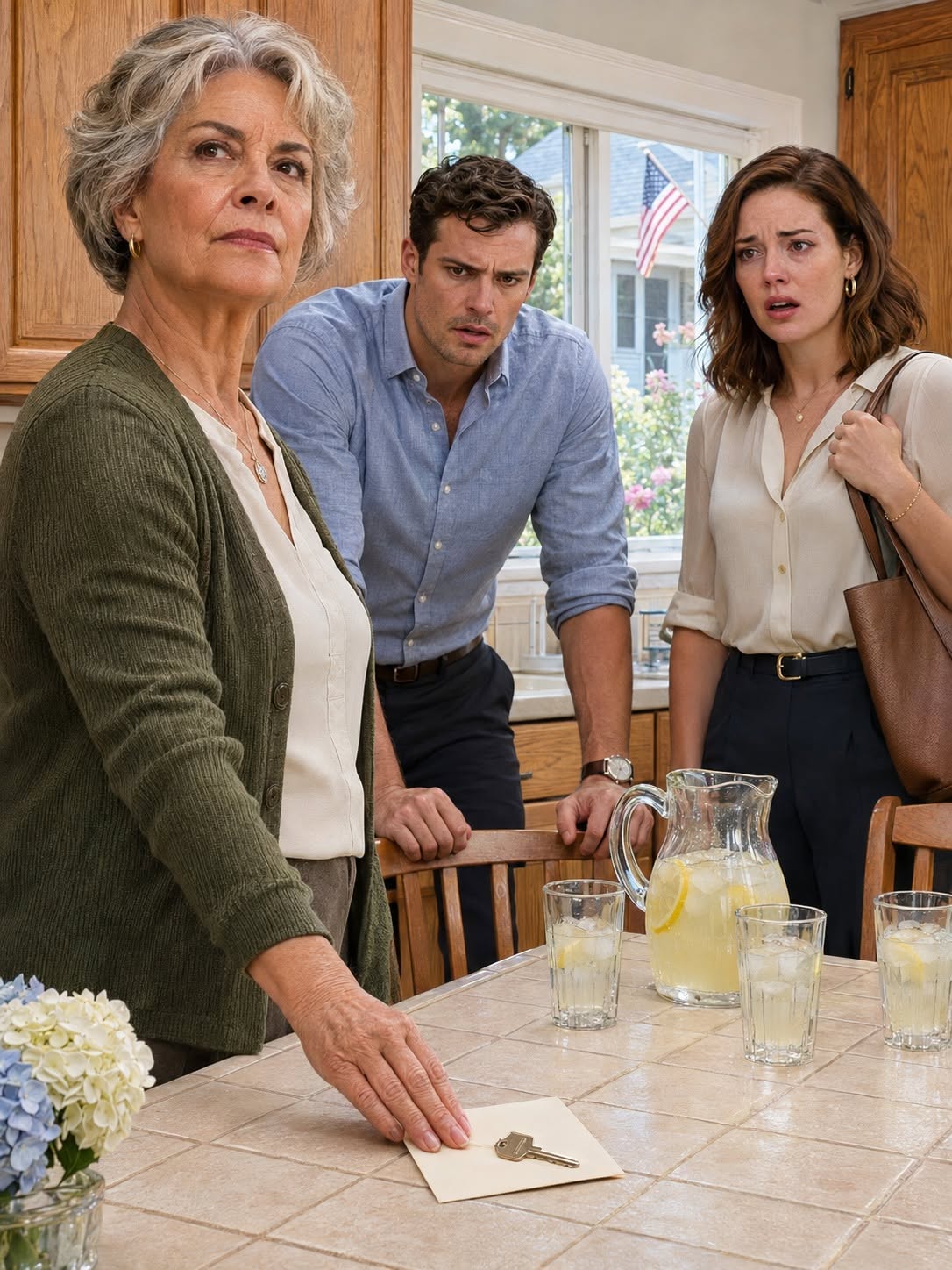
My daughter looked me straight in the eye across my own kitchen table and said, “Mom, we’re getting power of attorney. We’ve already put a deposit on your room.”
I was 63 years old. I had just finished my second cup of coffee. And I remember thinking very clearly that I had never once in my life been so calm.
My name is Wanda Peters. I spent 31 years as a clerk of court in Kent County, Michigan, which means I spent three decades watching families fight over money, houses, and who gets to decide what for whom.
I retired with a pension, a paid-off house in Grand Rapids, and a savings account built one careful paycheck at a time. My husband Dale died when our daughter was 11. After that, it was the two of us, and I made sure she never went without.
I’m telling you all this so you understand that I did not see it coming because I’m foolish. I didn’t see it coming because I’m her mother.
Before I go on, tell me your city in the comments. I love seeing how far these stories travel.
It started the night before. Shelby texted me, “Garrett and I want to come over tomorrow for a family discussion.”
A family discussion. We had never held one of those. We just talked over the phone, in the car, standing
at the sink with our hands in the dishwasher.
But I wrote back, “Come at 11. I’ll make coffee.”
And I put a coffee cake in the oven like a fool. They showed up dressed for church, which was my first
clue.
Shelby sat at the table with her hands folded in her lap like a girl called to the principal’s office.
Garrett wet, my son-in-law, stood by the window with his arms crossed, looking out at my backyard the
way a man looks at something he’s already priced.
He’s 31, a loan officer at a credit union, and he has a way of talking that makes you feel like you’re being walked through a refinancing package.
I’ve had that kitchen for 30 years. Cream tile countertops I picked out myself while everyone told me they’d go out of style. They never did. Not for me.
I poured three cups and sat down.
“Mom,” Shelby said, studying the grain of the table. “We think it’s time to start making some changes.”
“What kind of changes?”
Garrett turned around.
“We found a really lovely senior living community out in Walker. Independent living, dining room, activities. The brochure is honestly beautiful.”
“You have a brochure?”
Shelby slid it out of her purse. Glossy paper, silver-haired people laughing over salads. A woman in a cardigan painting a watercolor.
I didn’t touch it.
“We went ahead and put down a deposit,” Shelby said so quietly I almost missed it, “to hold a room. You can tour it this week.”
I looked at my daughter, the little girl I’d driven to a hundred swim meets. The teenager I’d sat up with
through mono and two heartbreaks and one totaled Corolla.
The grown woman I’d loaned $11,000 to for her wedding and never brought up again.
She wouldn’t lift her eyes.
“You put a deposit on a room for me,” I said, “without asking me.”
“We didn’t want to upset you before everything was arranged,” Garrett said, as if that explained anything. “And honestly, the timing works out. You move there, we move here, and take over the house.”
“It’s paid off, so the carrying costs would be next to nothing. You’d never have to shovel again.”
There it was. The house. The shoveling.
They had wrapped my home in the language of convenience and called it love.
That was when Shelby said it.
“And we’re getting power of attorney, Mom. Garrett already has the forms. It just makes everything smoother.”
I didn’t raise my voice. 31 years of watching people shout in courtrooms taught me that the loudest person in the room is usually the one who hasn’t made a plan yet.
I had one. It was already forming, quiet and quick, like a key finding a lock in the dark.
“Let me think about it,” I said.
Shelby let out a breath she’d been holding for 10 minutes. Garrett actually smiled.
They thought “Let me think about it” meant yes.
They had no idea what I was thinking about.
The next morning, I drove 20 minutes in the opposite direction from my usual bank and opened new checking and savings accounts at a branch I’d never set foot in.
By lunch, I’d moved most of my liquid money into them.
On the way home, I stopped at a hardware store and had a locksmith come out that afternoon to re-key every lock on my house.
I told him I’d misplaced my keys. He didn’t ask a single question, and I tipped him accordingly.
Two days later, I came home from the pharmacy and found Shelby’s car in my driveway.
She had tried to let herself in the back door with the emergency key I’d given her 3 years before. Except
that wasn’t possible, was it? I’d had the locks changed.
So, I walked around the side of the house and found my kitchen window propped open and my daughter standing on a step stool outside it. One leg already over the sill.
I want to be fair to her, so I’ll say it plainly.
It was ridiculous. A 34-year-old woman with a master’s degree climbing into her mother’s house like a teenager sneaking out.
“Shelby!”
She froze. Then she laughed. High and awful.
“Mom, I was just… The key wasn’t working, and I was worried you didn’t answer your phone.”
“I was at the pharmacy.”
“Garrett thought it would be good to get the deed and the tax records and the account information. Just so we can plan.”
“There is nothing in my office for you,” I said. “Next time, call, and if I don’t answer, wait.”
She climbed down. Her face went through embarrassment and landed on irritation.
“We’re trying to help you.”
“I know that’s what you tell yourselves,” I said, and walked her to her car.
That night, Garrett called.
No hello.
“Wanda, we need to talk about the accounts. Shelby says you’re being uncooperative, and frankly, at
your stage of life, you really should be letting family look at these things.”
“Garrett, I’m 63, not 93. I have a pension, two retirement accounts, and a house I own outright. My stage of life is fine.”
“We’re just trying to protect the family assets.”
“They’re not the family’s assets,” I said. “They’re mine. I earned every dollar of them, and they sit in accounts with my name on them. Is there anything else?”
A long pause.
“We’ll discuss it Sunday.”
“I won’t be home Sunday,” I said, and hung up.
I slept fine that night, which surprised me.
My mind was busy in the old way, the way it used to be on the Friday before a big docket. Sorting, sequencing, moving pieces.
I was good at that. I’d just never done it for myself.
I took 3 days to think. I knew I didn’t want a regular listing.
A sign in the yard, open houses, strangers walking through my bedroom, and Shelby driving by every afternoon to see who was parked in front.
I needed something fast and quiet.
A neighbor of mine, Ruth, had sold to a home-buying company after her husband died, and she gave me the name of the woman who handled it.
Her name was Paula Jenkins.
Paula came on a Wednesday with a clipboard and a measuring tape. She walked every room, said very little, and made me an offer before she reached the front walk.
It was below market, and I knew it would be, but it was cash. It would close in 13 days.
There would be no inspectors, no appraisers, and no daughter hovering in my hallway trying to listen
through the wall.
I said yes.
Then I called an attorney I trusted, a woman named Christine, who’d practiced in my courtroom for years,
and I asked her to look over every page before I signed.
She read the contract, raised an eyebrow at the price, and said, “It’s your house, Wanda, and it’s your call.”
I’ve never been so grateful for eight words.
The next two weeks were the strangest of my life.
Every morning, I made coffee and moved through the house like I was simply living in it. Every afternoon,
I packed.
The front room stayed exactly as they were.
The back bedroom, the hall closet, the shelves in the garage. Those I emptied a little at a time, box by
box, into a storage unit I’d rented across town under my own name in a neighborhood Shelby had no reason to ever visit.
I took Dale’s woodworking tools because he left them to me and they were mine.
I took all 26 photo albums, which weighed more than I’d have guessed.
I took the quilt my mother stitched from scraps of my childhood dresses and the little oil painting of
Lake Michigan at dusk that had hung over the fireplace in every home I’d ever had.
I left the furniture. I left the curtains, which I’d never loved.
I left the dining room set Shelby had always admired a little too hungrily.
One afternoon, she came by unannounced, and this time she rang the bell like a stranger.
I let her in.
She walked through the kitchen, scanning the counters and the walls, taking inventory without looking
like she was taking inventory.
“You look tired, Mom.”
“I slept 8 hours.”
“Have you thought any more about Walker?”
She held up her phone and swiped through pictures. A dining room with white tablecloths, a courtyard, a south-facing window.
“The room we put the deposit on gets wonderful light.”
“What happens to the deposit if I don’t go?”
“We’d lose it. But that’s not the point.”
“How much was it?”
She hesitated.
“1,200.”
I nodded and went to my purse. I wrote a check for $1,200, tore it out, and set it by her cup.
“I don’t want you out of pocket for a decision I never asked you to make.”
She stared at it.
“That’s not what this is about.”
“It’s part of what it’s about,” I said.
She looked at me for a long moment, trying to read me.
I gave her nothing.
Then quietly, like she knew how it sounded, she said, “Garrett really thinks we should do the power of attorney soon.”
“No, Mom. No, Shelby. I’m not signing away legal authority over my own life because it would make your planning easier.”
She stood up, trying to hold her face together.
“We’re worried about you.”
“I know,” I said, and I did.
Some of it was real. Any child worries when a parent gets older.
But the part of her that toured a facility behind my back, that sent her husband to look at my accounts, that climbed through my window, that part wasn’t worry.
That part was acquisition wearing the costume of concern.
She left with the check folded in her fist. And I watched her car sit at the curb for a long while before it pulled away.
5 days before closing, I found the place.
I’d spent my evenings scrolling listings across a dozen states, crossing off everything too remote, too crowded, too expensive, or too far from a decent hospital.
I settled on Chattanooga, Tennessee, nearly 700 miles south of Grand Rapids.
A ground-floor garden apartment in a quiet complex, two bedrooms, a screened porch looking out on a hillside of hickories and tulip poplars.
The landlord was a retired high school band director named Mr. Willis, who’d bought the unit decades
ago and wanted renters who were quiet and stable.
I called him on a Thursday. I told him I was a retired court clerk, a widow of many years looking for a calm place to land.
I offered 4 months’ rent upfront.
He emailed the lease before noon.
The closing was on a Tuesday. I signed in Paula’s office, watched the wire come through to the new account, shook her hand, and drove home for the last time.
That evening, Shelby called to confirm Sunday dinner.
I told her to come Friday instead.
Something in my voice must have sounded different because she didn’t push.
They arrived at 6:00. Shelby clutching a tote bag. Garrett wearing the easy confidence of a man who believes the paperwork is basically done.
I’d set out a pitcher of lemonade and nothing else.
The kitchen was mostly bare by then, though I’d left enough on the shelves to look lived in.
We sat at the same table where all of this had started.
Garrett got to it fast, as he always does.
“We need to talk next steps. Walker needs an answer by the end of the month, and we’d like to get a real estate attorney in to handle the transition.”
“The transition?” I said. “Mean you moving into my house?”
“Well, yes, since you’d be at the community.”
“I’m not going to the community.”
Shelby leaned forward.
“Mom…”
“And I won’t be here Sunday or next week or the week after.”
I took a small envelope from my cardigan pocket and set it on the table.
“That’s the new front door key for the buyers. Everything else is already handled.”
Garrett looked at the envelope, then at me.
“What does that mean?”
“The house sold Tuesday. The new owners take possession Monday morning. The money has cleared. I’m leaving this weekend.”
I’ve sat through verdicts in rooms with 200 people holding their breath.
That kitchen was quieter.
Shelby’s face crossed about six expressions in 4 seconds.
“You sold it, Mom? You can’t just… We were planning.”
“I know you were planning. I wasn’t invited to any of it.”
Garrett was on his feet, and under all that polish, I saw real panic.
“Where are you going? You have to tell us where you’re going.”
“I don’t, actually. I’m 63. I don’t owe anyone my itinerary.”
“This is insane,” he said, voice climbing. “You sold the house. Our house.”
“Your house,” I repeated. “Garrett, listen to what you just said.”
He closed his mouth.
Shelby was crying now quietly, the way she cried at 6 when she’d broken something and didn’t know how to unbreak it.
Part of me wanted to reach across the table and take her hand. The other part knew that if I did, I’d erase every line I just drawn.
“I love you,” I told her.
And I meant it with everything I had.
“And because I love you, I’m not going to let you turn me into a problem you solved. I’m not a problem.
I’m your mother. Those are different things.”
She pressed her fingers to her lips.
“I’ll call when I’m settled. I want us to talk, but I won’t give you my address. I won’t give you or Garrett
access to my money, and I won’t sign anything that hands my decisions to anyone else. Those are the terms.”
I looked at Garrett.
“For both of you.”
I picked up my purse.
“Help yourselves to the lemonade. The front door knob is already set to lock when you pull it shut
behind you, so leave that key envelope on the table. The new owners will want it.”
I walked out of my kitchen for the last time, down the hall past the pencil marks on the door frame where I’d measured Shelby every birthday from 4 to 12, and out into the cool October evening.
My car was in the driveway. It had been packed since that morning.
I drove two days, stopping the first night at a plain, clean motel outside Louisville, eating pot roast alone at a counter where no one knew my name, and sleeping better than I had in a year.
When I crossed into Tennessee, I rolled the window down.
The air smelled of leaf smoke and wet earth and something sweet I couldn’t place.
The apartment was exactly what the photos promised. Quiet, modest, mine.
On the kitchen counter, Mr. Willis had left a small potted paos and a note that said, “Welcome. Call if anything needs fixing.”
I stood in that empty living room holding the note and felt a lightness I hadn’t known since before Dale got sick.
I unpacked slowly.
The Lake Michigan painting went above the little electric fireplace.
Mother’s quilt went over the arm of the sofa where I could see it from anywhere.
Dale’s tools went in a low cabinet in the spare bedroom with the door left open so I could glance at
them while I read.
On my first morning, I walked to a farmers market a few blocks away and came home with sweet potatoes, a jar of sorghum, and a bundle of dried sage.
I made soup. I ate it on the porch while two squirrels argued over an acorn.
Then the phone started.
First it was Garrett.
Nine voicemails in 3 days.
The first few were reasonable. By the fifth, he was calling me selfish. By the ninth, he was talking about legal options.
I forwarded every one of them to Christine, and she called me that evening sounding almost cheerful.
“Wanda, he can talk about legal options all he wants. You’re a competent adult. There’s nothing to petition. But I’d like you to save every message.”
I did.
What I didn’t know yet was that Garrett had made things worse for himself long before that.
It came out 2 weeks after I moved when a woman named Sharon Barnes called from the credit union
where Garrett worked.
I’d had an old savings account there for years, a small one, mostly dormant, and I’d never thought twice about it.
Sharon was in compliance. She was very polite and very careful, and she asked whether I had authorized anyone to view my account history in the past 2 months.
“No,” I said. “Why?”
“Our system shows a colleague accessed your records on four separate dates. Three of them were before you sold your property. We have no authorization on file, and there’s no business reason for the access.”
I sat down on the porch step.
“Is his name Garrett?”
“I can’t discuss personnel matters, Mrs. Peters, but I do need to document that you did not consent.”
“I did not consent,” I said. “And I’ll put that in writing. Every word.”
I did.
I gave her the voicemails, the dates, and a statement from Christine.
I didn’t do it out of spite.
I spent 31 years in a courthouse learning that rules exist for a reason, and a man who handles other people’s money should know better than to peek into his mother-in-law’s.
It was Sharon who told me the fourth date.
It was earlier that week, on Tuesday, after I’d moved and updated the mailing address on that old account so my statements would follow me.
I hadn’t thought about it.
He had seen it.
He was on my porch 2 days later.
I heard the car first, then the footsteps on the walkway, then a knock that was far too hard for a Saturday
morning.
I looked through the screen.
Garrett stood there in a wrinkled jacket, unshaven, with the look of a man who hadn’t slept in a bed in
days.
I did not open the screen door.
I put my phone on speaker, set it on the porch rail, and said, “Christine, he’s here.”
“Good morning, Garrett,” Christine said from 700 miles away. “I’d like you to know this call is being recorded.”
He stared at the phone, then at me.
“Wanda, you can’t just disappear on us. Shelby is a wreck.”
“Shelby doesn’t know you’re here, does she?”
His jaw moved.
“That’s not the point.”
“How did you find me?”
He didn’t answer fast enough, and I watched him decide whether to lie.
“The address was on file,” he said finally. “I’m family. I was concerned.”
“You were fired for looking at that file,” I said.
The color left his face slowly, like water draining from a tub.
“They told you that?”
“They told me you’ve been terminated,” Christine said evenly. “And I can tell you that the credit union
has filed a report with the state regulator and the National Credit Union Administration.”
“Unauthorized access to a member’s account is not a workplace misunderstanding, Garrett. It’s a violation of federal privacy law, and the credit union has what it needs to refer it further. Mrs. Peters has
given a full statement. She has not yet decided whether to pursue anything of her own.”
“Wanda.”
His voice cracked on my name.
“Wanda, come on. I have a mortgage application with another lender. I can’t have a report on my file. I’ll never work in lending again.”
“You looked at my accounts three times to plan how to take my house,” I said. “And then you looked a fourth time to find me. You can’t be surprised that this is what that costs.”
“We were trying to help you.”
“No,” I said quietly. “You were trying to manage me. There’s a difference, and you know it because you made a career out of explaining the difference to strangers.”
He opened his mouth, and nothing came out.
For the first time since I’d known him, Garrett had no refinancing package to walk me through.
Mr. Willis had been watering his chrysanthemum planters across the lot.
He wandered over now, a tall, stooped man with a garden hose still in his hand, and stopped at the foot
of my steps.
“Everything all right, Mrs. Peters?”
“This gentleman was just leaving,” I said.
“Is that so?”
Mr. Willis looked Garrett up and down in the patient way he’d probably looked at a thousand teenage trombonists who’d skipped practice.
“This is private property, son. Residence only. If you come back, I’ll call the sheriff, and I’ve already got the number memorized.”
Garrett looked at me one last time, searching for the woman at the kitchen table who’d said she would
think about it.
She was gone.
She had been gone for 6 weeks.
He walked to his car. He sat in it for a long time before he drove away.
The rest unraveled the way those things do.
They had already given notice on their apartment, and the landlord wouldn’t take it back.
They spent two weeks on Garrett’s sister’s pullout couch.
The mortgage application died as he’d feared.
The regulator’s letter arrived in December, and the ban on working for any federally insured financial
institution came with it.
Christine mailed me a copy.
I filed it without opening it a second time.
Shelby had called me the night Garrett got back from Tennessee.
I let it ring twice before I picked up.
“Mom.”
Her voice was thin and scraped out.
“He told me where he went. I’m so sorry.”
“I know.”
“I need to tell you something. I knew he was looking at your account. I didn’t know how often, but I knew. I told myself it was fine because it was for your own good.”
I didn’t say anything.
I let her sit in it.
“It wasn’t fine,” she said. “I think I let him talk me into treating you like you were already gone.”
“Yes,” I said. “You did.”
“I don’t want to lose you.”
Her voice cracked on the last word.
“You haven’t lost me. You’ve lost access to things that were never yours. That’s a different thing.”
A hickory leaf drifted down onto the porch rail.
“I love you, Shelby. I want a relationship with you. But it has to be a real one, not one where I’m a piece on a board.”
“Okay,” she whispered. “Okay, Mom.”
“One more thing. If you stay with Garrett, that’s your business. But I won’t be speaking to him. Not now, and maybe not ever. That isn’t a punishment. It’s just what’s true.”
“I understand.”
And I think for the first time, she did.
A week later, an envelope came, forwarded from my old address.
Inside was the $1,200 check I’d written, torn neatly in half, and a note in Shelby’s handwriting.
“I never should have let you pay for my mistake. I’ll earn the deposit back myself, not from you, from me.”
She came to visit in March alone.
I gave her my address then because she’d earned it and because I’d watched her for 4 months make the harder choices.
She’d left Garrett’s sister’s couch, taken a part-time job, and was renting a small apartment across the river by herself.
Garrett was driving for a freight company and living separately.
And whether they would find their way back to each other was theirs to decide, not mine.
I made her sweet potato soup.
We ate on the porch under the hickories with mother’s quilt across our knees, and she told me she’d
been seeing a counselor.
She told me she’d taken the brochure from Walker out of her purse one day and thrown it in the trash,
and that it felt like the first honest thing she’d done in a year.
I didn’t tell her Garrett had left a second copy on my kitchen table and that I’d kept it in the bottom
drawer of my desk.
A reminder not of what they tried to take, but of what I refused to give.
The two most valuable things I carried out of that house didn’t fit in any box.
They were the knowledge of what I was worth and the willingness to act on it.
That afternoon, after Shelby’s car pulled out of the lot and the porch went still again, I rinsed our bowls, hung the dish towel on its hook, and sat down with a pencil to plan my week.
If you were in my shoes, would you have let Shelby back in, or would you have closed the door for good?
Related Post

I Lost One of My Twins During Childbirth — but One Day My Son Saw a Boy Who Looked Exactly Like Him
I believed I’d buried one of my twin sons the day they were born. Five [...]
My Husband Insisted on Sleeping in a Separate Hotel Room on Our 20th Anniversary Trip – I Cried When I Learned the Real Reason
PART 1 Five months after finishing chemotherapy, I surprised my husband with a weekend at [...]

At his grand promotion party, my husband publicly humiliated me, sneering, ‘You’ve lived off me for two years. Besides cooking, you’re useless.’
At his lavish promotion celebration, my husband publicly degraded me, sneering, ‘You’ve lived off me [...]