
The Gray Pup in the Ditch Grew Into an Animal My Home Couldn’t Hold
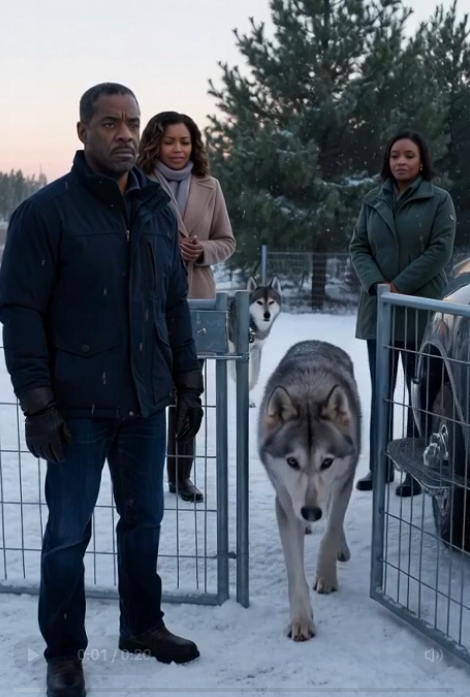
The sound reached me through the floor of the truck before I understood it was alive. I had slowed for a curve on Bridger Canyon Road, where wind had pushed loose snow across the pavement in pale ribbons. The January sun hung bright over the mountains, but the thermometer on my dashboard read eight degrees. Nothing should have been moving in the roadside ditch except powder and dead grass.
The Gray Pup in the Ditch Grew Into an Animal My Home Couldn’t Hold
Then I heard it again.
It was not a bark or even a whine. It was one thin note, broken in the middle, as though whatever made it had run out of strength before it ran out of fear.
I pulled onto the shoulder and left the engine running. Snow came over the top of my boots when I climbed down the bank, and for several seconds I saw nothing but cattails, frozen mud, and a black plastic shape caught against a fence post.
The plastic shape lifted its head.
“Easy,” I said, though I was the one slipping down the slope. “I see you.”
The animal was small enough to fit beneath one arm. Its coat was charcoal gray, stiff with ice, and its legs looked too long for the rest of it. One front paw was buried under crusted snow. Around its neck was a length of orange braided cord, the kind used on construction sites, cut off six inches from a crude knot.
It did not try to escape when I reached for it.
That frightened me more than teeth would have.
I had spent four years volunteering at the Bridger Valley Animal Center. I knew the difference between a frightened puppy holding still and an animal whose body had begun shutting down. This one’s gums were pale. Its breaths came so slowly that I lost count between them.
I called Erin Walsh at the shelter with one hand while I worked the cord loose with the other.
“You’re on speaker,” I told her. “I’ve got a puppy, maybe eight or nine weeks. Severe cold exposure. Barely responsive.”
“Don’t take him home,” Erin said immediately. “Elena’s at the emergency clinic. I’m calling ahead.”
“I know.”
“Warm him gradually. Nothing hot against the skin.”
“I know, Erin.”
“I’m saying it because you sound like you’re about to do something heroic and stupid.”
That was also fair.
I wrapped the puppy in the insulated blanket from behind my seat and held him against my chest while I climbed back to the truck. His body had the terrible heaviness of something no longer helping to carry its own weight.
Just before I closed the door, he drew in a shallow breath and made that sound again.
This time it stretched into a faint, uneven note.
Not a howl exactly. More like the memory of one.
Dr. Elena Ruiz met me at the side entrance of Gallatin Emergency Veterinary Clinic. She took one look at the bundle in my arms and waved us past the front desk.
Within minutes, the puppy was on a warming pad beneath layers of towels. A technician placed an IV catheter while Elena listened to his heart and called out numbers I tried not to interpret.
“How bad?” I asked.
“Bad enough that I don’t want to make promises.”
His temperature was too low for the first thermometer to register. The staff warmed him slowly, checked his blood sugar, treated the dehydration, and examined the frost damage on his ears and pads. I sat on the floor outside the treatment area because every chair felt too far away.
At some point Erin arrived with coffee. She handed me a cup and sat beside me without asking whether I wanted company.
“You were coming from the shelter?” she asked.
“Yeah.”
“So he picked the one truck on that road with blankets, gloves, and a man who can’t pass an injured animal.”
“He didn’t pick anything.”
“I know.”
I turned the orange cord over in my hands. One end had been sliced cleanly. The knot was too tight to have slipped over his head, and there was a raw band beneath the fur where it had rubbed his skin.
“He was tied,” I said.
Erin studied it. “Maybe.”
“Animals don’t tie themselves to fence posts.”
“We don’t know that he was tied there. Keep the cord. Don’t build the whole story before he survives the first chapter.”
That was something my wife, Laura, used to tell me.
She had been gone four years, but people still occasionally spoke in her sentences without knowing it. Erin had worked beside her at the shelter long before I started volunteering. After Laura died, I took over her Saturday morning shift because it was easier than sitting in the house while sunlight moved across rooms she had chosen the paint for.
I stayed at the clinic through the night.
Shortly after 3:00 a.m., Elena came into the waiting room with her stethoscope hanging around her neck.
“He’s warmer,” she said. “His blood pressure is improving, and he swallowed a little recovery formula. We’re not clear yet, but those are good signs.”
I stood so quickly that coffee spilled across my jeans.
“Can I see him?”
“For a minute.”
He looked even smaller inside the kennel. His eyes were open now—gray-brown, watchful, no longer empty. When I crouched, one ear shifted toward me.
“Hey,” I whispered. “You stayed.”
His nose moved once against the towel.
That was all. It was enough.
He remained at the clinic for two days. No microchip surfaced. Nobody responded to the shelter’s found-animal notice, and no missing-puppy report matched him. Elena estimated that he was between eight and ten weeks old, underweight but otherwise free of congenital problems she could detect.
“Shepherd mix?” I asked.
“Probably.”
“Probably?”
Elena smiled. “At this age, half the puppies in Montana look like shepherd mixes.”
She turned him sideways on the exam table. His narrow ribs showed beneath the gray fur, but he was standing now, unsteady and offended by the slippery surface.
“He has a long muzzle,” she said. “Big feet. Could have malamute, husky, shepherd—any number of things. Let him grow before you write his résumé.”
The puppy stared at the closed exam-room door rather than at either of us.
“He needs a foster placement,” Erin said.
Elena looked at me.
I looked at the puppy.
“You both planned this conversation before I got here.”
“We discussed possibilities,” Erin said.
“You put my name on the form, didn’t you?”
“I brought the form.”
The puppy finally turned his head. When I offered my fingers, he did not lick them or wag his tail. He leaned forward, breathed in once, and rested his chin against my knuckles.
I signed.
I called him Flint because of the moment his eyes opened in the clinic. There had been nothing dramatic in it—just a small spark returning where I had been afraid there would be none.
For the first week, he slept beside the back door on Laura’s old camping quilt. I moved the quilt twice, thinking the draft would bother him. Twice he dragged it back.
He ate carefully and disliked bowls that slid across the floor. He did not chase balls. Squeaky toys made him leave the room, but he could spend fifteen minutes dismantling a cardboard box with the concentration of a surgeon.
Most foster puppies wanted constant contact after a bad beginning. Flint wanted to know where I was, but he did not always want me close. He followed me from room to room and settled at a distance, usually in a place where he could see both the windows and the nearest exit.
At night, he woke at sounds I could not hear.
I would find him standing in the dark kitchen with his nose lifted toward the gap beneath the back door. When I spoke, his ears turned toward me, but the rest of him remained aimed at whatever was moving beyond the house.
Hannah first saw him over a video call.
My daughter lived in Spokane and taught eighth-grade science. We spoke every Sunday, though our conversations had become careful after Laura died. We discussed weather, work, and whether I had changed the furnace filter. We rarely discussed anything that could hurt us.
“You’re keeping him,” she said when Flint’s head appeared beside my chair.
“I’m fostering him.”
“That’s what you said about the beagle.”
“The beagle was adopted.”
“After you rejected three perfectly good families.”
“One had an unfenced yard.”
“One had a six-foot fence.”
“Next to a highway.”
Hannah laughed, but it faded when Flint looked directly into the phone. “He’s beautiful.”
“He’s strange.”
“All puppies are strange.”
“Not like this.”
She watched him for a moment. “Maybe don’t make strange sound like a problem.”
“I didn’t.”
“You did a little.”
By March, Flint had doubled in size. By April, he weighed more than most dogs twice his age. His chest remained narrow, but muscle moved beneath his coat when he walked. His paws did not slap clumsily against the floor. He placed them with unsettling precision.
He learned commands when they benefited him. He came reliably inside the house, less reliably outside. He could open the lever handle on the laundry-room door and once removed every item from my refrigerator’s bottom shelf without disturbing the carton of eggs above it.
He never barked when the mail carrier came. He watched.
He rarely wagged his tail in the loose, careless way I expected from a domestic puppy. When he was pleased, the change was smaller: his mouth softened, his ears eased sideways, and he pressed one shoulder against my leg before moving away.
The first time I tried to trim his nails, he panicked.
There was no warning growl and no deliberate attack. I touched the clipper to one front paw, and his body went rigid. A second later he twisted free with enough force to knock me backward into a cabinet.
His claws caught my forearm as he scrambled away. Three red lines appeared through my skin.
Flint retreated beneath the kitchen table, breathing fast. I stayed on the floor and set the clippers behind me.
“It’s all right,” I said. “I’m not coming after you.”
He watched me for nearly twenty minutes before crawling out. When he finally approached, he touched his nose to the scratches on my arm and flinched at the smell of blood.
The incident was not severe. That was what made it useful.
Flint had not meant to hurt me. He had only wanted to escape, and I had been as easy to move as a chair.
At his next appointment, Elena watched him pace the exam room. He did not sniff the cabinets or solicit attention from the technician. He traced the walls, tested the lower edge of the door with his nose, then settled in the only corner that gave him a clear view of both exits.
“How old now?” Elena asked.
“About six months.”
“And sixty-four pounds.”
“He’s eating the amount you recommended.”
“I’m not worried about his weight.”
She crouched without moving toward him. Flint looked at her, looked at the door, and looked back.
“There’s a behavioral consultant I want you to meet,” she said. “Dr. Lena Park. She works with captive canids and difficult hybrid cases.”
“You think he’s part wolf.”
“I think guessing from his face would be irresponsible. I also think pretending he’s an ordinary shepherd mix could become irresponsible.”
Dr. Park came to the clinic three days later.
She did not try to pet Flint. She entered sideways, placed her bag on the floor, and sat without looking directly at him. For twenty minutes she watched him watch her.
She asked about his sleep, appetite, fear responses, play, containment, and the way he reacted to unfamiliar people. She wanted to know whether he guarded food, whether he dug, whether he paced, whether he became more anxious when doors were closed.
Then she asked exactly where I had found him.
I showed her the location on my phone and gave her the orange cord, which I had sealed in a plastic bag after Erin suggested it might matter.
“People breed wolf-dog crosses and sell them as exotic pets,” Dr. Park said. “People also mislabel ordinary dogs because the word wolf raises the price. His appearance alone proves nothing.”
“What would prove it?”
“A laboratory can test for recent wolf ancestry. It won’t hand us a magical percentage or tell us his entire family tree. But it may tell us whether a wolf entered his lineage within the last few generations.”
Flint approached while she prepared the sample kit. He sniffed the unopened swab packet, then rested against my shin as she collected cells from inside his cheek.
“And if the test finds it?” I asked.
“Then both words in wolf-dog matter. He may form attachments to people, but that doesn’t make his needs identical to a pet dog’s.”
My phone vibrated while I was walking Flint across the clinic parking lot.
It was a message from Erin.
The first image showed a metal kennel at the shelter. Inside it crouched a young gray female with long legs, a narrow face, and eyes that seemed much too old. The second image was a close-up of her neck. An orange braided cord had cut a raw line through the fur. Beneath the photographs, Erin had written five words. Caleb, where exactly was Flint found?…
To read the rest of the story – CLICK the NEXT button 👇👇👇
Part 2
I enlarged the second photograph until the cord filled my screen.
The fibers were orange with a black thread woven through them. Near the knot was a small brass crimp, flattened on one side. It matched the cord I had carried into Dr. Park’s office so closely that I could picture both lengths being cut from the same spool.
“Stay here,” I told Flint, opening the truck door.
He climbed into the back seat but did not lie down. His nose remained close to the crack in the window as I called Erin.
“Where is she?”
“Treatment room two. A county road crew found her in a culvert south of Four Corners.”
“How old?”
“Elena thinks five to seven months.”
“That’s Flint’s age.”
“I know.”
“Is she hurt?”
“Dehydrated, underweight, old injury to one hind leg. She’s terrified of hands.”
I looked back at Flint. He was standing rigidly now, scenting the air that came through the vent.
“I’m coming.”
“You can come. He can’t meet her.”
“I know.”
“Caleb.”
“I said I know.”
At the shelter, Erin took me through the staff corridor rather than the public kennels. The female had been moved into a quiet room with blankets covering three sides of her enclosure. She stayed pressed against the rear wall, but her eyes followed us.
Flint was darker and broader through the shoulders. The female had a pale patch beneath her chin and a white streak on one front toe. Otherwise, the resemblance was difficult to dismiss.
Elena showed me the abrasion around her neck. “The cord wasn’t attached when they found her, but it was tight enough to leave this. She may have chewed through the loose end or pulled free.”
“Could they be littermates?”
“They could also be unrelated animals from the same breeder. We’ll compare samples if the county authorizes it.”
Erin had begun calling the female Juniper because the road crew found her beside a stand of the shrubs. The name was less important than having something gentler to call her than case number 26-014.
I carried one of Flint’s blankets into the room and left it several feet from the kennel. Juniper waited until we stepped back before stretching her neck toward it.
She smelled the fabric for a long time.
Then she made a soft sound deep in her throat.
From the parking lot came an answering note.
Flint had heard her through two walls and a closed truck.
Erin and I looked at each other, but neither of us turned the moment into proof. Littermates were not guaranteed to recognize each other after separation, and frightened animals made sounds for many reasons.
Still, when I returned to the truck, Flint smelled every inch of my coat. He pressed his muzzle against the sleeve that had brushed Juniper’s blanket and stood that way until I gently moved my arm.
The shelter published a carefully worded notice that afternoon. It described Juniper as a found juvenile canine and included only one photograph. There was no mention of Flint, wolves, hybrids, or genetic testing.
The call came the next morning from a woman named Tessa Cole.
She asked to speak with Erin privately and then drove to the shelter carrying a folder of printed screenshots. I was not part of the official investigation, but Erin asked whether I would identify Flint in one of the images.
Seven puppies stood inside a livestock panel enclosure. Some were tan, some silver, and two were dark gray. Each wore a different length of colored cord around its neck.
The gray male had one ear folded sideways and a lighter patch above his left eye. Flint had lost the patch as his adult coat came in, but I remembered it from the clinic.
The female beside him had a white front toe.
The advertisement read:
Timber wolf shepherd pups. Raised outdoors. Serious buyers only. Cash. No papers.
The seller had claimed that the puppies were “high content,” though Dr. Park later told us that such claims were often invented or based on unreliable family stories. Tessa had answered the ad because her brother wanted a wolf-looking dog.
She drove to the property, saw two adult animals pacing inside small dirt pens, and left without buying one.
“I should’ve reported it,” she said.
“You didn’t know they were being neglected,” Erin told her.
“I knew something felt wrong.”
That sentence stayed with me. Most people imagined that wrongdoing announced itself clearly. In reality, it often arrived as discomfort that was easier to explain away than act upon.
Animal Control Officer Ben Harlow took the screenshots and Tessa’s statement. The seller, Darren Pike, no longer lived at the listed address. The property owner said Pike had left after falling behind on rent and had taken the adult animals with him.
“What about the puppies?” I asked.
Ben closed his notebook. “We don’t know.”
The final screenshot was time-stamped 10:14 a.m. on the day I found Flint. It showed only the two gray puppies, sitting against the far side of the pen. The caption beneath them contained four words. Last two leave today…
To read the rest of the story – CLICK the NEXT button 👇👇👇
Part 3
Ben warned me not to conduct my own investigation.
He repeated the warning after Erin told him I had driven past Darren Pike’s former rental property. I had not entered the land or spoken to the owner. I had merely slowed on the county road and stared at an empty yard where seven puppies had once been photographed.
The pens were gone. Two circles of bare earth remained beneath the snow.
“There’s nothing there for you to fix,” Ben said.
“I wasn’t trying to fix anything.”
He gave me a look that suggested my reputation had reached beyond the shelter.
While the county searched for Pike, Flint continued growing.
At seven months, he could rest his chin on the kitchen counter without lifting his paws. I replaced the backyard gate latch after he learned to open it, then added a second latch when he learned that one too. He began digging shallow depressions beside the fence, not to bury toys but to lie with his body pressed against the cool soil.
He tolerated two people entering the house: Erin and Hannah.
My daughter arrived on a Friday evening carrying a backpack and the expression she used when she had already decided I was hiding something.
“You said he scratched you,” she told me.
“He did.”
“You didn’t say he was the size of a small horse.”
Flint stood ten feet away, evaluating her. Hannah turned slightly and avoided leaning over him.
“You’ve been reading,” I said.
“I teach science. Occasionally I use the internet.”
She placed a piece of chicken on the floor and stepped back. Flint waited until she moved into the kitchen before taking it.
“He doesn’t seem aggressive,” she said.
“He isn’t.”
“That isn’t the same as predictable.”
I disliked hearing Dr. Park’s reasoning in my daughter’s voice.
The genetic report arrived the following week.
Elena asked me to come to the clinic rather than discussing it by phone. Hannah came with me, though I had not invited her. Flint settled beneath my chair while Dr. Park placed a three-page report on the table.
“The laboratory detected recent gray-wolf ancestry,” she said. “The pattern is consistent with a wolf entering his lineage within the last few generations.”
“So the advertisement was true.”
“The advertisement made an exact percentage claim that we cannot verify. Neither can this test. Based on his physical development, behavior, and the breeding history, I would manage him as a high-content wolf-dog.”
Hannah read the report. “What does manage him mean?”
“Secure containment designed for climbing and digging. Controlled introductions. No dog parks. No casual boarding. A veterinarian willing and equipped to treat him. Careful planning around visitors, livestock, children, and unfamiliar animals.”
“I can build a better enclosure,” I said.
Dr. Park nodded. “You may be able to meet the physical requirements.”
The pause after that sentence was deliberate.
“What else?”
“Wolf-dogs are social animals, but their social needs may not be met simply by living with a person. Some do well with compatible canine companions. Some remain chronically stressed in ordinary homes. Flint is approaching adolescence, when behavior can change quickly.”
“He sleeps beside my door.”
“I believe he’s attached to you.”
“He comes when I call.”
“Most of the time?”
I did not answer.
Dr. Park folded her hands. “This isn’t a verdict against him, Caleb. And it isn’t an accusation against you. It is information.”
She told us that private possession was possible in Montana, but Flint’s classification could bring identification and record requirements. More important, if he escaped or frightened someone, people responding to the call might not distinguish between a scared hybrid and a wild wolf.
“The label can become dangerous to him,” she said.
I looked down. Flint’s side rose and fell against my boot.
“North Ridge Canid Sanctuary has agreed to evaluate Juniper when she’s medically stable,” Elena said. “They’re willing to discuss Flint too.”
“No.”
“Discussing isn’t surrendering him.”
“He was tied beside a road and left to freeze. I’m not handing him off because he turned out to be inconvenient.”
Hannah closed her eyes briefly.
Dr. Park did not react. “No one is asking you to decide today.”
The argument with Hannah began in the truck and followed us into the house.
“You hear surrender every time someone says help,” she said.
“He trusts me.”
“That doesn’t mean your house is automatically right for him.”
“You’ve known him for one weekend.”
“And you’ve known him for six months. That doesn’t make you an expert.”
I opened the back door for Flint. He moved into the yard, nose lifted toward the evening wind.
“This is what you did after Mom got sick,” Hannah said quietly.
I turned. “Don’t.”
“You decided loving someone meant never letting them out of your sight.”
“Your mother needed me.”
“I needed you too.”
“I was there.”
“You were monitoring me. Checking my tires, checking my bank account, calling if I didn’t answer within an hour. When I moved to Spokane, you acted like I had abandoned you.”
“You left six months after she died.”
“I moved, Dad. Those are not the same thing.”
The words landed between us. Neither of us noticed the mule deer until it cleared the far edge of the property.
Flint saw it first.
He crossed the yard without a sound. One second he stood beside the porch, and the next he was running, body low, every motion suddenly efficient.
“Flint!” I shouted.
The deer leaped the back fence.
Flint did not jump after it like a dog. He planted one front paw halfway up the boards, drove himself vertically, caught the top with both forelegs, and flowed over the six-foot fence as though he had practiced the movement every night while I slept. He vanished into the trees…
To read the rest of the story – CLICK the NEXT button 👇👇👇
Part 4
I reached the fence in time to hear brush snapping downhill.
Hannah was already calling 911 dispatch through the county’s non-emergency line. I ran for the gate, lost several seconds fighting the latch I had installed to keep Flint safe, and finally climbed over it.
By then, the woods were silent.
We searched until dark.
Erin brought two shelter volunteers. Ben contacted nearby ranches and asked the sheriff’s office to notify him before anyone responded to a wolf sighting. Dr. Park told me not to chase Flint if we located him.
“He may run from pressure even if he recognizes you,” she said. “Make yourself familiar and give him an exit.”
“He always comes back.”
“You’ve never asked him to come back from this.”
At midnight, the temperature dropped below freezing. I walked fence lines with a flashlight and Flint’s leash looped around my neck. Every shape became his body. Every reflection became his eyes.
Hannah followed until I ordered her home.
“You haven’t slept,” she said.
“Neither has he.”
“You don’t know that.”
“I know he’s out there.”
At 4:20 a.m., Ben called.
A rancher three miles east had reported a large gray canine inside his horse pasture. The animal had not attacked anything, but two mares had injured themselves pushing against a gate. The rancher was armed and wanted the animal removed immediately.
Ben reached the property before we did.
His truck blocked the drive, red lights turning the frost along the grass into shards of color. A man in insulated coveralls stood near the barn with a rifle pointed at the ground.
“I’ve got twelve thousand dollars’ worth of horses in there,” he told me. “That thing comes at one of them, I’m not waiting to ask what percentage it is.”
“I understand.”
I did understand. That was the worst part.
Flint had wedged himself inside an open equipment shed at the far end of the pasture. He was not stalking the horses or preparing to attack. He was cornered, exhausted, and terrified by the people who had gathered between him and every visible escape.
I started toward him.
Ben caught my arm. “Slow.”
“He knows me.”
“He also knows you chased him for six hours.”
Hannah retrieved Laura’s camping quilt from my truck. Flint had slept on it every night since leaving the clinic. She placed it near the open tailgate and backed away.
I sat in the frozen mud twenty yards from the shed.
I did not call his name again. I looked at the ground, turned one shoulder toward him, and waited.
For ten minutes nothing moved.
Then a gray muzzle appeared beyond a rusted piece of machinery. Flint smelled the air. He withdrew, returned, and took one step into the open.
The rancher shifted his weight. The rifle remained down, but Flint heard the movement and disappeared.
“Please,” I said without looking back. “Everyone stay still.”
My jeans soaked through at the knees. Dawn began turning the eastern sky colorless. I thought of the ditch, the frozen cord around Flint’s neck, and the first time he had leaned his chin against my hand.
A person can ruin trust by demanding proof of it.
I moved away from the truck.
Flint emerged again. He was limping, though I could see no blood. He approached the quilt, smelled it, and looked toward me.
I kept my hands flat against my thighs.
He climbed into the truck.
Hannah closed the rear door while I remained in the mud. Only after the latch clicked did my body begin shaking.
At the clinic, Elena found bruising, torn pads, and a mild muscle strain. Flint had run several miles, crossed at least one road, entered a livestock enclosure, and frightened people who had every legal reason to protect their animals.
No one had been bitten. No animal had been attacked.
We had been lucky in ways that could not be trained into a plan.
Ben met me outside the clinic.
“I’m documenting an at-large incident,” he said. “The rancher isn’t pursuing damages beyond the gate repair, provided you pay it. But you need a containment plan before Flint goes back outside unattended.”
“I’ll build one.”
“And until then?”
“He stays in the house or on two points of restraint.”
Ben glanced through the clinic window. Flint stood beside Hannah, staring at the automatic doors.
“Caleb, I was able to get there first because dispatch knew about him. Another deputy might hear ‘wolf in a horse pasture’ and make a different decision.”
“I know.”
“No, I need you to actually hear it. Next time, the person who finds him may not wait for you.”
At home, Flint refused food. He paced from the back door to the kitchen window, turned, and walked the same path again. His pads were bandaged, but he did not lie down until exhaustion forced him to.
Hannah sat on the floor near the hallway.
“He isn’t trying to leave you,” she said.
I leaned against the counter. “You don’t know what he’s trying to do.”
“Neither do you.”
The following morning, I called North Ridge Canid Sanctuary.
The director, Claire Donnelly, listened without interrupting. When I finished, she did not ask whether Flint was tame or whether I could pet him.
She asked how long he paced each night.
“I haven’t timed it.”
“Time it tonight.”
She invited me to visit without Flint.
North Ridge occupied forty wooded acres against the lower mountains, two hours from my house. The perimeter fencing was higher than the roofline of my garage and doubled at every entrance. Inside were trees, raised platforms, dens, open slopes, and corridors that allowed staff to move animals without sharing the same space.
Claire walked me past the quarantine area.
A young gray female stepped between two pines.
Juniper had gained weight. Her coat no longer hung unevenly over her ribs, and the raw line around her neck had begun to close.
Another canid moved along the opposite side of the partition. Juniper watched it, lowered her front end in an awkward invitation, and sprang sideways when it mirrored her movement. At the shelter, I had never seen her do anything except retreat. Here she ran…
To read the rest of the story – CLICK the NEXT button 👇👇👇
Part 5
Claire did not try to sell me a beautiful ending.
She showed me the medical building, the locked food-storage room, the double-gate systems, and the concrete barriers sunk beneath fence lines. She showed me an enclosure where an elderly hybrid spent most of the day hidden from visitors and another where two siblings dismantled every enrichment object the staff provided.
“This isn’t freedom,” she said. “People use that word because it makes surrender easier. It’s lifelong managed care.”
“It looks better than a backyard.”
“For some animals, it is. For others, a stable home with experienced owners can work. We evaluate the individual, not the story people tell about him.”
I watched Juniper circle behind the trees. She still avoided staff members carrying tools. She still froze when a metal gate struck its frame. Nothing about the sanctuary had erased what happened to her.
It had simply stopped asking her to behave as though it had not happened.
“Will she remember Flint?” I asked.
“Possibly. Familiar scent may reduce uncertainty, but we won’t put them together because we like the idea of a reunion. Compatibility has to be observed.”
“Will Flint remember me if he stays here?”
Claire rested both hands on the top of a rake. “Probably.”
The answer hurt less than what followed.
“Memory isn’t the decision, Caleb.”
I drove home determined to prove that my property could work.
Ben helped me interpret the containment requirements. I hired a crew to install taller panels around a section of the yard, added a roofed transition area, reinforced the bottom edge, and replaced the gate with a two-door entry.
The project consumed most of my savings.
Hannah stayed for another week. She painted the new gate and said nothing when I measured the panel height three times. We moved Laura’s old gardening bench out of the enclosure because Flint had already demonstrated that furniture became a ladder.
When it was finished, the run looked secure.
Flint hated it.
He entered willingly when I went with him. If I returned to the house, he paced the perimeter. He ignored food until I came back and spent hours testing corners with his nose and forepaws.
At night, he moved between the run and the kitchen but rarely settled. Claire had asked me to time the pacing. The first night it lasted an hour and twelve minutes. The next night, nearly two.
“He’s adjusting,” I told Hannah.
“To what?”
“The construction. The new smells.”
“And if he doesn’t?”
“He will.”
Hannah put down her paintbrush. “You keep answering every question before anyone finishes asking it.”
An update from Ben arrived three days later.
Darren Pike had been located in Idaho after a former customer provided a second phone number. With cooperation from the property owner and local authorities, animal control had recovered three adult wolf-dogs from a rented storage yard.
The photographs were not graphic. They did not need to be.
One animal stood inside a narrow pen where it had worn a trench into the ground. Another had broken teeth from chewing wire. Water containers were empty when officers arrived.
Pike claimed he had left the animals for only two days. Receipts and witness statements suggested it had been longer. He denied dumping any puppies, but location data from his old sales account placed him near both roads where Flint and Juniper were found.
The case would move slowly. There would be hearings, arguments over ownership, and no guarantee of a satisfying punishment.
Ben let me read part of Tessa’s statement.
She described Pike showing her the adult male and boasting that the animal was “too wild for anyone else to handle.” He had spoken as though keeping something distressed and difficult proved his own strength.
That evening, I stood outside Flint’s new enclosure.
He walked the fence line, turned at the same post, and walked back. There was no broken wire, no empty water dish, no neglect. I had built everything carefully.
Still, for the first time, I wondered whether a space could be inadequate even when love had paid for every board.
Dr. Park visited the next morning.
She watched Flint explore an enrichment box, then abandon it when a truck passed on the road. She noted his pacing and the way he repeatedly investigated the upper corners of the enclosure.
“You’ve built something safer,” she said.
“But?”
“Safety is not the only measure of welfare.”
“What are you recommending?”
“A temporary evaluation at North Ridge. Fourteen days. They’ll assess his response to the environment and begin controlled introductions if appropriate. You can bring him home afterward.”
“And if he does better there?”
“Then you’ll have information you don’t have now.”
I looked across the yard. Flint stood with his front paws against the fence, watching us.
Fourteen days sounded brief until I imagined sleeping in the house without him.
We drove to North Ridge the following Monday.
Flint entered the first gate beside me, alert but controlled. Claire secured it behind us before opening the second. Beyond the inner fence, Juniper stood among the trees.
She did not run to him. Flint did not pull toward her. For several seconds, they remained still. Then Juniper released one low, breathy note. Flint lifted his head. His tail rose from between his legs for the first time since we arrived. The inner gate opened…
To read the rest of the story – CLICK the NEXT button 👇👇👇
Part 6
Flint took three steps into the evaluation enclosure and stopped.
He looked back at me.
The expression was not gratitude, accusation, or permission. It was the concentrated stare he gave every unfamiliar threshold. He was checking whether the world behind him remained where he had left it.
I kept my hand at my side.
“Go ahead,” I said.
He moved toward the trees.
For the first two days, Flint and Juniper remained in neighboring spaces separated by secure fencing. They approached, retreated, exchanged scent, and rested within sight of each other. Staff recorded every interaction.
No one called it a reunion.
On the third morning, Claire allowed them into a larger shared corridor with two handlers positioned beyond the gates. Flint entered first. Juniper followed, curved away from him, then returned.
They smelled each other’s faces and shoulders. Juniper bounced sideways. Flint stared as though he had forgotten the purpose of play.
She did it again.
This time he followed.
They ran one uneven circle and separated. It lasted less than thirty seconds, but I had never seen Flint move that way in my yard. He was not chasing prey or testing a boundary. He adjusted his speed to another animal and changed direction when she did.
Claire closed the session while both were still relaxed.
“Why stop?” I asked.
“Because more isn’t always better. We end before either animal feels trapped.”
I spent the evaluation period volunteering at North Ridge. I repaired a storage shed, hauled branches, and cleaned empty transfer corridors. Claire assigned me work where Flint could sometimes see me but could not reach me.
On the fifth day, he came to the fence when I arrived. He smelled my hands and stayed near me for several minutes.
Then Juniper moved through the trees behind him.
Flint turned and followed her.
I stood alone beside the fence, surprised by the sharpness of the loss.
Claire was carrying a bucket along the service path. She saw my face but did not pretend not to.
“He didn’t reject you,” she said.
“It felt efficient.”
“He checked that you were here. Then he went back to what he was doing. That’s what security can look like.”
At home, Flint had slept lightly. A car door or distant dog could bring him to his feet. At North Ridge, I once found him stretched on his side in a patch of sunlight while Juniper rested beneath a nearby platform.
His paws twitched in sleep.
He did not wake when a maintenance cart passed.
Hannah came on the second weekend. We sat on a bench above the lower enclosures while Flint and Juniper investigated a pile of pine branches.
“He looks different,” she said.
“He looks farther away.”
“Maybe both.”
For a while we listened to wind move through the trees.
“I didn’t leave because of you,” Hannah said.
“I know.”
“No, you know the sentence. I’m not sure you believe it.”
I picked at a crack in the bench. “The house was empty after your mother died.”
“It was empty for me too.”
“I thought you needed space.”
“I needed you to ask whether I was sleeping. Whether I was angry. Whether I felt guilty for going back to work.”
“I didn’t know how.”
“You knew how to ask if my tires had enough tread.”
Despite myself, I laughed. Hannah did too, and the sound loosened something neither of us had known how to touch.
“I’m sorry,” I said.
She nodded, looking toward Flint. “I’m sorry I stopped answering.”
At the end of fourteen days, Claire met us in the sanctuary office.
“Flint is a strong candidate for permanent placement,” she said. “He’s young, physically healthy, and socially interested. He and Juniper are not ready to live together without supervision, but their interactions are promising.”
I looked through the window. Flint was carrying a branch twice the length of his body while Juniper followed, trying to grab the other end.
“If I say yes, that’s it?”
“North Ridge assumes legal responsibility. You can volunteer and remain part of his care, but he won’t be your pet. We don’t move animals back and forth once placement is final.”
Hannah waited.
Claire waited.
“I need one night,” I said.
Flint came home with me.
He entered the kitchen, smelled each cabinet, and walked to the back door. I put down his food. He ignored it.
He inspected the new enclosure and returned inside. For the next hour, he moved from the window to the door and back again.
At midnight, I spread Laura’s camping quilt beside my bed. Flint smelled it but did not lie down. He settled against the back door with his nose pointed toward the narrow line of cold air beneath it. For the first time since I had pulled him from the snow, he slept facing away from me…
To read the rest of the story – CLICK the NEXT button 👇👇👇
Part 7
I told Claire I needed one more day.
Then I told her I needed the weekend.
She did not pressure me. That kindness allowed me to pretend my delay was thoughtful rather than afraid.
I created a schedule for Flint. Longer walks before sunrise. More enrichment. Less time alone. I researched compatible companion animals, though every reputable person I consulted warned me that adding another wolf-dog would double the complexity rather than solve it.
For several days, Flint seemed calmer.
Then a delivery driver opened the outer yard gate without reading the warning sign.
Flint was inside the secure enclosure, but the stranger’s sudden arrival triggered an explosion of movement. He launched himself against a corner panel, climbed several feet, slipped, and caught one hind paw between the wire and frame.
The driver ran.
Flint twisted harder.
I reached the enclosure but stopped myself from grabbing him. Every instinct told me to pull his leg free. Every lesson Dr. Park had given me said a trapped, panicking animal could bite the person he trusted most.
I opened the side access panel and backed away.
Flint freed himself, landed badly, and retreated into the shelter box. Blood marked the lower rail.
Elena sedated him to examine the injury. The cut required stitches, but no tendon had been damaged.
“He’ll recover,” she said.
I sat beside the clinic kennel. “I built the enclosure they told me to build.”
“You reduced the risk. You didn’t change what frightens him.”
“I can change how people enter the property.”
“You can change many things.”
The unfinished sentence was not cruel.
That night, I placed Flint’s collar on the kitchen table. He did not normally wear it inside the enclosure because of the risk of catching it on something, but the collar had become proof in my mind that he belonged to me.
A brass tag carried his name and my phone number.
I remembered Darren Pike’s advertisement. Too wild for anyone else to handle.
Pike had turned possession into evidence of importance. I had told myself my reasons were different because I loved Flint.
They were different.
That did not automatically make my decision right.
Hannah arrived before dawn. I had not called her, but Erin had.
“You all talk about me,” I said when I opened the door.
“Constantly.”
Flint approached her slowly. Hannah let him smell her hand, then stepped aside so he could see the exit.
“I signed the intake papers,” I told her.
Her face changed, but she did not say she was proud of me. That would have made the choice sound noble when it felt like failure.
Instead she asked, “Do you want me to drive?”
“No. But come with us.”
I packed the quilt, his medical records, several familiar enrichment objects, and the food North Ridge used during his evaluation. The collar remained on the table until the last moment.
Then I slipped it into my coat pocket.
Snow had begun falling by the time we reached the sanctuary.
Claire met us at the transfer gate. Elena had cleared Flint for the move, but his injured paw remained wrapped. He stepped from the truck carefully and smelled the air.
Juniper appeared beyond the inner enclosure.
This time, Flint moved toward her before looking back at me.
I accompanied him through the first gate. At the second, Claire took the lead while I stayed behind the marked line. Flint entered the transfer corridor and paused.
I wanted to call him.
I wanted one final proof that my voice mattered more than the scents beyond the fence. The desire embarrassed me with its force.
I said nothing.
Flint looked at me for several seconds. Then he turned toward Claire, followed her through the corridor, and entered the wooded enclosure.
Juniper approached in a loose curve. Another young female named Sage remained farther uphill. Flint smelled Juniper’s muzzle, moved past her, and inspected the nearest tree.
There was no cinematic farewell. He did not press himself to the fence or cry when I stepped away.
He was busy.
Hannah and I waited until Claire confirmed that he was settled in the smaller transition habitat. Then we walked toward the parking lot.
Halfway there, a howl rose from one of the upper enclosures.
Another answered from across the sanctuary.
Juniper lifted her muzzle. Her voice joined the others, rough and young.
Flint stood beneath the trees listening.
For one terrible second, I thought he would remain silent. Then he raised his head. The note that came from him was deeper than the broken sound I had heard in the ditch. It carried across the fencing and through the falling snow until the other voices folded around it. Hannah reached for my hand. This time, I let her hold it…
To read the rest of the story – CLICK the NEXT button 👇👇👇
Part 8
The house did not become peaceful when Flint left.
It became quiet in a way that exposed every sound I had forgotten: the refrigerator cycling on, water shifting through the pipes, branches brushing the roof. For the first week, I woke whenever the furnace started because part of me still expected Flint to rise and check the doors.
His food bowl remained beside the pantry until Hannah put it in a cabinet.
“You don’t have to erase him,” she said. “But you also don’t have to trip over it every morning.”
I returned to North Ridge after ten days.
Claire had advised me to give Flint time to adjust without turning every new sound or appetite change into a reunion. When I finally approached his enclosure, he was lying on a raised patch of ground beside Juniper.
I called his name once.
His ears turned first. Then his head.
Flint stood and came down the slope, but he did not rush the fence. He stopped several feet away, smelled the air, and studied me.
I held my hand near the mesh without pushing my fingers through.
He approached, touched his nose to the spot opposite my palm, and remained there for one breath.
Then Juniper ran past carrying a strip of burlap.
Flint followed.
The interaction lasted less than a minute. I replayed it for days.
Over the next several months, my Saturdays developed a new rhythm. I repaired platforms, cleared snow from service paths, prepared enrichment, and learned which animals could tolerate my presence and which preferred that I remain invisible.
Flint and Juniper eventually moved into a larger habitat with Sage. Their first weeks together were closely supervised. There were disagreements over food, resting places, and objects that one possessed only after the other showed interest.
They adjusted.
Flint grew into his legs. His chest widened, and his winter coat turned silver along the shoulders. He still watched gates, but he no longer traced the same fence line for hours. He dug sleeping depressions beneath the trees and learned to move through shifting social arrangements that I had never been equipped to give him.
He always knew when I arrived.
Sometimes he approached. Sometimes he watched from the ridge. Claire never allowed me to interpret either response as a measure of love.
The case against Darren Pike moved more slowly than anger wanted it to.
He eventually admitted to abandoning Flint and Juniper after failing to sell them. He also accepted responsibility for neglecting the adult animals recovered from the storage property. The court prohibited him from breeding or possessing similar animals for a period of years and ordered restitution toward their care.
The outcome did not locate the other puppies.
Two were traced to buyers. One had been surrendered to an experienced facility in another state. Another lived with a family that, after learning the risks, began working with specialists and improving containment.
Two remained unaccounted for.
There was no moment when every consequence aligned neatly with what Pike had done. No crowded courtroom celebrated. No punishment could return the weeks Juniper had spent hiding from hands or remove the scar beneath Flint’s coat.
The adult wolf-dogs were placed with separate qualified facilities. North Ridge accepted one after space became available.
Tessa began volunteering at the shelter. She once apologized to me again for not reporting Pike after visiting his property.
“You left without giving him money,” I said. “Then you saved the screenshots. When the animals needed someone to remember, you remembered.”
It was the closest thing to forgiveness either of us could offer.
Hannah and I stopped limiting our Sunday calls to weather.
Some conversations were still awkward. We returned to old arguments from different directions and occasionally ended calls too soon. But she began telling me about her students, the man she was dating, and the possibility that she might apply for a position closer to Bozeman.
I tried not to turn the possibility into a plan for her.
That required more discipline than I expected.
In October, Erin called about an elderly hound named Mabel whose owner had entered assisted living. Mabel needed a quiet foster home for several weeks while the shelter searched for a permanent placement.
“I don’t know,” I said.
“She sleeps eighteen hours a day and is afraid of stairs.”
“I don’t mean because of her.”
“I know.”
Mabel arrived with cloudy eyes, soft ears, and no interest in testing any fence ever built. On her first night, she climbed onto Laura’s camping quilt, turned three slow circles, and began snoring.
I sat on the kitchen floor and listened.
Three weeks later, an older couple adopted her. I checked their fence, their veterinarian, and the nonslip rugs they had placed throughout the house. Erin rejected two of my additional questions before I could ask them.
Mabel left without taking part of me with her.
That discovery felt almost disloyal to Flint until I understood that grief did not need to be identical each time to be real.
On the anniversary of the day I found him, snow covered the sanctuary road.
Hannah drove over from Spokane and met me at North Ridge with coffee. We helped staff distribute straw and checked the lower gates after a night of heavy wind.
By late afternoon, the sky had cleared. Sunlight reached the upper ridge and turned the snow blue beneath the trees.
Flint stood there with Juniper.
He had become larger than I once believed possible, but size was no longer the first thing I noticed. He carried himself without the constant tension that had filled my kitchen. Juniper bumped his shoulder, and he moved aside before following her along the ridge.
I took his collar from my pocket.
I had carried it on every sanctuary visit without knowing why. The brass tag was scratched, and my old phone number had nearly worn smooth.
Claire had created a small education room near the visitor entrance. It contained photographs and stories about animals bred and sold to people unprepared for them. Nothing was displayed without the former owner’s permission.
I hung Flint’s collar beside his first clinic photograph.
In the picture, he was wrapped in towels, his eyes barely open. Beneath it, Claire had placed the orange cord recovered from his neck after the court released it from evidence.
I did not write a lesson for the display.
I wrote only the facts.
Found beside Bridger Canyon Road, January 8. Approximately nine weeks old. Recent wolf ancestry later confirmed. Transferred to North Ridge after home evaluation and two escapes. Lives with a compatible social group.
Hannah read the card.
“You left out the part where he destroyed your refrigerator.”
“That was never proven.”
“The yogurt container was in his bed.”
“Circumstantial.”
Outside, a howl rose from the far side of the sanctuary.
Flint lifted his head.
Juniper answered first. Sage joined her, then two animals in the neighboring habitat.
Flint’s voice came last.
The first time I heard that sound, he had been freezing against my chest, calling into a darkness that gave him nothing back.
A year later, the whole ridge answered.
Related Post

Five years after our divorce, I unexpectedly ran into my ex-husband at my cousin’s wedding. Standing beside him was the woman he had chosen after our marriage ended. He gave me a smug smile and said, “Leaving you was the smartest decision I ever made.”
Five years after our divorce, my ex-husband looked directly at me during my cousin’s wedding [...]

My Daughter Brought Home a Pale, Tattooed Goth Boy, and My Husband Immediately Told Him to Leave – Then the Boy Placed His Phone on the Table, and My Husband Went Even Paler
MY DAUGHTER HAD NEVER BROUGHT A BOYFRIEND HOME BEFORE, SO I EXPECTED MY HUSBAND TO [...]
A Little Girl Shared Her Lunch with a Homeless Stranger – Years Later, He Knocked on Her Door in a Suit
Ten years ago, I dragged my daughter away from a homeless man she’d been secretly [...]