
A Mother Dog and 4 Newborn Puppies Were Abandoned in Winter — Then a Navy SEAL Changed Everything
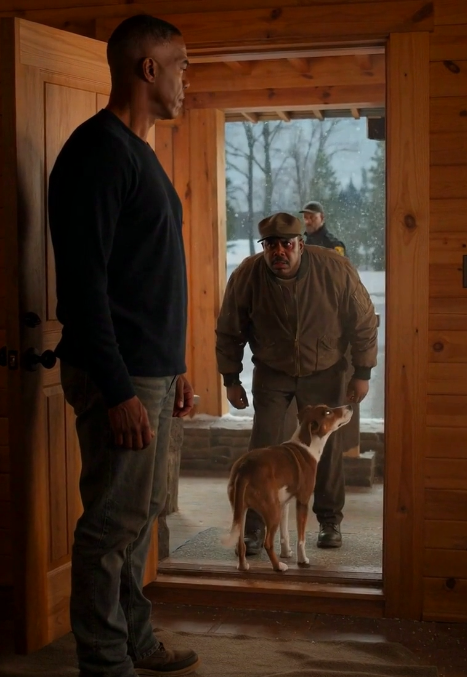
That morning, snow did not fall violently over the village. It fell in silence, slowly stealing life without making a sound. In the front garden of a locked house, a mother dog strained her body, shielding four newborn puppies barely two weeks old. Their breathing was growing weaker by the minute.
Their owner was gone, and the door was shut tight. Yet the mother refused to give up, clawing again and again at the wood, begging for warmth for her babies. Then, as if destiny had placed him there, a former Navy SEAL passed by.
He stopped, frozen in place by what he saw in the snow. He rushed them home, brought heat, and called a veterinarian. He knew that one heartbeat later, one breath later, they might not have survived.
What happened next would expose why these dogs were abandoned and change far more than one quiet winter morning. The morning had the kind of cold that did not announce itself with violence; it simply settled in.
Snow fell lightly across the northern edge of Brightwater, thin as ash, soft enough to quiet the world without erasing it. Rowan Cade drove through it with both hands steady on the wheel. His aging pickup moved at a measured pace along a county road that curved away from town into a stretch of scattered cabins and open fields.
He was forty years old, tall and broad-shouldered. He was built with the kind of dense strength that came from years of disciplined training rather than vanity. His posture remained straight even in the driver’s seat, shoulders squared, movements economical, as if his body had forgotten how to relax.
Rowan’s face was clean-shaven and angular, with a strong jaw and a nose that bore a faint deviation from a long-healed break. His hair, dark brown and cut into a precise undercut, was already dusted with snow near the temples. His eyes, a muted blue-gray, scanned the road with habitual alertness—not anxious, not hurried, simply aware.
Three years had passed since he left the Navy SEALs, yet the habits had stayed. He lived alone now, beyond the edge of Brightwater, in a small cabin tucked near the tree line where the forest began to thicken. He spoke to few people, kept his routines narrow and predictable, and avoided the kinds of choices that required emotional weight.
Winter suited him in that way. It reduced the world to essentials. As Rowan rounded a bend, he slowed without consciously deciding to. Something in him tightened—a subtle resistance, the same instinct that had once pulled him down half a second before explosions or turned his head toward danger he could not yet name.
On the right side of the road stood an old wooden house. Its paint was weathered to a dull gray, windows dark, porch half-buried under snow. He had passed it before, always empty-looking, always quiet. Today, something felt different.
He eased the truck forward and then braked, the tires crunching softly into packed snow. Beyond the low fence, beside the garden that had long since stopped growing anything but frost, he saw movement. At first, he thought it was debris shifted by the wind, a darker smudge against the white.
Then the shape lifted its head. It was a dog, medium-sized, a mixed breed. Her coat was a blend of pale brown and white, dulled by cold and neglect. She was thin—too thin—her ribs faintly visible beneath matted fur.
She stood over a shallow depression in the snow, her body curved protectively, legs trembling with the effort of staying upright. Rowan’s gaze dropped, following the line of her stance, and his breath caught. Four puppies lay beneath her, no more than two weeks old.
Their bodies were small and scattered, bellies pressed into the snow, paws curled inward. They were so still that for a terrible moment he assumed they were already gone. Rowan sat in the truck, engine idling, the cab filled with the low hum of heat struggling against the cold.
He felt the familiar calculus rise in him, quick and efficient. Stopping meant involvement. Involvement meant responsibility. There was no mission here, no order, no team. Just a choice he could make and never explain to anyone.
He could drive on and be home in fifteen minutes. The stove would be warm, the cabin would be silent. The dog lifted her head and looked directly at him. She did not bark. She did not retreat.
Her eyes were dark brown, glassy with exhaustion, but clear. There was no aggression in them, no fear-driven frenzy. There was only a steady, deliberate focus, as if she had been waiting for this exact moment for someone to notice.
Rowan opened the door. Cold rushed in, sharp and biting. He stepped into the snow, boots sinking slightly, and the sound of the door closing behind him felt louder than it should have.
He moved slowly, careful not to startle her, every motion controlled. Years of training had taught him that stillness could be as important as speed. The mother dog shifted her weight but did not move away.
Her body remained curved around the puppies, her head lowered, ears pinned back, not in threat but in fatigue. Up close, Rowan could see the toll the winter had taken. Frost clung to the edges of her fur. A faint tremor ran through her legs with each gust of wind.
Her breathing was shallow and uneven. He knelt a few steps away, one knee pressing into the snow, and raised his hands just enough to show they were empty.
“Easy,” he said quietly, his voice low and steady.
He did not expect her to understand the word, only the tone. Calm had a sound to it. Animals knew that better than most people.
He reached toward the nearest puppy, brushing snow away from its tiny face. The dog stiffened, muscles tightening despite her exhaustion, and Rowan paused, hand hovering. He waited.
The second stretched, heavy and deliberate. Then the dog did not move to stop him. She held his gaze, her body still a shield, but she allowed the space. That was enough.
Rowan slipped off his parka and spread it across the snow, blocking the wind. One by one, he gathered the puppies, lifting them gently, pressing each against his chest beneath his thermal shirt. Their bodies were frighteningly light, cold through even the layers of fabric.
He counted their breaths, feeling for any sign of resistance, any flicker of life. As he lifted the third puppy, a memory surfaced uninvited. His hands once cradling something far heavier, something that had gone still despite everything he had done.
He pushed the thought away and focused on the present. He carried the puppies to the truck and laid them across the passenger seat, wrapping them in his jacket and a spare blanket from behind the seat. When he returned, the mother dog attempted to follow.
She took two unsteady steps and collapsed into the snow with a soft, breathless sound. Rowan was beside her instantly, sliding one arm beneath her chest, the other under her hind legs. She did not resist.
Instead, she leaned briefly into him, her head pressing against the hollow of his neck before her body went slack in his arms. That moment landed deeper than he expected—trust offered without condition. He carried her to the truck and settled her carefully on the floor, positioning her so she could see the puppies.
Her eyes tracked them even as exhaustion pulled her down. Before starting the engine, Rowan pulled out his phone and called the Sheriff’s non-emergency line, then Animal Control. He reported an emergency rescue due to extreme cold.
He spoke plainly, providing location, condition, and his intent to transport for immediate warming. The response was measured and calm. Given the weather, he was instructed to keep the animals safe and warm until an official check could be made.
Temporary custody. Emergency foster hold. He ended the call and sat for a moment, hands resting on the wheel, breath steady but heavy. The decision had already been made.
There was no version of the day now in which he drove away unchanged. As the truck eased back onto the road, the heater began to push thin ribbons of warmth into the cab. Rowan glanced down at the smallest of the puppies, bundled near the seatbelt buckle.
For a heartbeat, nothing happened. Then the tiny body shuddered once, barely perceptible. It was a fragile tremor that rippled through its side before settling again.
Rowan’s foot eased off the accelerator, his grip tightened on the wheel. He leaned closer and whispered, the words barely louder than his breath.
“Stay. Just stay.”
Outside, the snow continued to fall, quiet and patient, as if the world itself were holding still, waiting to see what would live. Rowan brought them home as daylight thinned into a pale winter afternoon.
His cabin sat at the edge of the pine line, modest and square-shouldered, like the man who lived inside it. Its roof was heavy with snow, and its windows caught the low sun in narrow bands of gold. The place had been built for function rather than comfort: thick logs, tight seams, a single porch that faced the clearing.
But as Rowan pushed the door open with his shoulder, the scent of old wood and iron greeted him like something patient that had been waiting. He moved with quiet urgency, boots shedding snow in a widening arc across the floor. His breath was controlled, his thoughts aligned.
The mother dog watched him from the floor of the truck, her dark eyes following every motion, never leaving the bundle of puppies cradled against his chest. Inside, Rowan laid the puppies near the hearth on a rug he had not used in years…To read the rest of the story – CLICK the NEXT button 👇👇👇
He struck a match, hand steady despite the cold, coaxing the flame until it caught and began to breathe. The crackle of the fire filled the room with a sound that felt almost unfamiliar, as if the cabin itself were waking from a long sleep. He layered towels and an old wool blanket, checking the space between heat and distance with the same care he once used to measure blast radii.
The puppies were frighteningly small, two weeks old at most. Their coats were mottled in soft browns and blacks, their bellies pale and cold. Their movements were barely perceptible, but they were there—still there.
Rowan set an alarm on his watch, then another on the stove timer, spacing them out with intention. Warmth, check breathing, rotate positions. Nothing rushed, nothing wasted.
He did not speak to them. He simply worked. The mother dog lay down beside the hearth, her body angled so she could see all four puppies at once.
She did not try to rise again. Exhaustion had claimed her, but not her vigilance. Dr. Lila Hartwell arrived before dusk, her tires crunching up the drive with purposeful precision.
She was in her early forties, medium height, with a build that suggested strength earned through long hours rather than exercise alone. Her hair was chestnut brown, pulled back into a low knot that did not bother with fashion. Her skin bore the faint weathering of someone who moved between clinics and barns year-round.
She wore a white veterinary coat over dark trousers and practical boots, a canvas medical bag slung across her shoulder. Her eyes, a clear hazel behind thin-framed glasses, took in the room in a single sweep: fire, blankets, puppies, the dog on the floor. Finally, they settled on Rowan with a brief assessing nod.
“You called in time,” she said, her voice calm and matter-of-fact, the way professionals speak when panic would only get in the way.
She knelt easily, setting her bag down, hands already moving with practiced confidence. One by one she examined the puppies, checking reflexes, listening for breath, and murmuring observations. “Severe hypothermia… dehydration… lack of milk.”
She explained it plainly, without drama, but the weight of her words pressed into the room. A little later, she turned her attention to the mother dog. Up close, the signs were harder to ignore.
Lila parted the fur along the dog’s neck, revealing faint abrasions in a pattern too narrow and too even to be accidental. She traced a finger along a bruised patch on the left flank, her expression tightening just enough to register concern.
“These aren’t fresh,” she said quietly. “But they’re not old enough to dismiss either.”
She did not say the word abuse. She did not need to; Rowan understood. He nodded once, filing it away with the other facts he was already collecting.
He wrote everything down in a small notebook, his handwriting blocky and precise: times, temperatures, weights. Lila showed him how to warm milk substitute properly, how to avoid shocking their systems, and how to recognize the difference between exhaustion and failure.
He listened without interruption, absorbing it all. There was no grief in his movements, no outward fear, only focus. Lila noticed that too.
When she finished, she met his gaze. “You’re doing this right.”
It was not praise; it was acknowledgment. As the fire settled into a steady burn and dusk deepened outside, Rowan stepped out to make a second call—Animal Control, followed by the Sheriff’s Office—to update them on the animals’ condition.
The responses were measured and procedural. With the weather worsening overnight, he was cleared to keep them warm under an emergency foster hold until morning. Temporary custody. Lawful ground. The words mattered more than he expected.
When he returned inside, he felt something ease in his chest, a fraction of tension he had carried since stopping on the road finally releasing. About an hour later, headlights washed briefly across the window, followed by a soft knock.
Rowan opened the door to find Mrs. June Alden standing on the porch. She was bundled in an olive wool coat over a knitted sweater, a brown apron still tied at her waist as if she had come straight from her kitchen. She was in her seventies, small but upright, with silver hair pulled into a low bun and round glasses perched on her nose.
Her hands were broad and capable, the hands of someone who had kneaded dough and lifted trays for decades. Her eyes were sharp, curious, and kind in a way that missed very little.
“I saw smoke,” she said, holding up a paper bag and a folded blanket. “Figured someone finally remembered this place has a fireplace.”
She stepped inside without waiting for an invitation, her gaze moving immediately to the hearth. She did not gasp or fuss. She simply nodded, as if confirming something she had already suspected.
She set the bag down and knelt, peering at the puppies with gentle competence. “Poor little things,” she murmured, not pitying, just factual.
When the mother dog lifted her head slightly, Mrs. Alden angled her body to appear smaller, less intrusive. “You’re safe,” she said softly.
The dog’s eyes followed her, then drifted back to the puppies. As Mrs. Alden stood, brushing flour from her palms, she leaned closer to Rowan and lowered her voice.
“That house you found them by,” she said, glancing toward the dark beyond the window. “It’s been empty a lot lately. Lights off, car gone for days. But when it’s occupied…”
She paused, choosing her words. “The shouting carries. Always has.”
The statement settled between them, heavy and unresolved. Rowan thanked her. She squeezed his arm once—firm, brief—and left the way she had come, the door closing softly behind her.
Left alone again, Rowan returned to the hearth. The puppies stirred faintly, one letting out a sound so small it barely qualified as a whimper. The mother dog shifted, nose touching each tiny body in turn, counting them by instinct.
Rowan watched, something unfamiliar tightening behind his ribs. The firelight painted the room in warm shadows. For the first time in years, the cabin did not feel like a place he passed through. It felt like a place holding something fragile, something worth staying awake for.
Rowan returned to the road before the sun had fully climbed above the tree line. The cold had sharpened overnight, tightening the air and making each breath feel deliberate. Deputy Soren Pike followed in his patrol truck, tires carving clean tracks through the thin new snow.
Pike was a man in his early forties, solidly built without being imposing, his posture relaxed but attentive. His face was square, framed by short-cropped brown hair and a neatly kept shadow of stubble that suggested a preference for practicality over polish. He carried himself with the quiet confidence of someone who trusted procedure not because it was comforting, but because it worked.
They parked at the edge of the property where Rowan had first stopped. The wooden house sat unchanged, gray and unwelcoming, its windows dark, its porch bowed slightly under the weight of winter. Rowan felt the familiar tightening in his chest—not fear exactly, but the alert stillness that preceded assessment.
He had brought the mother dog with him, secured in the back of his truck. When he opened the door, she stepped down carefully, her movements measured. She was still thin, her coat dull where frost had clung to it for too long, but there was a steadiness in her now.
They moved slowly across the yard. Snow near the garden was churned and uneven, marked by overlapping footprints that did not belong to Rowan or Pike. Pike crouched, gloved hand tracing the edge of a disturbed patch.
“Dragged,” he said, not looking up. “Not far, but enough.”
He straightened and nodded once, making a note on his tablet. Rowan followed the line of disruption to the porch. Beneath the overhang, half-buried in snow and dirt, lay a length of rope.
It was coarse, frayed at one end, darkened with grime. Rowan knelt, careful not to touch it with bare hands. The smell hit him—a mix of sweat, damp wood, and something sharper beneath.
Pike photographed the rope in place, then bagged it with practiced efficiency. Behind them, the mother dog froze. Her ears pinned back, her body angled away from the porch, a low sound vibrating in her chest.
It was not a bark, not a growl meant to threaten, but a warning carried on instinct alone. She refused to step closer, pulling subtly against the leash, eyes fixed on the rope as if it were alive. Rowan felt a prickle along his arms.
He had seen dogs react to danger before, but this was different. This was recognition, memory. He crouched beside her, resting a hand lightly along her shoulder, feeling the tension coiled beneath her skin.
“Okay,” he murmured, more to steady himself than her.
She did not relax, but she stopped resisting, her gaze never leaving the porch. Pike watched the exchange in silence, his expression thoughtful. He did not dismiss it; he logged it.
They continued the inspection, documenting everything. A broken latch on the gate, scuffed boards along the porch rail, a smear of something dark near the steps that might have been mud, or might have been blood long since diluted by snow. Rowan took photographs from multiple angles, his movements precise.
As they worked, another vehicle pulled up along the road. A woman stepped out, camera slung across her chest, notebook tucked under one arm. She was in her early thirties, lean and quick in her movements.
Her coat was a weathered green parka, practical and worn at the cuffs. Her boots were scuffed in a way that suggested she spent more time chasing stories than sitting behind a desk. Her eyes—dark, alert—took in the scene in seconds.
“Ava Klein,” she said, approaching with a polite distance. “Brightwater Gazette.”
Her voice was calm, curious without being intrusive. “I heard Animal Control had been called out here yesterday. Thought I’d see what was going on.”
Pike gave her a measured look, then nodded. “We’re documenting an ongoing investigation,” he said. “No conclusions yet.”
Ava smiled slightly, as if she respected the boundary. She made a note anyway. Her gaze flicked briefly to the dog, then back to Rowan.
“You the one who found them?” she asked.
Rowan inclined his head once. He did not elaborate. Ava seemed to understand. She watched the mother dog for a moment longer than necessary.
“She remembers,” Ava said softly, more observation than question.
The words lingered. Rowan felt them settle somewhere deep, an echo of his own unspoken thoughts. He turned away, focusing instead on the task at hand.
They finished the exterior sweep, Pike sealing the evidence bags, Ava keeping her distance while recording impressions rather than details. The house remained closed. No forced entry. No owner in sight. Only absence and the cold.
They returned to the trucks. Rowan lifted the mother dog back into the cab, offering her water before starting the engine. She drank sparingly, then rested her head against the seat, eyes half-lidded but alert.
As they pulled away, Rowan glanced back once more at the house. It looked smaller now, diminished by scrutiny.
Back at the cabin, warmth met them at the door. The fire still burned, tended by Rowan’s careful planning. Dr. Lila Hartwell was already inside, kneeling near the hearth with her medical kit open.
She looked up as Rowan entered, her expression shifting instantly from calm to concern. One of the puppies lay apart from the others, his tiny body trembling.
“Ren,” Lila said quietly. She placed two fingers against the puppy’s side, counting breaths. “He’s seizing. Mild, but it’s there.”
She worked quickly, administering warmth and gentle stimulation, her hands steady. Rowan knelt beside her, watching every movement, his jaw set. This was the moment—the one that cut through procedure and evidence.
The clock Lila had mentioned in passing now ticked loud in Rowan’s mind. Forty-eight hours. A line drawn not in ink, but in survival. Ren’s body stilled after a few long seconds. Lila exhaled slowly.
“That’s all the margin we have,” she said, meeting Rowan’s eyes. “Cold injuries don’t announce themselves all at once. They wait. If there’s more damage, it will show soon.”
The mother dog had risen, placing herself close to Ren, her nose hovering just above him, breathing in his scent as if checking that he was still there. Rowan felt a strange pull then. Not panic, not despair, but resolve.
This was no longer about rescue alone. It was about time and truth, and what followed when instinct refused to stay quiet. Outside, the wind shifted, carrying with it the faint sound of a car on the road.
Somewhere beyond the trees, Brightwater went on with its morning, unaware that a line had been crossed, that something buried had begun to surface. Rowan stood, hands resting on his knees, and looked down at the four fragile lives by the fire. He simply stayed, the way the dog had stayed in the snow, trusting that presence itself could be a kind of promise.
The weather broke just enough to make the road passable, which was how Rowan knew the visit would come. Trouble waited for windows like that. He spent the morning preparing quietly for something he hoped would not happen but expected all the same.
The cabin was orderly. Each object was placed where it could be reached without thought. The fire burned low but steady.
The puppies slept in a tight cluster near the hearth, their breathing small and synchronized. The mother dog lay between them and the door, her body angled outward, eyes half-lidded but never fully closing. Rowan checked his phone and sent a brief update to Deputy Soren Pike, careful with words.
He did not dramatize. He simply noted the likelihood of contact and the time window. Pike replied with a single line: Understood. I’ll swing by.
It was enough. Rowan slipped his phone into his pocket and set a small recorder on the shelf by the door, the red light covered but ready. When the knock came, it was not tentative.
It was a blunt, impatient sound, knuckles striking wood as if the door itself were at fault. Rowan rose and moved without hurry. He opened the door just wide enough to see the men on the porch.
Hank Dower stood at the center, shoulders hunched against the cold, his bomber jacket stained and frayed at the cuffs. He was in his early forties, heavy through the middle. His face was ruddy, eyes bloodshot, stubble uneven along his jaw.
He wore a cap pulled low, shadowing his gaze, but not enough to hide the twitch that passed through his mouth when he recognized Rowan. Flanking him were two men of similar age, dressed in dark coats and scuffed boots.
“You’ve got something of mine,” Hank said, skipping any pretense. His voice was loud, edged with a practiced sneer meant to fill space and intimidate. “Dogs! You took them! Either give them back, or we settle up like adults!”
Rowan did not step aside. He did not cross his arms. He stood square in the doorway, posture neutral, hands relaxed at his sides.
“They’re under an emergency foster hold,” he said calmly. “Weather-related, documented. You’re not authorized to take them.”
Hank laughed, a sharp bark that carried no humor. “Paper tricks don’t change ownership. They’re mine. I paid for them.”
He gestured vaguely toward the interior, then toward Rowan’s chest. “You want to keep playing hero? You can buy them. Cash. Now!”
The mother dog rose, silent as a shadow. She did not growl. She placed herself directly behind Rowan’s legs, her head level, eyes fixed on Hank. The shift was subtle, but the air changed with it. Hank noticed.
Rowan spoke again, his voice even. “Veterinary records indicate severe hypothermia and signs consistent with neglect. There are photographs, statements from neighbors. You can leave now.”
Hank’s jaw tightened. “You don’t know what you’re talking about,” he snapped, then immediately contradicted himself. “They were fine. Just a night out. Dogs can handle cold. Besides that one…”
He jerked his chin toward the mother dog. “She’s mean. Always was.”
Rowan did not respond to the accusation. He let the words hang. The recorder captured every syllable. One of the men behind Hank shifted his weight, glancing toward the road as if measuring distance.
Hank stepped forward, one boot crossing the threshold. The mother dog moved with him, a clean, controlled motion that placed her squarely between Hank and the warmth beyond the door. She did not bare her teeth. She simply held his gaze.
Hank froze, surprised, then bristled. “Get that thing back!” he barked.
“That’s far enough,” Rowan said. Not louder, not sharper. Just final.
A patrol truck crunched into the drive then, tires loud against the frozen gravel. Deputy Pike stepped out, hat low, coat buttoned, his presence calm and unhurried. He took in the scene in a glance and stopped beside Hank with deliberate ease.
“Morning,” Pike said. “We’re here to follow up on a report.”
Hank spun, anger flaring into something closer to panic. “This is bullshit,” he said, gesturing wildly. “He stole my dogs. You’re just going to let him?”
Pike’s eyes moved to Rowan, then to the recorder shelf, then back to Hank. “Sir,” he said, “I need you to lower your voice and step off the porch.”
Ava Klein arrived moments later, parking at the edge of the drive. She stayed back, respectful of the boundary, but her lens captured the raised voices and the moment Hank realized he was being observed. His anger shifted again, flattening into something brittle.
“This isn’t over,” Hank said, backing away. “You think papers and badges scare me?”
He glanced once more at the door, at the warmth behind it, at the dog who had not moved an inch. Then he turned and stalked down the steps. The trucks pulled away, and the drive was empty once more.
The quiet returned in stages, like a tide receding. Rowan closed the door and leaned his forehead briefly against the wood. The mother dog turned from the door and walked to the hearth.
She paused, head tilted, then lowered herself beside the smallest puppy, her body curving protectively. Rowan watched as she lifted her muzzle and pressed it gently to the pup’s flank. It was not training. It was something older.
Rowan knelt, heart beating a fraction faster than before. He felt the quiet conviction that whatever Hank threatened would be answered not with force, but with time, truth, and witnesses.
The filing came through on a Tuesday morning, quiet as frost. Rowan learned about it from the vibration of his phone on the kitchen counter while he measured milk. Hank Dower had submitted a claim of ownership.
The document was brief, asserting that the dogs were his and that Rowan had unlawfully taken them. Rowan read it once, then again. He felt the familiar narrowing of focus that arrived when the rules changed from confrontation to endurance.
Brightwater did not react all at once. The town never did. News traveled by proximity and tone rather than speed—through the grocery aisle, the post office line. People looked longer than usual. Some nodded, some did not.
Silence settled. The kind that required choosing sides without saying so. Rowan understood that kind of quiet. He had lived inside it for years.
Dr. Lila Hartwell returned that afternoon. She looked more tired than usual, dark circles faint beneath her eyes, but her movements were as precise as ever. She knelt by the hearth and examined the puppies one by one.
When she lifted the smallest and tilted his ear toward the light, she paused. “Rowan,” she said, alertness edged with concern. “Do you see this?”
She angled the ear closer. The mark was faint, almost nothing—a pale smudge near the inner edge of cartilage. On its own, it might have been dismissed as dirt or a healing scratch.
Lila’s thumb brushed it lightly. “There,” she said, as the same suggestion of a symbol appeared on the next puppy, barely visible. “Temporary ink. Used sometimes to track litters. It fades, or it’s scrubbed.”
She straightened, her expression tight. “It doesn’t prove anything by itself, but it doesn’t belong here.”
Rowan nodded. Another piece. Not proof yet, but direction. He documented it carefully, photographing the marks under proper lighting.
Ava Klein called just before dusk. Her voice came through the line low and steady. “I followed a lead,” she said. “Not from the claim, but from the noise around it.”
She explained that Hank had been careless with his phone. Old messages, listings sent and deleted, prices adjusted based on age and coat. Ava had obtained copies through a source she did not name.
“It’s not conclusive yet,” she added, “but it’s a pattern.”
Rowan stepped outside to stack another armload of wood. The mother dog followed, her gait quieter now, her body filling out slowly with care. She stopped short at the edge of the porch, nose lifting.
Her ears shifted. She did not bark; she did not freeze. She turned, grasped the hem of his parka gently between her teeth, and pulled—once, firm, insistent—away from the steps.
Rowan halted. He scanned the ground where he had been about to step and saw it. A small pile of meat, dark against the snow, placed deliberately near the porch post.
He crouched, keeping distance, and the smell reached him. Alcohol, sharp and wrong. He backed away and brought the dog inside, hands steady despite the surge of anger that followed.
This was not an accident; it was a message. He photographed the bait, documented placement and time, and contacted Deputy Pike. The response was swift but measured.
The act alone was indirect; plausible deniability remained intact. But motive had weight now, and the pattern gave it shape. Pike advised caution and additional lighting. Rowan listened.
The days that followed stretched thin. Hank’s claim moved forward through channels slow and deliberate. Brightwater remained divided. Mrs. June Alden brought bread and said nothing of the rumors, only asked after the puppies by name.
When the call came from Pike, it carried a different tone. The warrant had been approved. Limited scope, lawful entry—enough to look where looking had become necessary.
Rowan closed his eyes for a brief second and felt the weight lift. The pieces were finally allowed to touch. He knelt by the hearth one last time before leaving, checking each puppy. The mother dog watched him with steady focus, then rose and placed herself beside him.
The warrant was executed at first light, the hour when winter makes no promises but clarity. Rowan did not go with the deputies. He waited at the cabin.
Deputy Soren Pike called just after nine. His voice was measured, professional, but there was relief beneath it. The house behind the old shed had told its story quickly.
Dirty cages stacked in a back room, straw soaked through with waste. A ledger folded and hidden under a loose floorboard listing prices and initials. A phone unlocked with effort revealed the rest: messages arranging meet-ups, photos sent and deleted.
Hank Dower was taken into custody without resistance. When Pike described it, he did not embellish. He did not need to. Rowan thanked him and ended the call.
He stood for a moment, letting the quiet return. Outside, Brightwater continued its morning routines. Inside, something shifted. It was not triumph; it was release.
Ava Klein arrived before noon. She set her camera bag down and asked permission before stepping closer to the hearth. Rowan nodded.
“I’ll run the piece today,” she said quietly. “No names in the lead. Facts first, documents. The rest will follow.”
It did. The article moved through town like a thaw—not sudden, not dramatic, but undeniable. People who had held their distance came forward with blankets, formula, and small bills folded into envelopes.
Mrs. June Alden brought a basket of towels. Others lingered longer, asking practical questions. The silence that had divided Brightwater softened, then broke.
The turning point arrived not with news, but with life. Near mid-afternoon, as the light angled low and the cabin warmed fully for the first time in days, one of the puppies opened his eyes.
It was a small, ordinary miracle—dark, unfocused, a blink that looked more like a question than a declaration. Rowan froze. Ava lifted her camera, then lowered it again, choosing the moment over the image.
The mother dog rose and moved closer, her posture calm. She sniffed the puppy gently, then settled, pressing her body into a protective curve that seemed to say: Now we stay.
By evening, the town had chosen. Donations were logged and organized. Dr. Lila Hartwell returned to check weights and reflexes. She confirmed what they already felt: the danger had passed.
The cabin changed by degrees. A spare room became storage. A crate appeared near the wall, then another. A chalkboard went up with feeding times written in blocky letters.
Rowan moved through it all with the same deliberate calm he had once used to prepare for missions, but this work carried no edge of violence. The mother dog no longer trembled. Her coat regained its sheen, her eyes brightened, and she took to her new role with dignity.
She did not seek affection from strangers, nor did she retreat. She stood watch, silent and present.
That night, after the last visitor had gone, Rowan sat by the fire with his boots off. He rested a hand on the dog’s back and felt the warmth there, steady and earned. Outside, snow fell again, light and forgiving. Inside, four small bodies breathed, eyes opening to a world that had decided to keep them.
Winter held on, but it loosened its grip in ways only people who live north learn to notice. The light came earlier, not by much, yet enough to change how mornings felt.
Rowan Cade stood at the cabin window with a mug warming his palms. The mother dog sat beside him, her body aligned with his, as if they shared a habit now. The puppies, no longer fragile shapes by the hearth, were awake and busy, tumbling over each other.
The court date had passed without spectacle. The ruling granted Rowan temporary custodial care during recovery and authorized a supervised adoption process. It was a sentence that acknowledged responsibility and time.
Brightwater moved in step after that. The community room was prepared with folding tables and borrowed heaters. Ava Klein helped coordinate, her presence steady and respectful.
Dr. Lila Hartwell arrived early, checking paperwork and speaking in a voice meant to reassure. Families came in ones and twos. There was a widower with careful hands. A young couple with mud on their boots. A retired teacher whose scarf smelled of wool and lavender.
Each person was asked the same questions; each signed the same forms. Transparency mattered. As Rowan guided the mother dog into the room to observe, she stopped at the threshold.
Her ears shifted, and she angled her body toward a child standing near the back with his mother. The boy was maybe eight, with wind-reddened cheeks. He did not reach out. He simply met her eyes and waited.
The mother dog took three deliberate steps forward, then sat, her tail resting still against the floor. Rowan felt his chest tighten. He knelt and watched as one of the puppies broke from the pile and toddled toward the boy.
Lila caught Rowan’s eye and gave the smallest nod. Sometimes the decision was already made. By noon, the four puppies had found their homes.
There were no speeches, no applause—only the soft sounds of coats being shrugged on and papers folded. Rowan moved from table to table, answering questions. The mother dog approached each puppy in turn, touching noses, breathing them in as if counting by scent rather than sight.
She accepted the rhythm of departure with a steadiness that felt earned. When the last family turned toward the door, she watched without moving, then crossed the room and sat beside Rowan’s leg.
The community room emptied slowly. Ava lingered last. “Are you keeping her?” she asked, glancing at the dog.
Rowan did not answer right away. He looked at the place where the puppies had been, then at the steady presence at his side.
“Yes,” he said simply.
Ava smiled once and packed up without another word. Back at the cabin, the quiet felt different. Not hollow, but complete.
Rowan set two bowls by the hearth and watched the mother dog drink. He fed the fire and sat on the porch steps. The dog joined him, lowering herself with a sigh that seemed to come from deep in her chest.
She rested her head against his boot. Children’s laughter carried from somewhere down the road—thin, bright, the sound of beginnings settling into homes that were no longer cold. Rowan closed his eyes and let it reach him.
He thought of the road where he had first stopped, the garden white and still, and the choice that had asked for more than he thought he had left to give. Destiny, he understood, did not arrive with thunder. It arrived as a moment when turning away would be easier, and staying would change everything.
He stayed. Sometimes the miracle is not a sudden rescue from winter. Sometimes, God does not stop the storm, nor does He erase loneliness in one clean moment.
Instead, He places a choice in front of an ordinary day, on an ordinary road, and asks a human heart to stay when it would be easier to turn away. That is how grace often arrives: quietly, without applause, wrapped in small acts that look simple until you realize they change everything.
If you are reading this in the middle of your own long season, remember this: You do not have to fix the whole world to be part of good work. You can bring warmth to one corner of it. A phone call you have been delaying, a neighbor you have not checked on, or a kind word given without needing credit.
In the end, those small choices become seeds of healing. Seeds do not shout when they grow, but they still change the landscape.
Related Post
At 3:16 a.m., my husband texted me: I married Valeria. I’ve been sleeping with her for ten months. You’re boring and pathetic.” I read the message four times, sitting on the living room couch with the TV on mute, blue light washing over my face like something colder than a slap
PART 2 — The House That Remembered The banging came again. It was not really [...]
My 6-Year-Old Son Gave All His Savings to Help Our Elderly Neighbor – The Next Morning, Our Yard Was Filled with Piggy Banks, and Patrol Cars Were Everywhere
My six-year-old son gave away every dollar in his piggy bank to help our elderly [...]
I arrived three hours late after performing emergency surgery on a six-year-old. My fiancé had married my best friend. I turned to leave—then saw the man who would change everything they thought they’d won.
PART 1 “You showed up three hours late to your own wedding, Samantha. Don’t stand [...]