
No one at the wedding knew what she was hiding beneath her dress, but the dog sensed that something was wrong just in time…
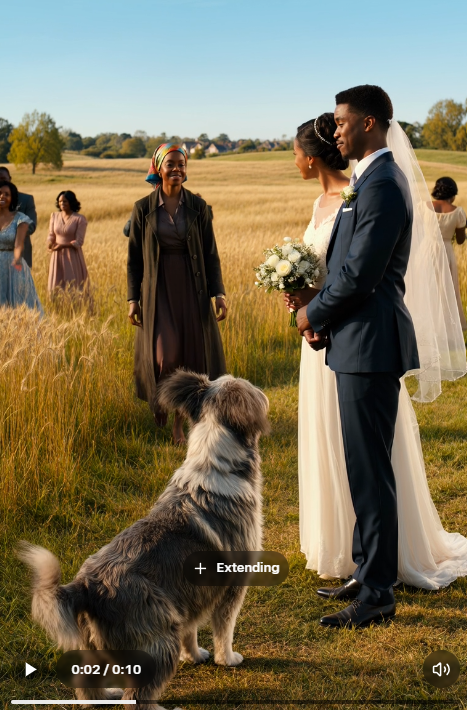
In the small Ukrainian village of Vyshnivka, surrounded by golden wheat fields and rolling green hills, a wedding celebration unfolded last spring. The air was filled with the sweet scent of blooming cherry trees, while the sounds of traditional Ukrainian music—the gentle strings of the bandura and the melodies of the sopilka—filled everyone’s hearts with joy.
It was a day of unity, love, and hope, as the entire village gathered to celebrate the marriage of Olena and Mykola, two young people who had found love despite the hardships of living in a country where resilience had become part of everyday life.
The war in Ukraine cast a shadow over the land, but in Vyshnivka, people clung to moments of happiness. Weddings had become more than celebrations—they were acts of defiance, proof that life could still flourish even in the darkest of times.
Nearly the entire village attended the celebration, from gray-haired grandmothers dressed in embroidered traditional blouses to children running barefoot through the grass.
The tables overflowed with homemade varenyky, borscht, and golden korovai—a traditional Ukrainian wedding bread decorated with intricate dough patterns. The guests’ laughter blended with the clinking of glasses raised in honor of the newlyweds’ future.
But no one gathered there realized that a sinister threat was quietly approaching the celebration…
A young woman wrapped in a headscarf slowly made her way toward the crowd. Hidden beneath her clothing was an explosive device. Her steps were calm and deliberate, while her heart carried the weight of a mission meant to destroy the joy of that day.
The villagers, completely absorbed in the festivities, noticed nothing unusual.
There was, however, one guest who remained alert—a dog named Bayrak, the loyal companion of Taras, the groom’s friend. Bayrak was an ordinary village dog with shaggy gray-and-white fur and bright, watchful eyes.
He had grown up in Vyshnivka, where neighbors fed him leftovers from homemade meals, and children affectionately patted his head, calling him “our Bayrak.”
But on that day, something about the stranger unsettled him. His ears stiffened, the fur along his neck stood on end, and a low growl rumbled from deep within his chest.
None of the guests paid any attention to the dog until he suddenly sprang into action. Moving with lightning speed, Bayrak charged toward the woman, his sharp barking cutting through the joyful celebration. The guests froze, unable to understand what was happening.
Some assumed the dog had simply become frightened or was playing around, but Taras, who knew his loyal companion well, immediately sensed that something was terribly wrong.
“Bayrak, come back!” he shouted.
But the dog didn’t obey.
Bayrak leaped at the woman, sinking his teeth into her clothing and knocking her to the ground.
At that very moment, a deafening explosion erupted.
The blast echoed across the fields, sending terrified guests running in every direction. Fortunately, the explosion occurred far from the crowd, on the edge of the meadow, where Bayrak had stopped the stranger…
When the dust finally settled, everyone understood what had happened.
The woman, later identified as the terrorist carrying out the attack, was killed instantly.
Bayrak also lost his life, sacrificing himself to prevent a terrible tragedy.
Because of his courage and instincts, every wedding guest survived unharmed. Not a single person was injured, although without the dog’s intervention, the consequences could have been catastrophic.
“The dog prevented the detonation of an improvised explosive device being carried by the terrorist,” a local police spokesperson later said in an interview.
“His actions saved dozens of lives.”
Those words quickly spread through the news, and Bayrak’s story soon became known across Ukraine.
In Vyshnivka, news of Bayrak’s heroism deeply moved everyone. A wedding that could have ended in tragedy instead became a symbol of hope and selfless sacrifice.
Still dressed in their wedding clothes, Olena and Mykola thanked Taras through tears for raising the dog who had become their savior.
But Taras, a man with rough hands and a kind heart, simply shook his head.
“Bayrak was always special,” he said. “He could sense when something wasn’t right. I lost a friend, but he saved every one of us.”
The following day, the villagers gathered to honor Bayrak’s memory.
At the site of the explosion, they erected a simple wooden cross decorated with blue-and-yellow ribbons—the colors of the Ukrainian flag.
Children brought wildflowers, while adults shared stories about how Bayrak had roamed through the village, barked at strangers, and protected farmyards from foxes.
“He was ours,” they said.
“Our protector.”
The story touched not only the people of Vyshnivka, but the entire nation of Ukraine.
In a country where every day brings new hardships, Bayrak’s sacrifice became a reminder that heroes are not always human.
Social media quickly filled with tributes to the “hero with four paws.”
Artists painted portraits of Bayrak, and schoolchildren in neighboring villages wrote essays about him.
One local newspaper published an article with the headline:
“Bayrak: The Dog Who Saved a Wedding.”
Bayrak’s story confirmed what many people had long believed—that dogs possess an extraordinary ability to sense when something is wrong.
Scientists explain this through their remarkable sense of smell, their sensitivity to changes in human behavior, and instincts refined over thousands of years of living alongside people.
Dogs can detect the scent of chemicals such as explosives and notice subtle signals that humans often miss—rapid breathing, nervous movements, even changes in body odor caused by stress.
Throughout Ukraine, dogs have repeatedly proven their loyalty.
During the war, they helped rescue workers locate people trapped beneath rubble, warned communities of approaching danger, and even served alongside the military by guarding checkpoints.
Bayrak, though only an ordinary village dog, became part of that proud tradition.
His actions were not merely a coincidence—they reflected the deep bond between humans and dogs, a bond especially cherished throughout Ukraine.
The people of Vyshnivka decided that Bayrak’s heroism should never be forgotten.
They began raising money to build a memorial—a modest bronze statue of the dog that would stand in the center of the village square.
“Let everyone who comes to Vyshnivka know that we once had a hero like him,” said the village elder, Maria Ivanovna.
The local school also announced an essay competition so students could write about what Bayrak’s story meant to them.
Bayrak’s story is about much more than one heroic act.
It reminds us how deeply connected we are to one another, whether human or animal.
In Ukraine, where each day tests the strength of the human spirit, stories like this become beacons of hope.
Bayrak, a simple village dog, showed that even in the darkest moments, light can still be found.
Olena and Mykola, whose wedding could have ended in unimaginable tragedy, now call Bayrak their guardian angel.
They vowed that every year on their wedding anniversary, they would bring flowers to his memorial cross and tell their children about him.
“He gave us our lives,” Olena says, wiping away a tear.
“We will never forget.”
The people of Vyshnivka continue to live their lives, raise their children, and celebrate weddings.
But now there will always be a place in their hearts for Bayrak—the shaggy hero who proved that a dog truly is man’s best friend.
May his story inspire us all to be braver, kinder, and more attentive to those around us.
Related Post
They let him almost drown without helping him… and what happened next was something no one expected…
The water was cold, not like when you quickly dip your hand in and pull [...]
Eight Years After My Husband Walked Out Days After I Told Him I Was Pregnant, He Invited Me to Christmas Dinner to Show Off the “Perfect Life” He’d Built Without Me
Eight Years After My Husband Walked Out Days After I Told Him I Was Pregnant, [...]
My mother-in-law had no pension. I cared for her with all my heart for 12 years. With her last breath, she handed me a torn pillow. When I opened it, I couldn’t hold back my tears…
My mother-in-law had no retirement savings, and for twelve years, I cared for her as [...]